Introduction
A report dated 1 August 1941 by Higher SS and Police Leader SS-Obergruppenführer Friedrich Jeckeln describes a three-day “cleansing operation” carried out by the 1st SS-Brigade RFSS across Volhynia. Framed as a military and anti-partisan sweep in the army’s rear, the documents records mass shootings of 73 Russian soldiers, 165 officials and civilians accused of supporting the Soviet regime and 1,658 Jews portrayed as “given significant support to the Bolshevik system and who had betrayed Ukrainians to the Bolshevik authorities”.
Document


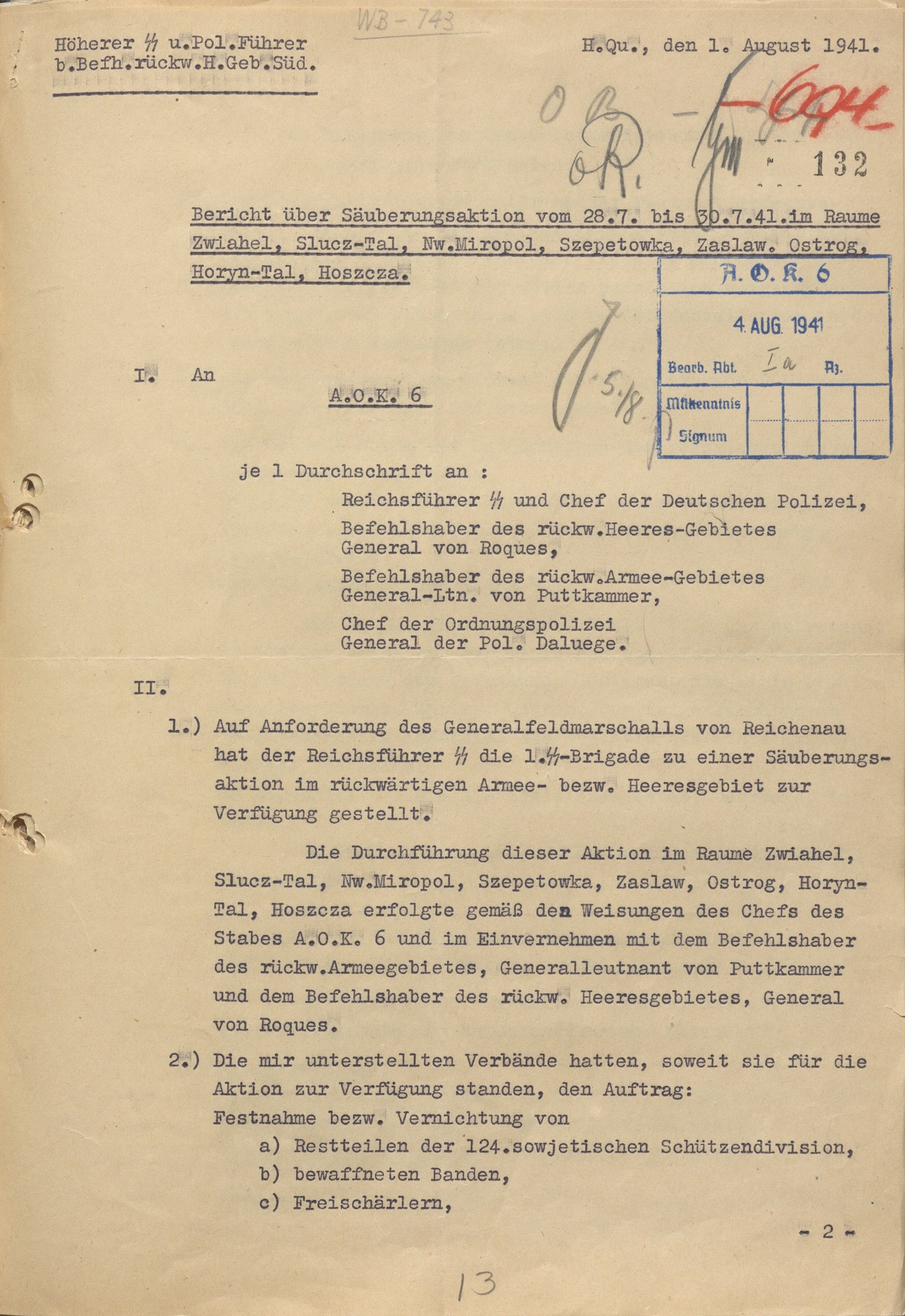


H.Qu., den 1. August 1941.
Höherer SS und Polizeiführer beim Befehlshaber rückwärtiges Heeresgebiet Süd.
Bericht über Säuberungsaktion vom 28.7. bis 30.7.41 im Raume Zwiahel, Slucz-Tal, Nw. Miropol, Szepetowka, Zaslaw, Ostrog, Horyn-Tal, Hoszcza.
I. An A.O.K. 6.
Je eine Durchschrift an: Reichsführer SS und Chef der Deutschen Polizei, Befehlshaber des rückwärtigen Heeres-Gebietes General von Roques, Befehlshaber des rückwärtigen Armee-Gebietes Generalleutnant von Puttkammer, Chef der Ordnungspolizei General der Polizei Daluege.
II.
1.) Auf Anforderung des Generalfeldmarschalls von Reichenau hat der Reichsführer SS die 1. SS-Brigade zu einer Säuberungsaktion im rückwärtigen Armee- bzw. Heeresgebiet zur Verfügung gestellt. Die Durchführung dieser Aktion im Raume Zwiahel, Slucz-Tal, Nw. Miropol, Szepetowka, Zaslaw, Ostrog, Horyn-Tal, Hoszcza erfolgte gemäß den Weisungen des Chefs des Stabes A.O.K. 6 und im Einvernehmen mit dem Befehlshaber des rückwärtigen Armeegebietes, Generalleutnant von Puttkammer, und dem Befehlshaber des rückwärtigen Heeresgebietes, General von Roques.
2.) Die mir unterstellten Verbände hatten, soweit sie für die Aktion zur Verfügung standen, den Auftrag: Festnahme bzw. Vernichtung von
a) Restteilen der 124. sowjetischen Schützendivision,
b) bewaffneten Banden
c) Freischärlern
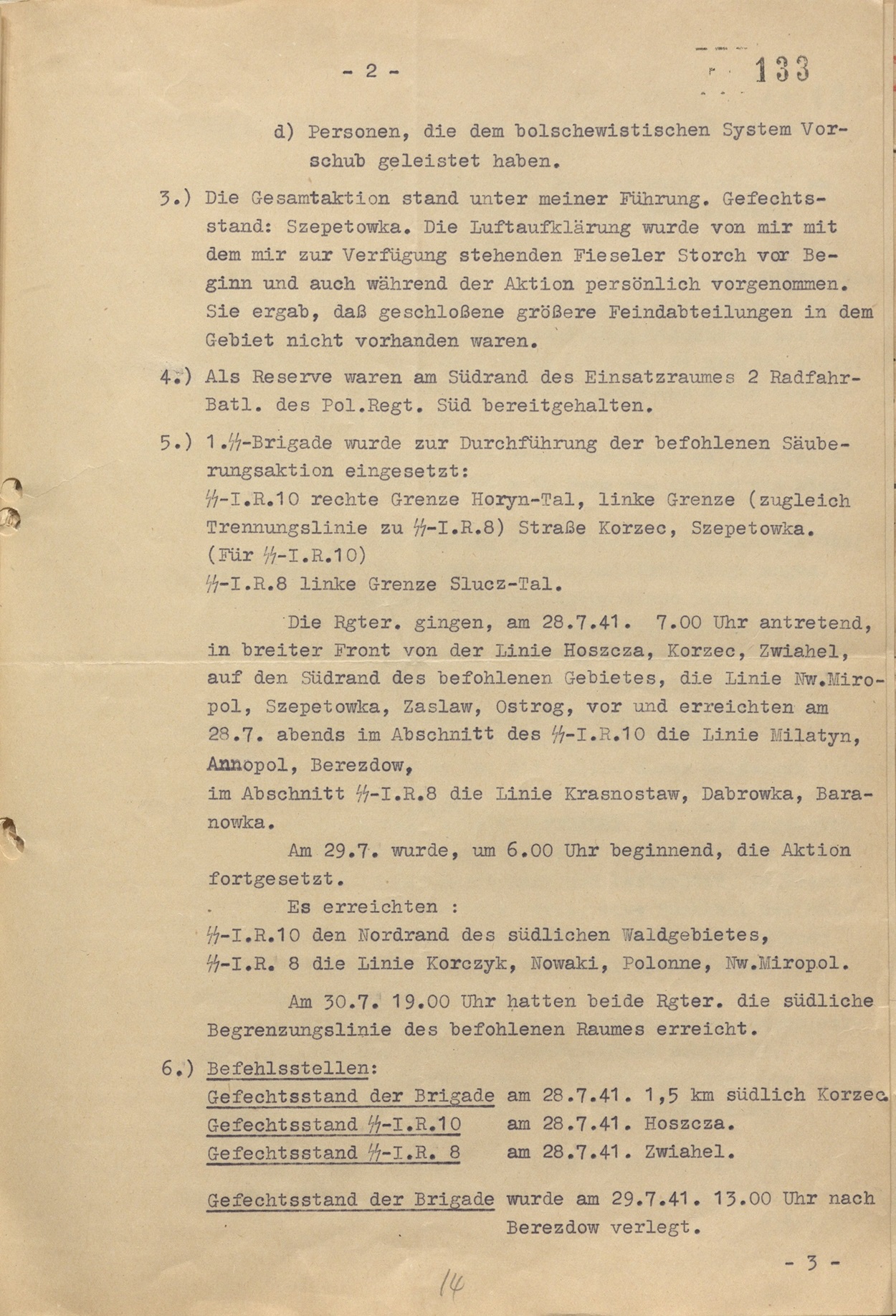
d) Personen, die dem bolschewistischen System Vorschub geleistet haben.
3.) Die Gesamtaktion stand unter meiner Führung. Gefechtsstand: Szepetowka. Die Luftaufklärung wurde von mir mit dem mir zur Verfügung stehenden Fieseler Storch vor Beginn und auch während der Aktion persönlich vorgenommen. Sie ergab, daß geschlossene größere Feindabteilungen in dem Gebiet nicht vorhanden waren.
4.) Als Reserve waren am Südrand des Einsatzraumes 2 Radfahrabt. des Pol. Regt. Süd bereitgehalten.
5.) 1. SS-Brigade wurde zur Durchführung der befohlenen Säuberungsaktion eingesetzt:
SS-I.R.10 rechte Grenze Horyn-Tal, linke Grenze (zugleich Trennungslinie zu SS-I.R.8) Straße Korzec, Szepetowka. (Für SS-I.R.10)
SS-I.R.8 linke Grenze Slucz-Tal.
Die Rgter. gingen, am 28.7.41, 7.00 Uhr antretend, in breiter Front von der Linie Hoszcza, Korzec, Zwiahel, auf den Südrand des befohlenen Gebietes, die Linie Nw. Miropol, Szepetowka, Zaslaw, Ostrog, vor und erreichten am 28.7. abends im Abschnitt des SS-I.R.10 die Linie Milatyn, Annopol, Berezdow, im Abschnitt SS-I.R.8 die Linie Krasnostaw, Dabrowka, Baranowka.
Am 29.7. wurde, um 6.00 Uhr beginnend, die Aktion fortgesetzt.
Es erreichten:
SS-I.R.10 den Nordrand des südlichen Waldgebietes,
SS-I.R.8 die Linie Korczyk, Nowaki, Polonne, Nw. Miropol.
Am 30.7. 19.00 Uhr hatten beide Rgter. die südliche Begrenzungslinie des befohlenen Raumes erreicht.
6.) Befehlsstellen:
Gefechtsstand der Brigade am 28.7.41, 1,5 km südlich Korzec.
Gefechtsstand SS-I.R.10 am 28.7.41 Hoszcza.
Gefechtsstand SS-I.R.8 am 28.7.41 Zwiahel.
Gefechtsstand der Brigade war am 29.7.41, 13.00 Uhr nach Berezdow verlegt.
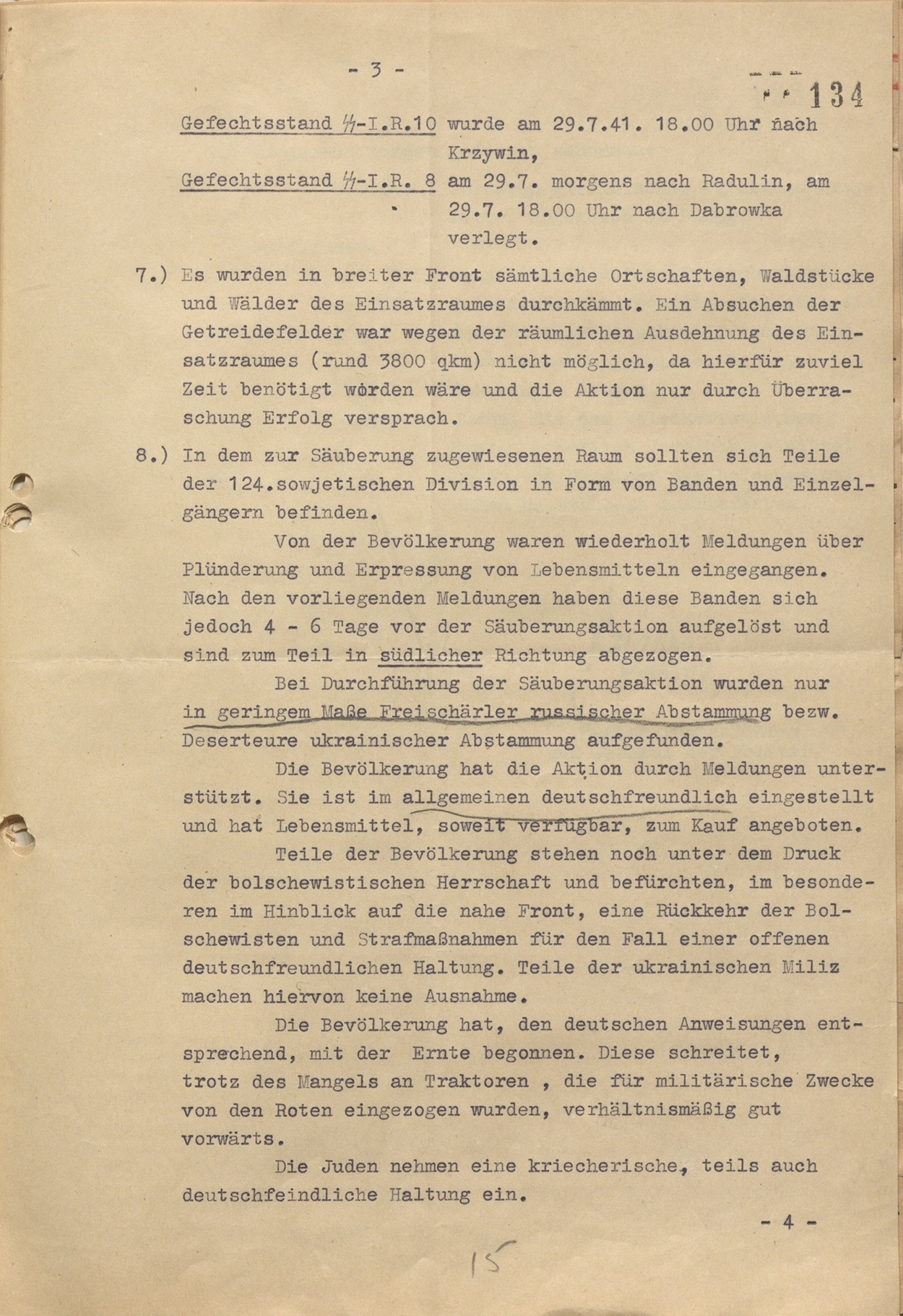
Gefechtsstand SS-I.R.10 wurde am 29.7.41. 18.00 Uhr nach Krzywin,
Gefechtsstand SS-I.R.8 am 29.7. morgens nach Radulin, am 29.7. 18.00 Uhr nach Dabrowka verlegt.
7.) Es wurden in breiter Front sämtliche Ortschaften, Waldstücke und Wälder des Einsatzraumes durchkämmt. Ein Absuchen der Getreidefelder war wegen der räumlichen Ausdehnung des Einsatzraumes (rund 3800 qkm) nicht möglich, da hierfür zuviel Zeit benötigt worden wäre und die Aktion nur durch Überraschung Erfolg versprach.
8.) In dem zur Säuberung zugewiesenen Raum sollten sich Teile der 124. sowjetischen Division in Form von Banden und Einzelgängern befinden.
Von der Bevölkerung waren wiederholt Meldungen über Plünderung und Erpressung von Lebensmitteln eingegangen. Nach den vorliegenden Meldungen haben diese Banden sich jedoch 4–6 Tage vor der Säuberungsaktion aufgelöst und sind zum Teil in südlicher Richtung abgezogen.
Bei Durchführung der Säuberungsaktion wurden nur in geringem Maße Freischärler russischer Abstammung bzw. Deserteure ukrainischer Abstammung aufgefunden.
Die Bevölkerung hat die Aktion durch Meldungen unterstützt. Sie ist im allgemeinen deutschfreundlich eingestellt und hat Lebensmittel, soweit verfügbar, zum Kauf angeboten.
Teile der Bevölkerung stehen noch unter dem Druck der bolschewistischen Herrschaft und befürchten, im besonderen im Hinblick auf die nahe Front, eine Rückkehr der Bolschewisten und Strafmaßnahmen für den Fall einer offeneren deutschfreundlichen Haltung. Teile der ukrainischen Miliz machen hiervon keine Ausnahme.
Die Bevölkerung hat, den deutschen Anweisungen entsprechend, mit der Ernte begonnen. Diese schreitet, trotz des Mangels an Traktoren, die für militärische Zwecke von den Russen eingezogen wurden, verhältnismäßig gut vorwärts.
Die Juden nehmen eine kriecherische, teils auch deutschfeindliche Haltung ein.
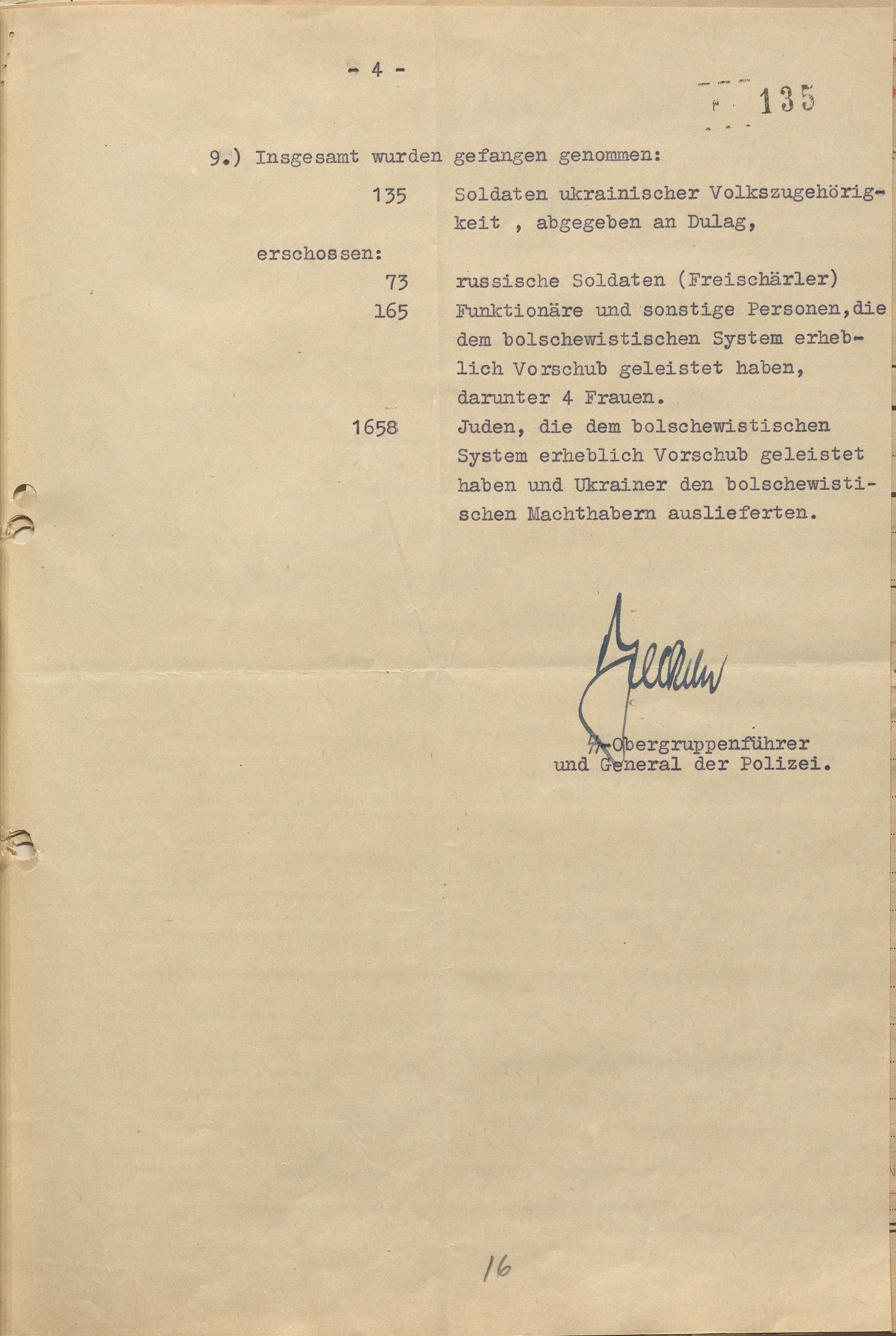
9.) Insgesamt wurden gefangen genommen:
135 Soldaten ukrainischer Volkszugehörigkeit, abgegeben an Dulag,
erschossen:
73 russische Soldaten (Freischärler)
165 Funktionäre und sonstige Personen, die dem bolschewistischen System erheblich Vorschub geleistet haben, darunter 4 Frauen.
1658 Juden, die dem bolschewistischen System erheblich Vorschub geleistet haben und Ukrainer den bolschewistischen Machthabern auslieferten.
[Unterschrift]
SS-Obergruppenführer und General der Polizei.
HQ, 1 August 1941
Higher SS and Police Leader with the Commander of the Rear Army Area South
Report on the cleansing operation from 28–30 July 1941 in the area of Zwiahel, Slucz Valley, Nw. Miropol, Szepetowka, Zaslaw, Ostrog, Horyn Valley, Hoszcza
I.
To Army High Command 6 (A.O.K. 6)
Copies to:
Reichsführer-SS and Chief of the German Police;
Commander of the Rear Army Area, General von Roques;
Commander of the Rear Army District, Lieutenant General von Puttkammer;
Chief of the Order Police, General of Police Daluege.
II.
1.) At the request of Field Marshal von Reichenau, the Reichsführer-SS made the 1st SS Brigade available for a cleansing operation in the rear army and army district areas. The execution of this operation in the region of Zwiahel, Slucz Valley, Nw. Miropol, Szepetowka, Zaslaw, Ostrog, Horyn Valley, and Hoszcza was carried out according to the instructions of the Chief of Staff of A.O.K. 6 and in coordination with the commanders of the Rear Army District, Lieutenant General von Puttkammer, and the Rear Army Area, General von Roques.
2.) The units under my command, as far as available for the operation, were given the order to arrest or annihilate:
a) remnants of the 124th Soviet Rifle Division,
b) armed bands,
c) irregular fighters,
d) persons who had aided the Bolshevik system.
3.) The entire operation was under my command.
Headquarters: Szepetowka.
Aerial reconnaissance was carried out by myself personally, using the Fieseler Storch aircraft at my disposal, both before and during the operation. It showed that no larger organized enemy units were present in the area.
4.) As reserve forces, two bicycle detachments of Police Regiment South were held ready at the southern edge of the operational area.
5.) The 1st SS Brigade was deployed for the execution of the ordered cleansing operation:
SS Infantry Regiment 10 – right boundary: Horyn Valley, left boundary (also the boundary with SS Infantry Regiment 8): road Korzec–Szepetowka.
SS Infantry Regiment 8 – left boundary: Slucz Valley.
The regiments advanced on 28 July 1941 at 7:00 a.m. on a broad front from the line Hoszcza–Korzec–Zwiahel toward the southern edge of the assigned area, along the line Nw. Miropol–Szepetowka–Zaslaw–Ostrog, and reached by the evening of 28 July, in the sector of SS-I.R.10, the line Milatyn–Annopol–Berezdow, and in the sector of SS-I.R.8, the line Krasnostaw–Dabrowka–Baranowka.
On 29 July, beginning at 6:00 a.m., the operation was continued.
The following positions were reached:
SS-I.R.10 – northern edge of the southern forest area,
SS-I.R.8 – the line Korczyk–Nowaki–Polonne–Nw. Miropol.
By 19:00 on 30 July, both regiments had reached the southern boundary line of the assigned area.
6.) Command posts:
Headquarters of the brigade on 28 July 1941, 1.5 km south of Korzec.
Headquarters SS-I.R.10 on 28 July 1941, Hoszcza.
Headquarters SS-I.R.8 on 28 July 1941, Zwiahel.
Headquarters of the brigade relocated to Berezdow at 13:00 on 29 July 1941.
Headquarters SS-I.R.10 moved on 29 July 1941, 18:00 to Krzywin.
Headquarters SS-I.R.8 moved on 29 July, in the morning to Radulin, and at 18:00 to Dabrowka.
7.) All villages, wooded areas, and forests of the operational zone were combed through on a broad front. Searching the grain fields was not possible due to the size of the area (around 3,800 square kilometers), as this would have required too much time, and the operation relied on surprise for success.
8.) It was assumed that remnants of the 124th Soviet Division, in the form of bands and stragglers, were located in the area assigned for cleansing.
Repeated reports had been received from the population regarding looting and extortion of foodstuffs. According to available information, these bands had disbanded 4–6 days before the cleansing operation and had partly withdrawn southward.
During the execution of the cleansing operation, only a small number of irregular fighters of Russian origin and Ukrainian deserters were found.
The population supported the operation by providing information. In general, it is friendly toward the Germans and, where possible, offered food for sale.
Parts of the population are still under the pressure of Bolshevik rule and fear, especially given the proximity of the front, the return of the Bolsheviks and resulting punishment for showing a more openly pro-German attitude. Parts of the Ukrainian militia are no exception in this regard.
The population has begun the harvest in accordance with German instructions. Despite the lack of tractors, which had been requisitioned by the Russians for military purposes, the harvest is progressing relatively well.
The Jews adopt a servile, partly also anti-German attitude.
9.) The following were captured in total:
135 soldiers of Ukrainian nationality, handed over to the Dulag (transit camp),
shot:
73 Russian soldiers (irregulars),
165 officials and other persons who had given significant support to the Bolshevik system, including four women,
1,658 Jews who had given significant support to the Bolshevik system and who had betrayed Ukrainians to the Bolshevik authorities.
{signature]
SS-Obergruppenführer and General of Police.
Archivial reference:
BArch, RH 20-6/111, Bl. 132 – 135.
Further Reading:
Die Verfolgung und Ermordung der europäischen Juden durch das nationalsozialistische Deutschland 1933-1945 (VEJ) 7, Dokument 49.