Introduction
A confidential report dated April 7, 1942, issued by the Lublin Labor Office, documents labor allocations for March 1942, including transfers of workers to the Reich, SS construction projects, and the reorganization of Jewish forced labor during the early phase of Operation Reinhard. The report explicitly records the onset of mass deportations in Lublin that “in mid-month a larger resettlement action of Jews was initiated by the SS and Police Leader, which is still ongoing and during which the ghetto was sealed off. Of the 40,000 Jews residing in Lublin, all but approximately 2,000 are being removed from the city. These 2,000 consist of approximately 800 skilled workers and their family members.” The document further states that “The resettlement action is also to be carried out in the towns of the rest of the district”.
Document


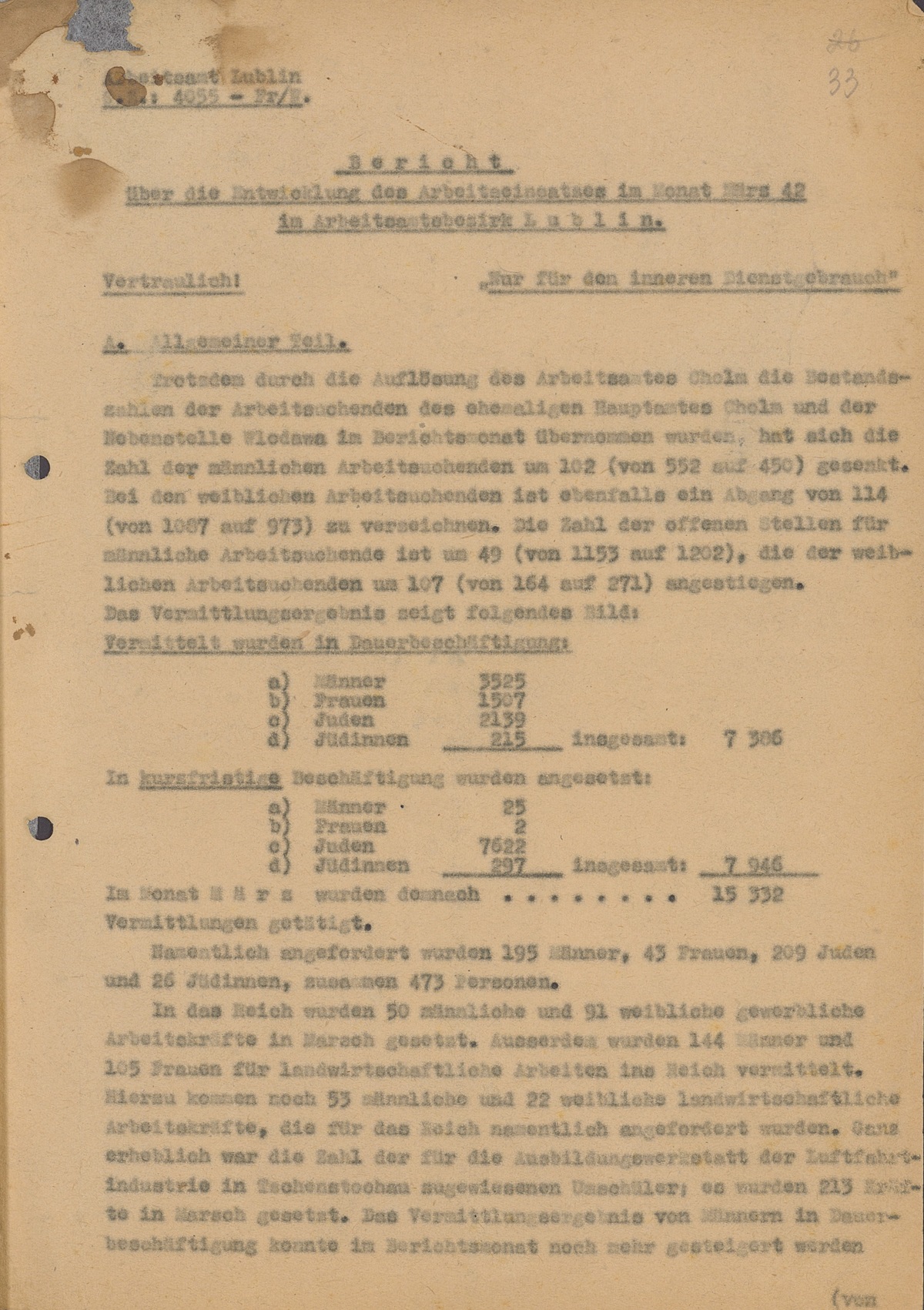


Arbeitsamt Lublin
… 4055 – Fr/W.
Bericht über die Entwicklung des Arbeitseinsatzes im Monat März 42 im Arbeitsamtsbezirk Lublin.
Vertraulich! „Nur für den inneren Dienstgebrauch“
A. Allgemeiner Teil.
Trotzdem durch die Auflösung des Arbeitsamtes Cholm die Bestandszahlen der Arbeitsuchenden des ehemaligen Hauptamtes Cholm und der Nebenstelle Wlodawa im Berichtsmonat übernommen wurden, hat sich die Zahl der männlichen Arbeitsuchenden um 102 (von 552 auf 450) gesenkt, bei den weiblichen Arbeitsuchenden ist ebenfalls ein Abgang von 114 (von 1087 auf 973) zu verzeichnen. Die Zahl der offenen Stellen für männliche Arbeitsuchende ist um 49 (von 1153 auf 1202), die der weiblichen Arbeitsuchenden um 107 (von 164 auf 271) angestiegen. Das Vermittlungsergebnis zeigt folgendes Bild:
Neu eingestellt wurden in Dauerbeschäftigung:
a) Männer 3525
b) Frauen 1507
c) Juden 2139
d) Jüdinnen 215
insgesamt 7 386
In kurzfristige Beschäftigung wurden angesetzt:
a) Männer 25
b) Frauen 2
c) Juden 7622
d) Jüdinnen 297
insgesamt 7 946
Im Monat März wurden demnach 15 332 Vermittlungen getätigt.
Namentlich angefordert wurden 195 Männer, 43 Frauen, 209 Juden und 26 Jüdinnen, zusammen 473 Personen.
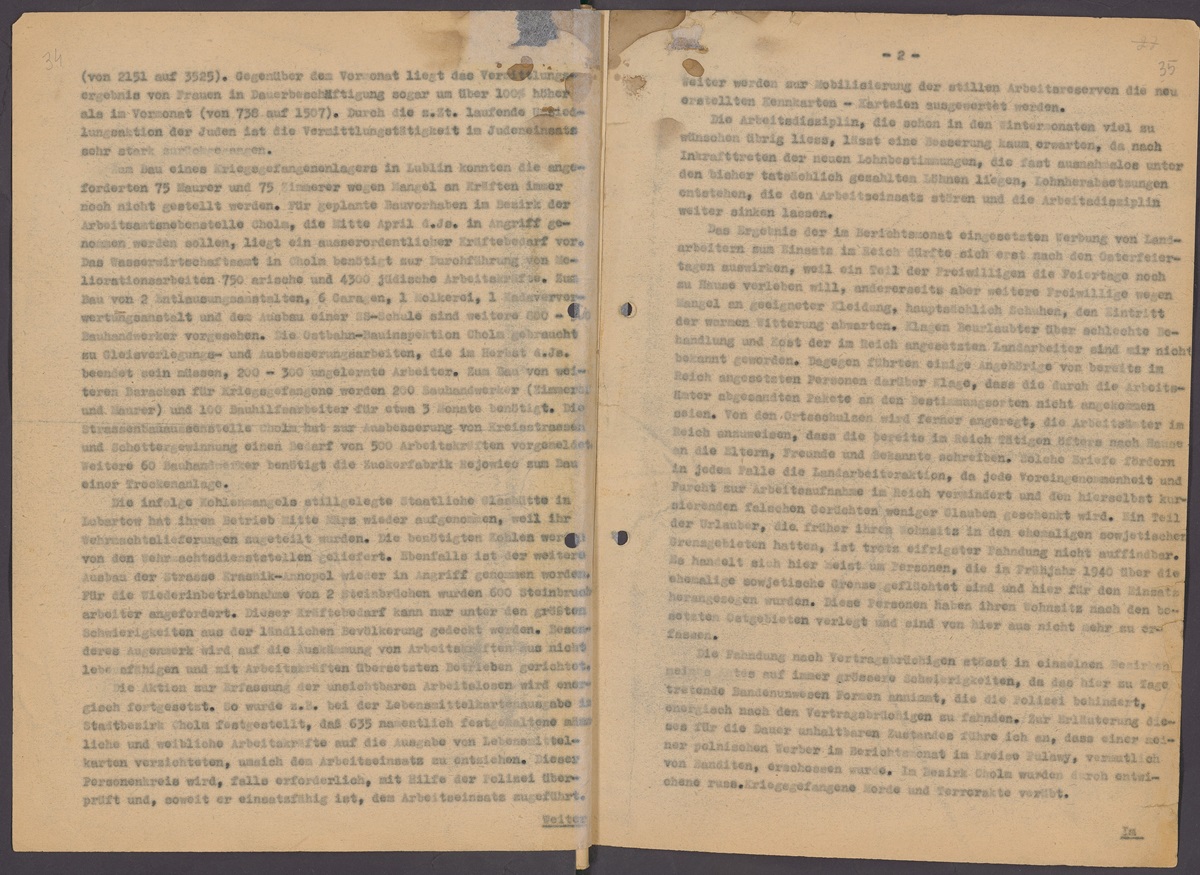
In das Reich wurden 50 männliche und 91 weibliche gewerbliche Arbeitskräfte in Marsch gesetzt. Außerdem wurden 144 Männer und 105 Frauen für landwirtschaftliche Arbeiten ins Reich vermittelt. Hierzu kommen noch 53 männliche und 22 weibliche landwirtschaftliche Arbeitskräfte, die für das Reich namentlich angefordert wurden. Ganz erheblich war die Zahl der für die Ausbildungswerkstatt der Luftfahrtindustrie in Tschenstochen ausgewiesenen Umschüler; es wurden 213 Kräfte ins Marsch gesetzt. Das Vermittlungsergebnis von Männern in Dauerbeschäftigung konnte im Berichtsmonat noch sehr gesteigert werden (von 2131 auf 3525). Gegenüber dem Vormonat liegt das Vermittlungsergebnis von Frauen in Dauerbeschäftigung sogar um über 100% höher als im Vormonat (von 738 auf 1507). Durch die z.Zt. laufende Umsiedlungsaktion der Juden ist die Vermittlungstätigkeit in Judeneinsatz sehr stark zurückgegangen.
Zum Bau eines Kriegsgefangenenlagers in Lublin konnten die angeforderten 75 Maurer und 75 Zimmerer wegen Mangel an Kräften immer noch nicht gestellt werden. Für geplante Bauvorhaben im Bezirk der Arbeitsamtsnebenstelle Cholm, die Mitte April d.J. in Angriff genommen werden sollen, liegt ein außerordentlicher Kraftbedarf vor. Das Wasserwirtschaftsamt in Cholm benötigt zur Durchführung von Meliorationsarbeiten 750 arische und 4300 jüdische Arbeitskräfte. Zum Bau von 2 Entlausungsanstalten, 6 Garagen, 1 Molkerei, 1 Kadaververwertungsanstalt und der Ausbau SS-Schule sind weitere 800–900 Bauhandwerker vorgesehen. Die Ostbahn-Bauinspektion Cholm gebraucht zu Gleisverlegungs- und Ausbesserungsarbeiten, die im Herbst d.J. beendet sein müssen, 200–300 ungelernte Arbeiter. Zum Bau von weiteren Baracken für Kriegsgefangene werden 200 Bauhandwerker (Männer und Maurer) und 100 Bauhilfsarbeiter für etwa 3 Monate benötigt. Die Strassenbauaussenstelle Cholm hat zur Ausbesserung von Kreisstrassen und Schottergewinnung allein im Bezirk von 500 Arbeitskräften vorgemeldet. Weitere 60 Bauhandwerker benötigt die Zuckerfabrik Rejowiec zum Bau einer Trockenanlage.
[…]
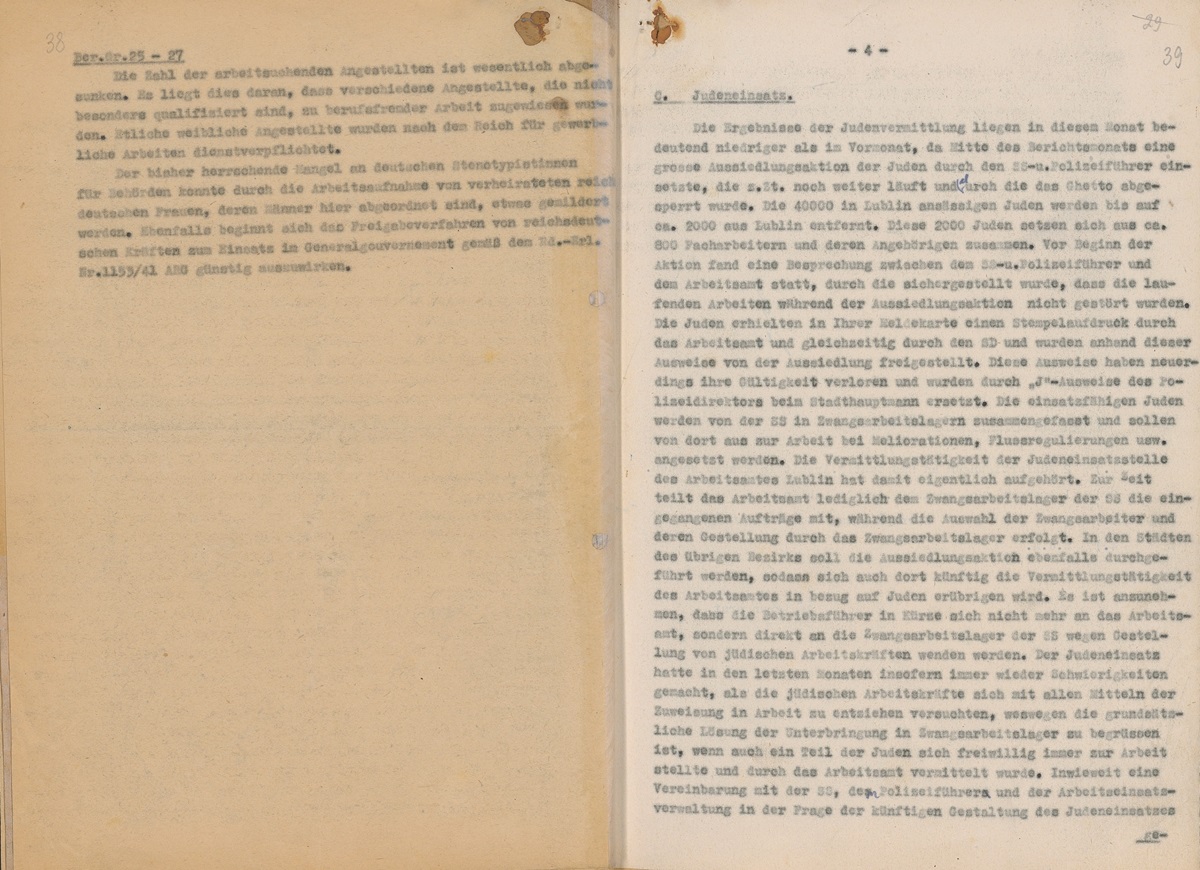
C. Judeneinsatz.
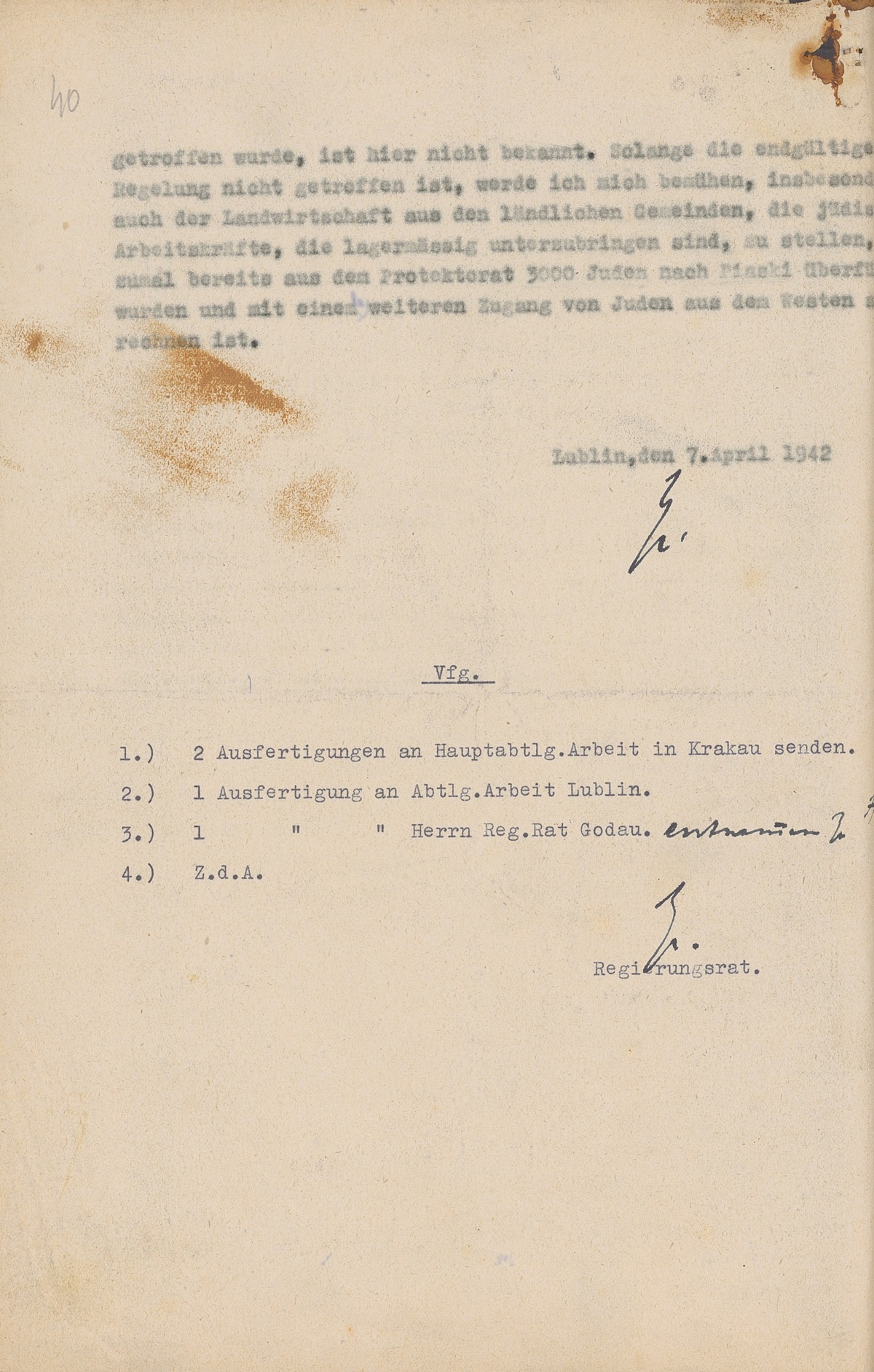
Die Ergebnisse der Judenvermittlung liegen in diesem Monat bedeutend niedriger als im Vormonat, da Mitte des Berichtsmonats eine größere Aussiedlungsaktion der Juden durch den SS- u. Polizeiführer einsetzte, die z.Zt. noch weiter läuft und druch die das Ghetto abgesperrt wurde. Die 40000 in Lublin ansässigen Juden werden bis auf ca. 2000 aus Lublin entfernt. Diese 2000 Juden setzen sich aus ca. 800 Facharbeitern und deren Angehörigen zusammen. Vor Beginn der Aktion fand eine Vorbesprechung zwischen dem SS- u. Polizeiführer und dem Arbeitsamt statt, durch die sichergestellt wurde, dass die laufenden Arbeiten während der Aussiedlungsaktion nicht gestört wurden. Die Juden erhielten in ihrer Meldekarte einen Stempelaufdruck durch das Arbeitsamt und gleichzeitig durch den SD und wurden anhand dieses Ausweises von der Aussiedlung freigestellt. Diese Ausweise haben neuerdings ihre Gültigkeit verloren und wurden durch „J“-Ausweise des Polizeidirektors beim Stadthauptmann ersetzt. Die einsatzfähigen Juden werden von der SS in Zwangsarbeitslager zusammengefasst und sollen von dort aus zur Arbeit bei Meliorationen, Flussregulierungen usw. eingesetzt werden. Die Vermittlungstätigkeit der Judeneinsatzstelle des Arbeitsamtes Lublin hat damit eigentlich aufgehört. Zur Zeit teilt das Arbeitsamt lediglich dem Zwangsarbeitslager der SS die eingegangenen Aufträge mit, während die Auswahl der Zwangsarbeiter und deren Gestellung durch das Zwangsarbeitslager erfolgt. In den Städten des übrigen Bezirks soll die Aussiedlungsaktion ebenfalls durchgeführt werden, sodass auch dort künftig die Vermittlungstätigkeit des Arbeitsamtes in bezug auf Juden erübrigen wird. Es ist anzunehmen, dass die Betriebsführer in Kürze sich nicht mehr an das Arbeitsamt, sondern direkt an die Zwangsarbeitslager der SS wegen Gestellung von jüdischen Arbeitskräften wenden werden. Der Judeneinsatz hatte in den letzten Monaten insofern immer wieder Schwierigkeiten gemacht, als die jüdischen Arbeitskräfte sich mit allen Mitteln der Zuweisung in Arbeit zu entziehen versuchten, weswegen die grundsätzliche Lösung der Unterbringung in Zwangsarbeitslager zu begrüßen ist, wenn auch ein Teil der Juden sich freiwillig immer zur Arbeit stellte und durch das Arbeitsamt vermittelt wurde. Inwieweit eine Vereinbarung mit der SS, dem Polizeiführer und der Arbeitsdienststelle zur Vermittlung in der Frage der künftigen Gestaltung des Judeneinsatzes getroffen wurde, ist hier nicht bekannt. Solange die endgültige Regelung nicht getroffen ist, werde ich mich bemühen, insbesondere auch der Landwirtschaft aus den ländlichen Gemeinden, die jüdische Arbeitskräfte, die lagermäßig unterzubringen sind, zu stellen, zumal bereits aus dem Protektorat 3000 Juden nach Piaski überführt wurden und mit einem weiteren Zugang von Juden aus dem Westen zu rechnen ist.
Lublin, den 7. April 1942
[Unterschrift]
Vfg.
1.) 2 Ausfertigungen an Hauptabtlg. Arbeit in Krakau senden.
2.) 1 Ausfertigung an Abtlg. Arbeit Lublin.
3.) 1 „ „ Herrn Reg.Rat Godau. einhändig
4.) Z.d.A.
[Unterschrift ]
Regierungsrat.
Labor Office Lublin
… 4055 – Fr/W.
Report on the development of labor deployment in March 1942 in the Lublin Labor Office district
Confidential! “For internal official use only”
A. General Section
Although, due to the dissolution of the Labor Office in Chełm, the employment statistics of job seekers from the former main office in Chełm and the branch office in Włodawa were taken over during the reporting month, the number of male job seekers decreased by 102 (from 552 to 450). Among female job seekers, a decrease of 114 (from 1087 to 973) was likewise recorded. The number of vacancies for male job seekers increased by 49 (from 1153 to 1202), and for female job seekers by 107 (from 164 to 271). The placement results show the following picture:
Newly placed in permanent employment:
a) Men: 3525
b) Women: 1507
c) Jews: 2139
d) Jewish women: 215
Total: 7,386
Assigned to short-term employment:
a) Men: 25
b) Women: 2
c) Jews: 7,622
d) Jewish women: 297
Total: 7,946
Thus, in the month of March a total of 15,332 placements were made.
Specifically requested by name were 195 men, 43 women, 209 Jews, and 26 Jewish women, together 473 persons.
To the Reich, 50 male and 91 female industrial workers were dispatched. In addition, 144 men and 105 women were placed in the Reich for agricultural work. Added to these were 53 male and 22 female agricultural workers who were specifically requested for the Reich by name. Particularly significant was the number of retrained workers assigned to the aviation industry training workshop in Częstochowa; 213 workers were dispatched. The placement result for men in permanent employment increased considerably during the reporting month (from 2,131 to 3,525). Compared to the previous month, the placement result for women in permanent employment was even more than 100% higher (from 738 to 1,507). Due to the resettlement action of Jews currently underway, placement activity in Jewish labor deployment has declined sharply.
For the construction of a prisoner-of-war camp in Lublin, the requested 75 bricklayers and 75 carpenters still could not be provided due to lack of manpower. For planned construction projects in the district of the Chełm Labor Office branch, which are to begin in mid-April of this year, there is an extraordinary demand for labor. The Water Management Office in Chełm requires 750 Aryan and 4,300 Jewish workers to carry out drainage and land-improvement works. For the construction of 2 delousing facilities, 6 garages, 1 dairy, 1 carcass utilization plant, and the expansion of the SS school, an additional 800–900 skilled construction workers are planned. The Eastern Railway Construction Inspectorate in Chełm requires 200–300 unskilled workers for track-laying and repair work, which must be completed in the autumn of this year. For the construction of additional barracks for prisoners of war, 200 construction craftsmen (bricklayers and carpenters) and 100 construction laborers are needed for approximately three months. The Chełm road construction outpost has reported a requirement of 500 workers in the district alone for district road repairs and gravel extraction. A further 60 construction craftsmen are needed by the Rejowiec sugar factory for the construction of a drying facility.
[…]
C. Jewish Labor Deployment
The results of Jewish labor placements are considerably lower this month than in the previous month, since in mid-month a larger resettlement action of Jews was initiated by the SS and Police Leader, which is still ongoing and during which the ghetto was sealed off. Of the 40,000 Jews residing in Lublin, all but approximately 2,000 are being removed from the city. These 2,000 consist of approximately 800 skilled workers and their family members. Before the action began, a preliminary discussion took place between the SS and Police Leader and the Labor Office to ensure that ongoing work would not be disrupted during the resettlement action. The Jews received a stamped notation in their registration cards from the Labor Office and simultaneously from the SD, and on the basis of this identification were exempted from resettlement. These identification papers have recently lost their validity and have been replaced by “J” passes issued by the Police Director at the City Governor’s office. Jews capable of work are being assembled by the SS into forced labor camps and are to be deployed from there for drainage works, river regulation, etc. The placement activity of the Jewish Labor Office section in Lublin has thus effectively ceased. At present, the Labor Office merely forwards incoming labor requests to the SS forced labor camp, while the selection and provision of forced laborers is carried out by the camp itself. The resettlement action is also to be carried out in the towns of the rest of the district, so that in the future the Labor Office’s placement activity with regard to Jews will likewise become unnecessary there. It is to be assumed that plant managers will shortly no longer turn to the Labor Office, but directly to the SS forced labor camps for the provision of Jewish laborers. In recent months, Jewish labor deployment had repeatedly caused difficulties insofar as Jewish workers attempted by all means to evade assignment to work, which is why the fundamental solution of housing them in forced labor camps is to be welcomed, even if a portion of the Jews always presented themselves voluntarily for work and were placed through the Labor Office. Whether an agreement has been reached with the SS, the Police Leader, and the labor service office regarding future arrangements for Jewish labor deployment is not known here. Until a final regulation has been made, I will endeavor, in particular also for agriculture in the rural communities, to provide Jewish laborers who are to be accommodated in camps, especially since 3,000 Jews have already been transferred from the Protectorate to Piaski and further arrivals of Jews from the West are to be expected.
Lublin, 7 April 1942
[Signature]
Disposal:
- Send 2 copies to the Main Department of Labor in Kraków.
- 1 copy to the Labor Department Lublin.
- 1 copy to Government Councillor Godau, by hand.
- To the files.
[Signature]
Government Councillor.
Archivial reference:
Archiwum Państwowe w Lublinie (APL)/35/509/0/2/8