Introduction
Report by SS-Obergruppenführer Oswald Pohl, head of the SS Main Economic and Administrative Office (SS-WVHA), to Reichsführer-SS Heinrich Himmler, dated 6 February 1943, on “the quantity of scrap material from the Jewish resettlement that has so far been shipped out from the Auschwitz and Lublin camps.” The report states that a total of 825 railway wagons of confiscated property were collected, sorted, and dispatched from the Auschwitz and Majdanek concentration camps.
Document



Abschrift.
Geheim
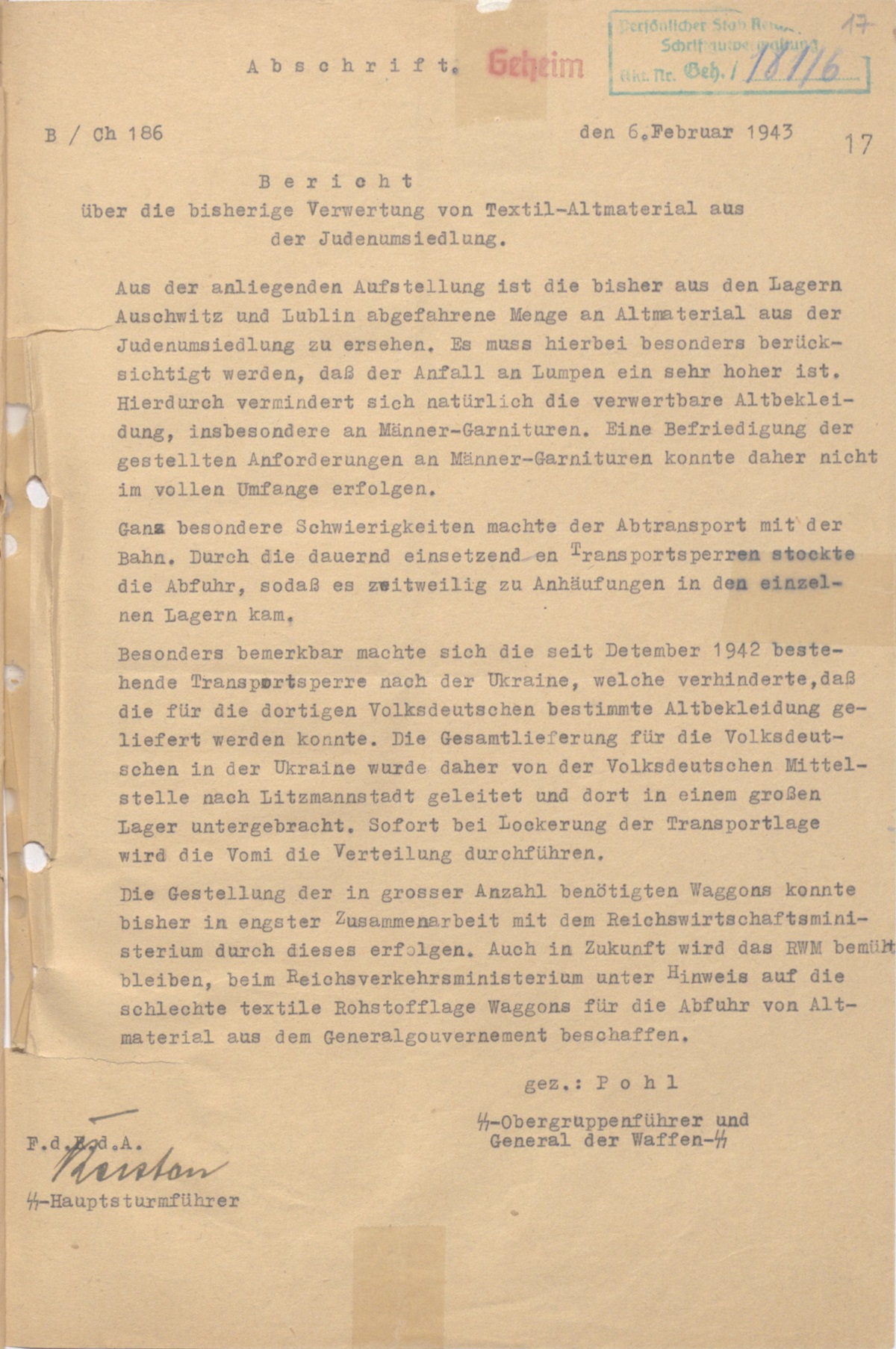
B / Ch 186
den 6. Februar 1943
Bericht über die bisherige Verwertung von Textil-Altmaterial aus der Judenumsiedlung.
Aus der anliegenden Aufstellung ist die bisher aus den Lagern Auschwitz und Lublin abgefahrene Menge an Altmaterial aus der Judenumsiedlung zu ersehen. Es muss hierbei besonders berücksichtigt werden, daß der Anfall an Lumpen ein sehr hoher ist. Hierdurch vermindert sich natürlich die verwertbare Altbekleidung, insbesondere an Männer-Garnituren. Eine Befriedigung der gestellten Anforderungen an Männer-Garnituren konnte daher nicht im vollen Umfange erfolgen.
Ganz besondere Schwierigkeiten machte der Abtransport mit der Bahn. Durch die dauernd einsetzenden Transportsperren stockte die Abfuhr, sodaß es zeitweilig zu Anhäufungen in den einzelnen Lagern kam.
Besonders bemerkbar machte sich die seit Dezember 1942 bestehende Transportsperre nach der Ukraine, welche verhinderte, daß die für die dortigen Volksdeutschen bestimmte Altbekleidung geliefert werden konnte. Die Gesamtlieferung für die Volksdeutschen in der Ukraine wurde daher von der Volksdeutschen Mittelstelle nach Litzmannstadt geleitet und dort in einem großen Lager untergebracht. Sofort bei Lockerung der Transportlage wird die Vomi die Verteilung durchführen.
Die Gestellung der in grosser Anzahl benötigten Waggons konnte bisher in engster Zusammenarbeit mit dem Reichswirtschaftsministerium durch dieses erfolgen. Auch in Zukunft wird das RWM bemüht bleiben, beim Reichsverkehrsministerium unter Hinweis auf die schlechte textile Rohstofflage Waggons für die Abfuhr von Altmaterial aus dem Generalgouvernement zu beschaffen.
gez.: Pohl
SS-Obergruppenführer und General der Waffen-SS
F. d. R. d. A.
[Unterschrift]
SS-Hauptsturmführer
Abschrift. Geheim
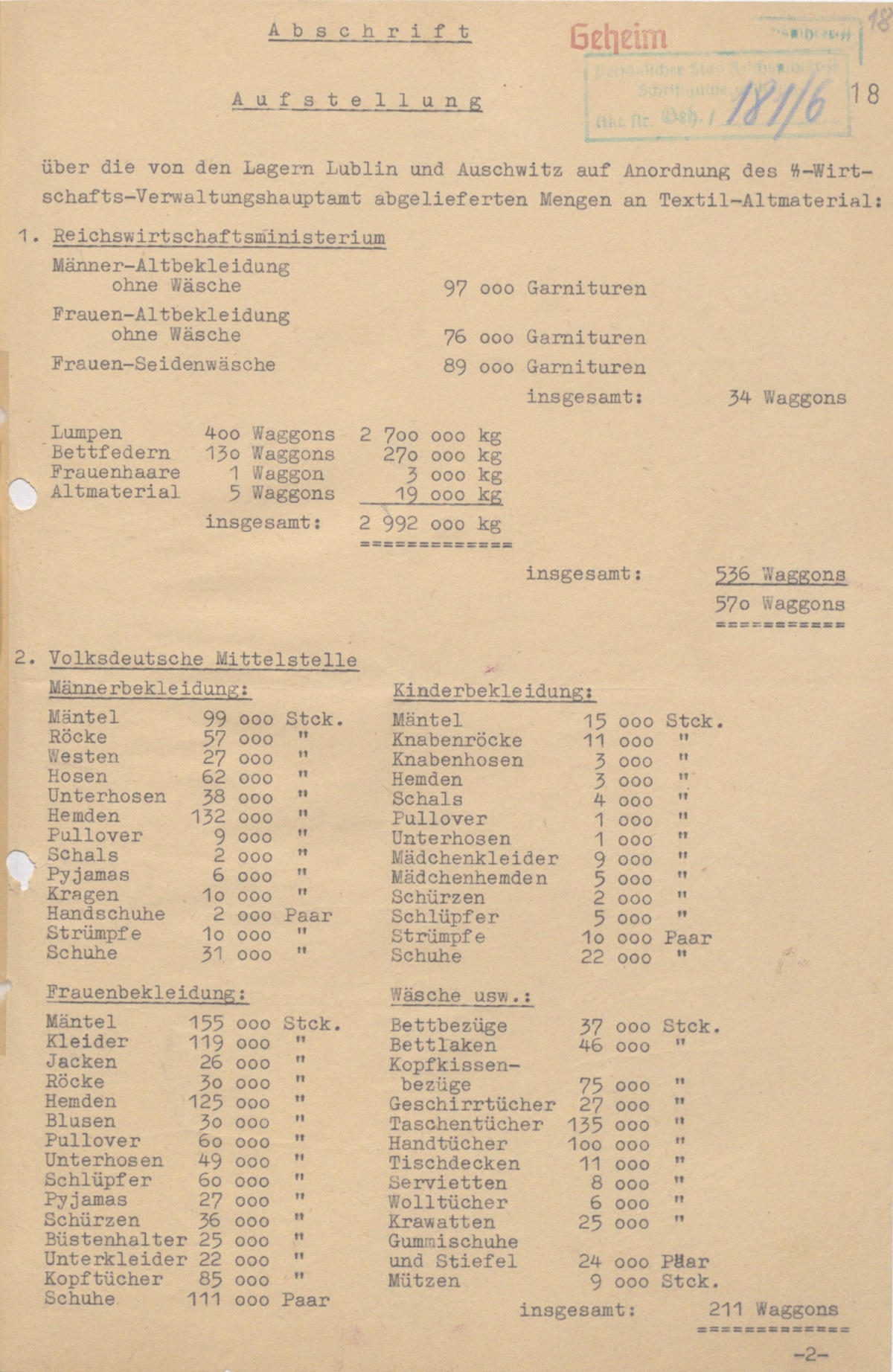
Aufstellung über die von den Lagern Lublin und Auschwitz auf Anordnung des SS-Wirtschafts-Verwaltungshauptamt abgelieferten Mengen an Textil-Altmaterial:
1. Reichswirtschaftsministerium
Männer-Altbekleidung ohne Wäsche 97 000 Garnituren
Frauen-Altbekleidung ohne Wäsche 76 000 Garnituren
Frauen-Seidenwäsche 89 000 Garnituren
insgesamt: 34 Waggons
Lumpen 400 Waggons 2 700 000 kg
Bettfedern 130 Waggons 270 000 kg
Frauenhaare 1 Waggon 3 000 kg
Altmaterial 5 Waggons 19 000 kg
insgesamt: 2 992 000 kg
insgesamt: 536 Waggons
570 Waggons
2. Volksdeutsche Mittelstelle
Männerbekleidung:
Mäntel 99 000 Stck.
Röcke 57 000
Westen 27 000
Hosen 62 000,
Unterhosen 38 000
Hemden 132 000
Pullover 9 000
Schals 2 000
Pyjamas 6 000
Kragen 10 000
Handschuhe 2 000 Paar
Strümpfe 10 000
Schuhe 31 000.
Kinderbekleidung:
Mäntel 15 000 Stck.
Knabenröcke 11 000
Knabenhosen 3 000
Hemden 3 000
Schals 4 000
Pullover 1 000
Unterhosen 1 000
Mädchenkleider 9 000
Mädchenhemden 5 000
Schürzen 2 000
Schlüpfer 5 000
Strümpfe 10 000 Paar
Schuhe 22 000.
Frauenbekleidung:
Mäntel 155 000 Stck.
Kleider 119 000
Jacken 26 000
Röcke 30 000
Hemden 125 000
Blusen 30 000
Pullover 60 000
Unterhosen 49 000
Schlüpfer 60 000
Pyjamas 27 000
Schürzen 36 000
Büstenhalter 25 000
Unterkleider 22 000
Kopftücher 85 000
Schuhe 111 000 Paar.
Wäsche usw.:
Bettbezüge 37 000 Stck.
Bettlaken 46 000
Kopfkissenbezüge 75 000
Geschirrtücher 27 000
Taschentücher 135 000
Handtücher 100 000
Tischdecken 11 000
Servietten 8 000
Wolltücher 6 000
Krawatten 25 000
Gummischuhe und Stiefel 24 000 Paar
Mützen 9 000 Stck.
insgesamt: 211 Waggons
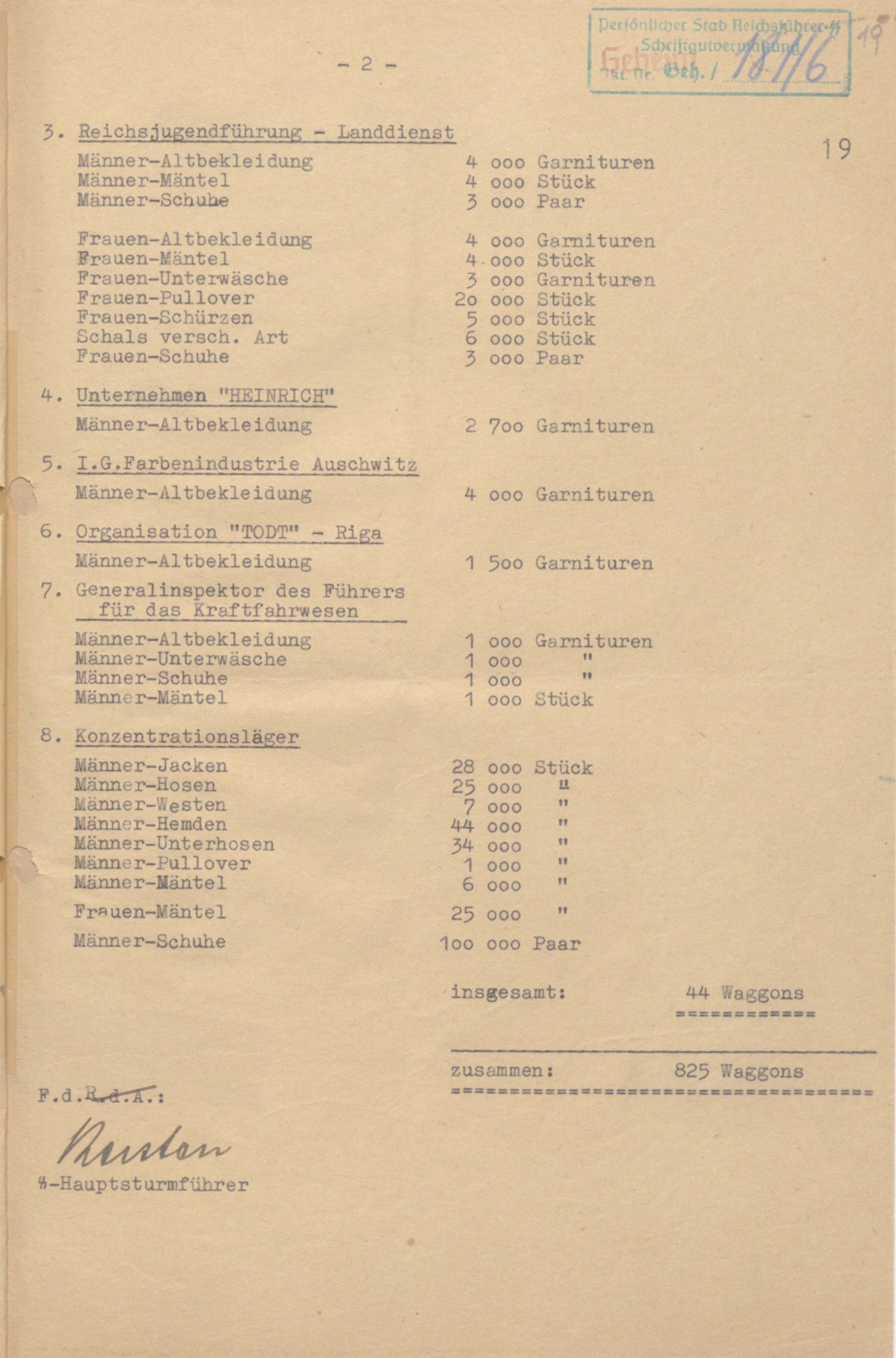
3. Reichsjugendführung – Landdienst
Männer-Altbekleidung 4 000 Garnituren
Männer-Mäntel 4 000 Stück
Männer-Schuhe 3 000 Paar
Frauen-Altbekleidung 4 000 Garnituren
Frauen-Mäntel 4 000 Stück
Frauen-Unterwäsche 3 000 Garnituren
Frauen-Pullover 20 000 Stück
Frauen-Schürzen 5 000 Stück
Schals versch. Art 6 000 Stück
Frauen-Schuhe 3 000 Paar
4. Unternehmen „HEINRICH“
Männer-Altbekleidung 2 700 Garnituren
5. I.G. Farbenindustrie Auschwitz
Männer-Altbekleidung 4 000 Garnituren
6. Organisation „TODT“ – Riga
Männer-Altbekleidung 1 500 Garnituren
7. Generalinspektor des Führers für das Kraftfahrwesen
Männer-Altbekleidung 1 000 Garnituren
Männer-Unterwäsche 1 000 „
Männer-Schuhe 1 000 „
Männer-Mäntel 1 000 Stück
8. Konzentrationslager
Männer-Jacken 28 000 Stück
Männer-Hosen 25 000 „
Männer-Westen 7 000 „
Männer-Hemden 44 000 „
Männer-Unterhosen 34 000 „
Männer-Pullover 1 000 „
Männer-Mäntel 6 000 „
Frauen-Mäntel 25 000 „
Männer-Schuhe 100 000 Paar
insgesamt: 44 Waggons
zusammen: 825 Waggons
F. d. R. d. A.
[Unterschrift]
SS-Hauptsturmführer
Copy
Secret
B / Ch 186
6 February 1943
Report on the previous utilization of textile scrap material from the Jewish resettlement
From the attached statement, the quantity of scrap material from the Jewish resettlement that has so far been shipped out from the Auschwitz and Lublin camps can be seen. It must be taken particularly into account that the proportion of rags is very high. This naturally reduces the amount of usable second-hand clothing, especially men’s outfits. For this reason, it was not possible to meet the stated requirements for men’s outfits in full.
The transport by rail caused particularly great difficulties. Because transport bans were repeatedly imposed, shipments were delayed, so that temporary accumulations arose in the individual camps.
The transport ban to Ukraine that has been in force since December 1942 was especially noticeable, as it prevented the delivery of second-hand clothing intended for the ethnic Germans there. The entire shipment for the ethnic Germans in Ukraine was therefore routed by the Volksdeutsche Mittelstelle to Litzmannstadt and stored there in a large depot. As soon as the transport situation is eased, the VOMI will carry out the distribution.
The provision of the large number of rail wagons required has so far been accomplished in the closest cooperation with the Reich Ministry of Economics by that ministry. In the future as well, the RWM will continue to make efforts with the Reich Ministry of Transport, pointing to the poor textile raw-material situation, to obtain wagons for the removal of scrap material from the General Government.
Signed: Pohl
SS-Obergruppenführer and General of the Waffen-SS
For the correctness of the copy
[signature]
SS-Hauptsturmführer
Copy. Secret
Inventory of the quantities of textile scrap material delivered from the Lublin and Auschwitz camps by order of the SS Main Economic and Administrative Office:
- Reich Ministry of Economics
Men’s used clothing without underwear: 97,000 outfits
Women’s used clothing without underwear: 76,000 outfits
Women’s silk underwear: 89,000 outfits
Total: 34 rail wagons
Rags: 400 wagons – 2,700,000 kg
Feathers: 130 wagons – 270,000 kg
Women’s hair: 1 wagon – 3,000 kg
Scrap material: 5 wagons – 19,000 kg
Total: 2,992,000 kg
Total: 536 wagons
570 wagons
- Volksdeutsche Mittelstelle (Office for Ethnic Germans)
Men’s clothing:
Overcoats 99,000 pieces; jackets 57,000; waistcoats 27,000; trousers 62,000; underpants 38,000; shirts 132,000; sweaters 9,000; scarves 2,000; pajamas 6,000; collars 10,000; gloves 2,000 pairs; stockings 10,000; shoes 31,000 pairs.
Children’s clothing:
Overcoats 15,000 pieces; boys’ jackets 11,000; boys’ trousers 3,000; shirts 3,000; scarves 4,000; sweaters 1,000; underpants 1,000; girls’ dresses 9,000; girls’ blouses 5,000; aprons 2,000; panties 5,000; stockings 10,000 pairs; shoes 22,000 pairs.
Women’s clothing:
Overcoats 155,000 pieces; dresses 119,000; jackets 26,000; skirts 30,000; blouses/shirts 125,000; blouses 30,000; sweaters 60,000; underpants 49,000; panties 60,000; pajamas 27,000; aprons 36,000; brassieres 25,000; slips/underdresses 22,000; headscarves 85,000; shoes 111,000 pairs.
Linen etc.:
Bed covers 37,000; sheets 46,000; pillowcases 75,000; dishcloths 27,000; handkerchiefs 135,000; towels 100,000; tablecloths 11,000; napkins 8,000; woolen scarves 6,000; neckties 25,000; rubber shoes and boots 24,000 pairs; caps 9,000.
Total: 211 wagons
- Reich Youth Leadership – Rural Service
Men’s used clothing 4,000 outfits; men’s coats 4,000 pieces; men’s shoes 3,000 pairs.
Women’s used clothing 4,000 outfits; women’s coats 4,000 pieces; women’s underwear 3,000 outfits; women’s sweaters 20,000; women’s aprons 5,000; scarves of various kinds 6,000; women’s shoes 3,000 pairs.
- Company “HEINRICH”
Men’s used clothing 2,700 outfits - I.G. Farben Industry, Auschwitz
Men’s used clothing 4,000 outfits - Organization “TODT” – Riga
Men’s used clothing 1,500 outfits - General Inspector of the Führer for Motor Transport
Men’s used clothing 1,000 outfits; men’s underwear 1,000; men’s shoes 1,000; men’s coats 1,000 pieces - Concentration camps
Men’s jackets 28,000; men’s trousers 25,000; men’s waistcoats 7,000; men’s shirts 44,000; men’s underpants 34,000; men’s sweaters 1,000; men’s coats 6,000; women’s coats 25,000; men’s shoes 100,000 pairs.
Total: 44 wagons
Grand total: 825 wagons
For the correctness of the copy
[signature]
SS-Hauptsturmführer
Archivial reference:
BArch NS 19/225