Introduction
On 9 November 1943, the Commander of the Security Police and SD in Lithuania sent a telex to the Vilna office and ordered the preparation of a report on the “executive/security situation in all of Lithuania for the year 1943 up to the present”. The Security Police office in Vilna submitted its report two days later, on 11 November 1943.
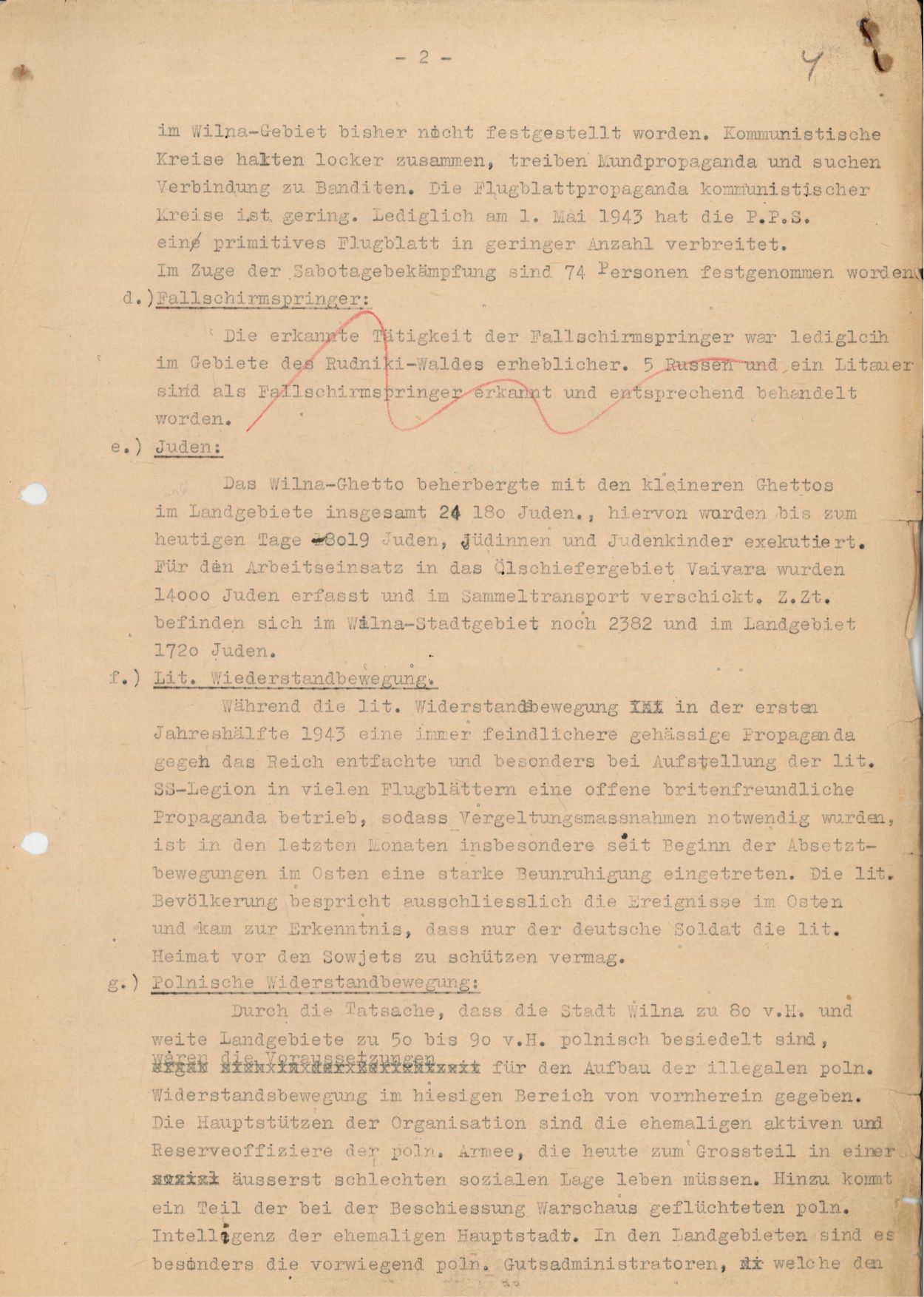
On the Jews, the report stated that the Vilna Ghetto and the smaller rural ghettos together had contained “24,180 Jews”. Of these, “8,019 Jews, Jewesses, and Jewish children have been executed”, while a further “14,000 Jews were registered and dispatched in collective transports” for forced labor in the Vaivara oil shale region.
According to the report, only “2,382 Jews in the city district of Vilna and 1,720 in the rural district” remained.
Document


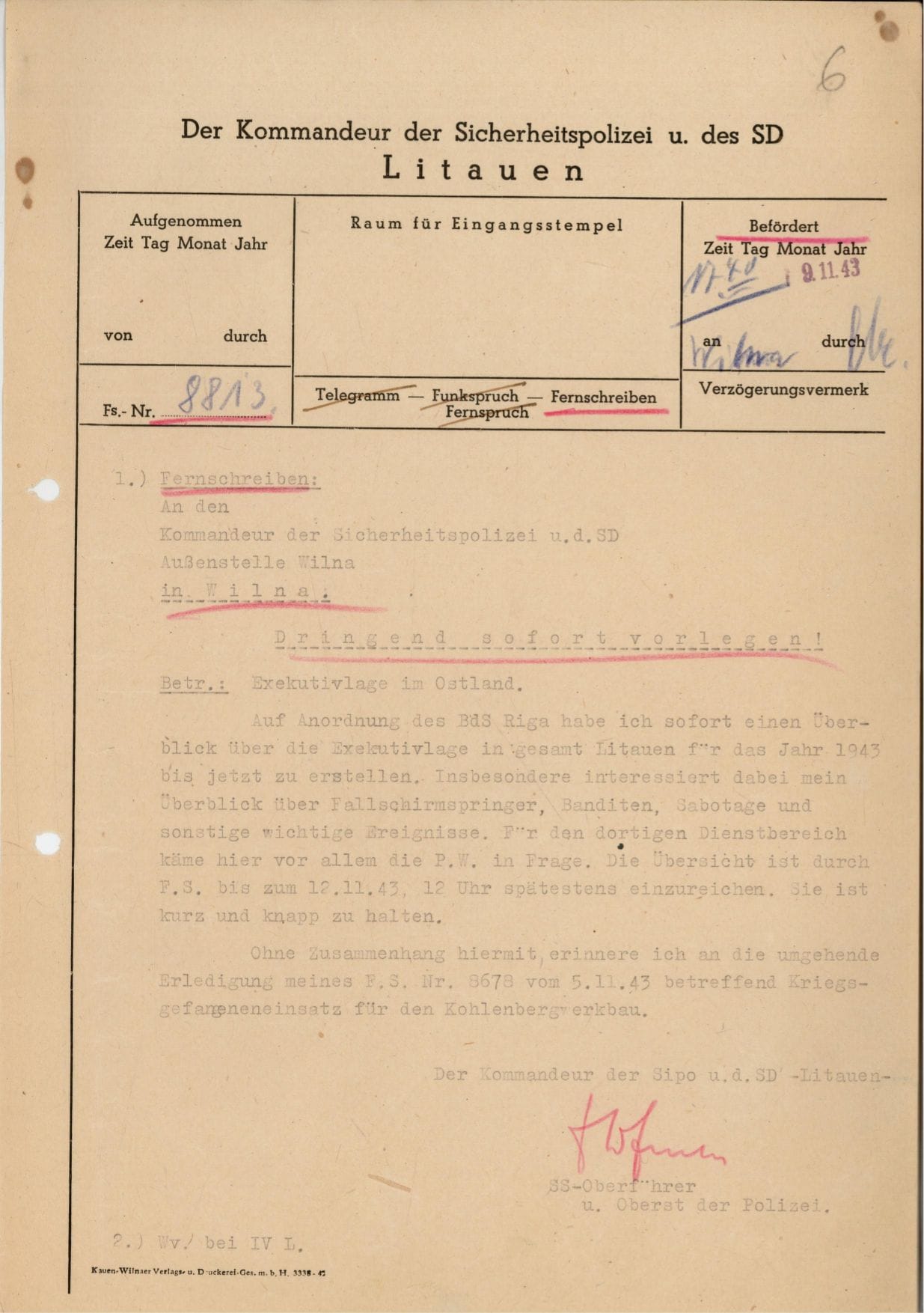


Der Kommandeur der Sicherheitspolizei u. des SD
Litauen
Befördert
Zeit Tag Monat Jahr
17 40 9.11.43
an durch
Wilna [?]
Fs.-Nr. 8813
Telegramm — Funkspruch — Fernschreiben — Fernspruch
1.) Fernschreiben:
An den
Kommandeur der Sicherheitspolizei u.d.SD
Außenstelle Wilna
in Wilna.
Dringend sofort vorlegen!
Betr.: Exekutivlage im Ostland.
Auf Anordnung des BdS Riga habe ich sofort einen Überblick über die Exekutivlage in gesamt Litauen für das Jahr 1943 bis jetzt zu erstellen. Insbesondere interessiert dabei mein Überblick über Fallschirmspringer, Banditen, Sabotage und sonstige wichtige Ereignisse. Für den dortigen Dienstbereich käme hier vor allem die P.W. in Frage. Die Übersicht ist durch F.S. bis zum 12.11.43, 12 Uhr spätestens einzureichen. Sie ist kurz und knapp zu halten.
Ohne Zusammenhang hiermit, erinnere ich an die umgehende Erledigung meines F.S. Nr. 8678 vom 5.11.43 betreffend Kriegsgefangeneneinsatz für den Kohlenbergwerkbau.
Der Kommandeur der Sipo u.d.SD Litauen
[Unterschrift]
SS-Oberführer u. Oberst der Polizei.
2.) WV. bei IV L.
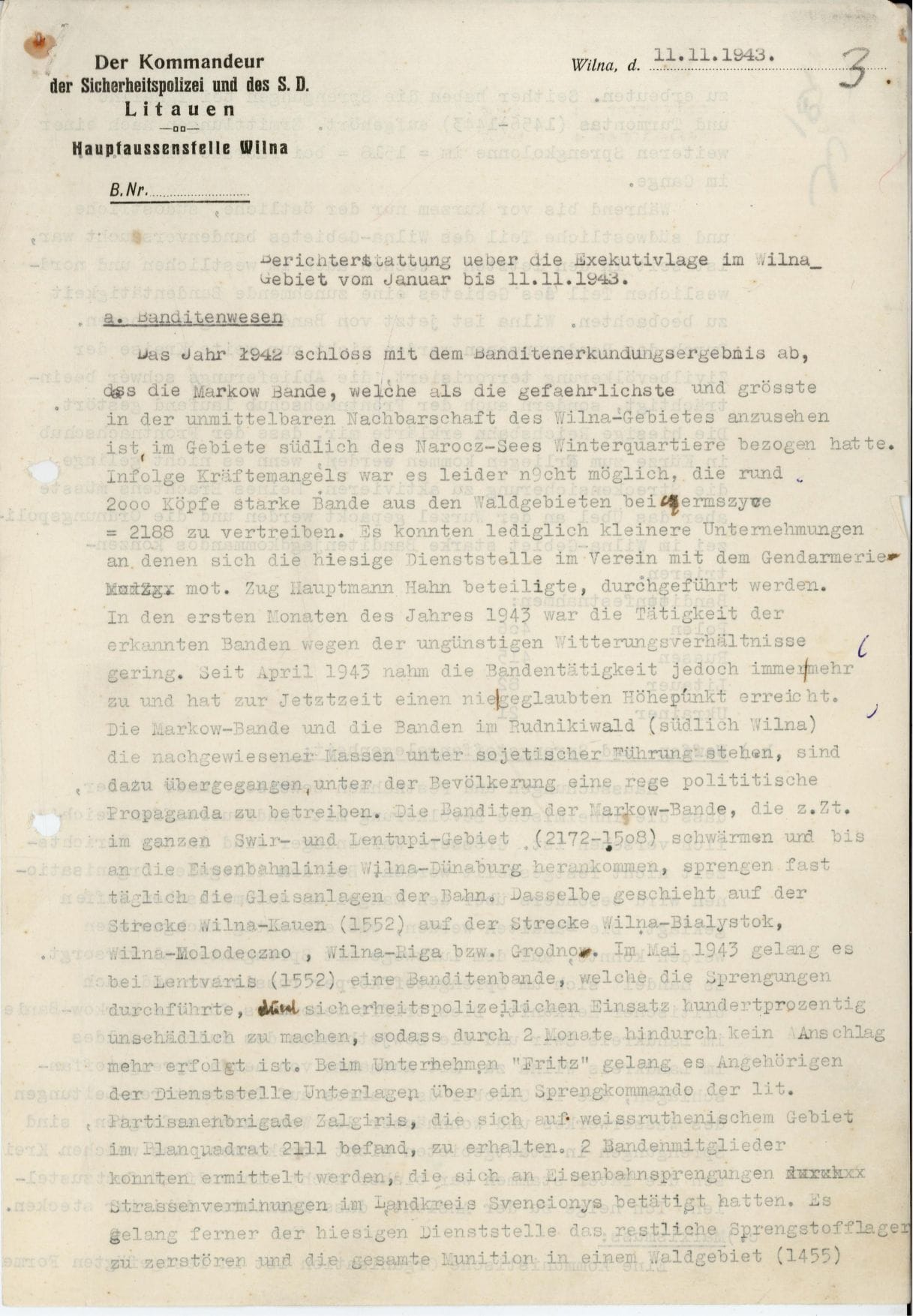
Der Kommandeur der Sicherheitspolizei und des S.D. Litauen
Hauptaussenstelle Wilna
Wilna, d. 11.11.1943.
B.Nr.
Berichterstattung ueber die Exekutivlage im Wilna-Gebiet vom Januar bis 11.11.1943.
a. Banditenwesen
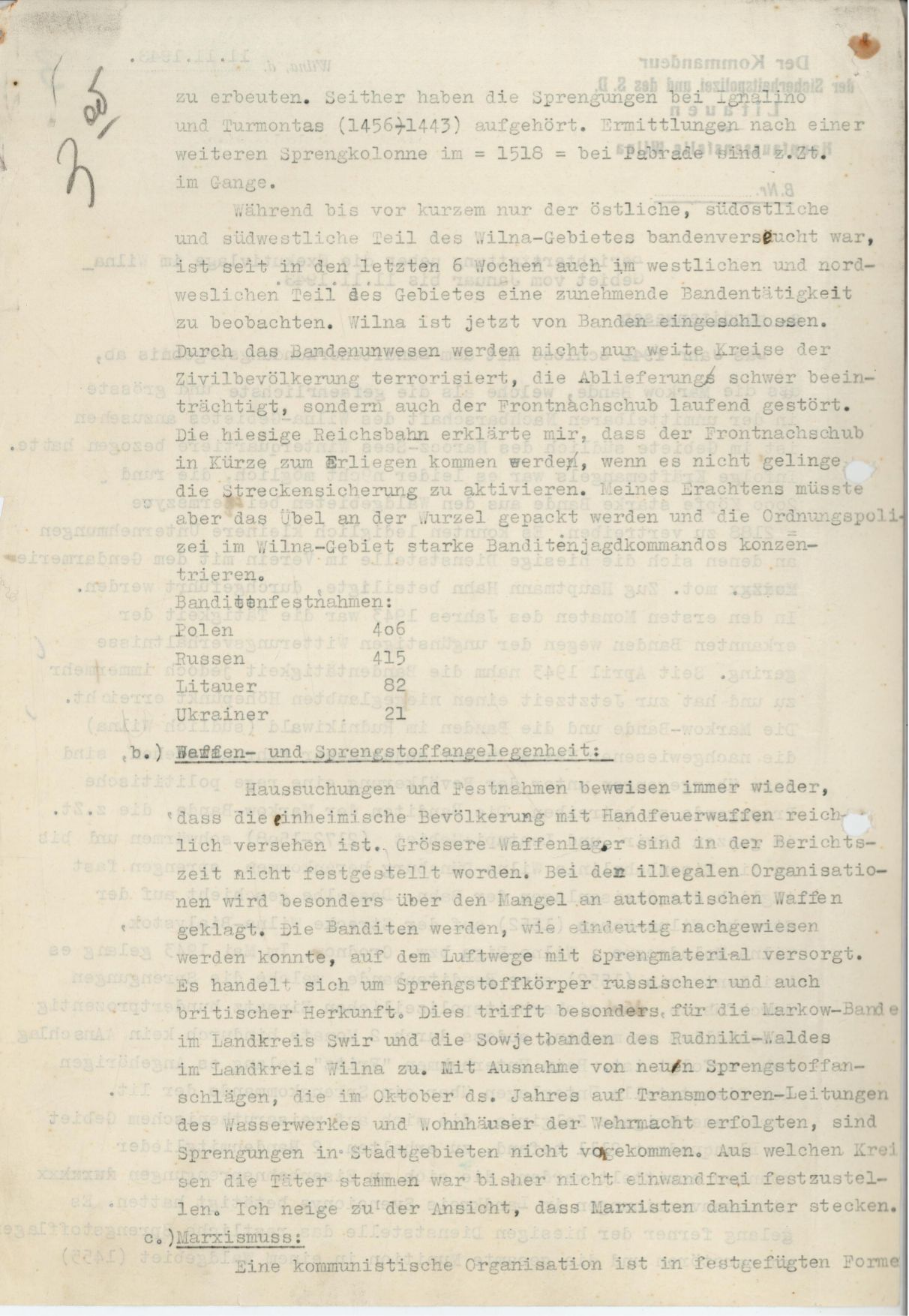
Das Jahr 1942 schloss mit dem Banditenerkundungsergebnis ab, dass die Markow Bande, welche als die gefährlichste und grösste in der unmittelbaren Nachbarschaft des Wilna-Gebietes anzusehen ist, im Gebiete südlich des Narocz-Sees Winterquartiere bezogen hatte. Infolge Kräftemangels war es leider nicht möglich, die rund 2000 Köpfe starke Bande aus den Waldgebieten bei Sviermszye = 2188 zu vertreiben. Es konnten lediglich kleinere Unternehmungen an denen sich die hiesige Dienststelle in Verein mit dem Gendarmerie-mot.Zug Hauptmann Hahn beteiligte, durchgeführt werden. In den ersten Monaten des Jahres 1943 war die Tätigkeit der erkannten Banden wegen der ungünstigen Witterungsverhältnisse gering. Seit April 1943 nahm die Bandentätigkeit jedoch immermehr zu und hat zur Jetztzeit einen niegeglaubten Höhepunkt erreicht. Die Markow-Bande und die Banden im Rudnikiwald (südlich Wilna) die nachgewiesener Massen unter sowjetischer Führung stehen, sind dazu übergegangen, unter der Bevölkerung eine rege politische Propaganda zu betreiben. Die Banditen der Markow-Bande, die z.Zt. im ganzen Swir- und Lentupi-Gebiet (2172-1508) schwärmen und bis an die Eisenbahnlinie Wilna-Dünaburg herankommen, sprengen fast täglich die Gleisanlagen der Bahn. Dasselbe geschieht auf der Strecke Wilna-Kaün (1552), auf der Strecke Wilna-Bialystok, Wilna-Molodeczno, Wilna-Riga bzw. Grodno. Im Mai 1943 gelang es bei Lentvaris (1552) eine Banditenbande, welche die Sprengungen durchführte, durch sicherheitspolizeilichen Einsatz hundertprozentig unschädlich zu machen, sodass durch 2 Monate hindurch kein Anschlag mehr erfolgt ist. Beim Unternehmen „Fritz“ gelang es Angehörigen der Dienststelle Unterlagen über ein Sprengkommando der lit. Partisanenbrigade Zalgiris, die sich auf weissruthenischem Gebiet im Planquadrat 2111 befand, zu erhalten. 2 Bandenmitglieder konnten ermittelt werden, die sich an Eisenbahnsprengungen und Strassenverminungen im Landkreis Svencionys betätigt hatten. Es gelang ferner der hiesigen Dienststelle das restliche Sprengstofflager zu zerstören und die gesamte Munition in einem Waldgebiet (1455) zu erbeuten. Seither haben die Sprengungen bei Ignalino und Turmontas (1456-1443) aufgehört. Ermittlungen nach einer weiteren Sprengkolonne im = 1518 = bei Pebrade sind z.Zt. im Gange.
Während bis vor kurzem nur der östliche, südostliche und südwestliche Teil des Wilna-Gebietes bandenverseucht war, ist seit in den letzten 6 Wochen auch im westlichen und nordwestlichen Teil des Gebietes eine zunehmende Bandentätigkeit zu beobachten. Wilna ist jetzt von Banden eingeschlossen. Durch das Bandenunwesen werden nicht nur weite Kreise der Zivilbevölkerung terrorisiert, die Ablieferung schwer beeinträchtigt, sondern auch der Frontnachschub laufend gestört. Die hiesige Reichsbahn erklärte mir, dass der Frontnachschub in Kürze zum Erliegen kommen werde, wenn es nicht gelinge die Streckensicherung zu aktivieren. Meines Erachtens müsste aber das übel an der Wurzel gepackt werden und die Ordnungspolizei im Wilna-Gebiet starke Banditenjagdkommandos konzentrieren.
Banditenfestnahmen:
Polen 406
Russen 415
Litauer 82
Ukrainer 21
b.) Waffen- und Sprengstoffangelegenheit
Haussuchungen und Festnahmen beweisen immer wieder, dass die einheimische Bevölkerung mit Handfeürwaffen reichlich versehen ist. Grössere Waffenlager sind in der Berichtszeit nicht festgestellt worden. Bei den illegalen Organisationen wird besonders über den Mangel an automatischen Waffen geklagt. Die Banditen werden, wie eindeutig nachgewiesen werden konnte, auf dem Luftwege mit Sprengmaterial versorgt. Es handelt sich um Sprengstoffkörper russischer und auch britischer Herkunft. Dies trifft besonders für die Markow-Bande im Landkreis Swir und die Sowjetbanden des Rudniki-Waldes im Landkreis Wilna zu. Mit Ausnahme von neün Sprengstoffanschlägen, die im Oktober ds. Jahres auf Transmotoren-Leitungen des Wasserwerkes und Wohnhäuser der Wehrmacht erfolgten, sind Sprengungen in Stadtgebieten nicht vorgekommen. Aus welchen Kreisen die Täter stammen war bisher nicht einwandfrei festzustellen. Ich neige zu der Ansicht, dass Marxisten dahinter stecken.
c.) Marxismus:
Eine kommunistische Organisation ist in festgefügten Formen im Wilna-Gebiet bisher nicht festgestellt worden. Kommunistische Kreise halten locker zusammen, treiben Mundpropaganda und suchen Verbindung zu Banditen. Die Flugblattpropaganda kommunistischer Kreise ist gering. Lediglich am 1. Mai 1943 hat die P.P.S. ein primitives Flugblatt in geringer Anzahl verbreitet. Im Zuge der Sabotagebekämpfung sind 74 Personen festgenommen worden.
d.) Fallschirmspringer:
Die erkannte Tätigkeit der Fallschirmspringer war lediglich im Gebiete des Rudniki-Waldes erheblicher. 5 Russen und ein Litauer sind als Fallschirmspringer erkannt und entsprechend behandelt worden.
e.) Juden:
Das Wilna-Ghetto beherbergte mit den kleineren Ghettos im Landgebiete insgesamt 24 180 Juden., hiervon wurden bis zum heutigen Tage 8019 Juden, Jüdinnen und Judenkinder exekutiert. Für den Arbeitseinsatz in das Ölschiefergebiet Vaivara wurden 14000 Juden erfasst und im Sammeltransport verschickt. Z.Zt. befinden sich im Wilna-Stadtgebiet noch 2382 und im Landgebiet 1720 Juden.
f.) Lit. Wiederstandbewegung.
Während die lit. Widerstandsbewegung in der ersten Jahreshälfte 1943 eine immer feindlichere gehässige Propaganda gegen das Reich entfachte und besonders bei Aufstellung der lit. SS-Legion in vielen Flugblättern eine offene britenfreundliche Propaganda betrieb, sodass Vergeltungsmassnahmen notwendig wurden, ist in den letzten Monaten insbesondere seit Beginn der Absetzbewegungen im Osten eine starke Beunruhigung eingetreten. Die lit. Bevölkerung bespricht ausschliesslich die Ereignisse im Osten und kam zur Erkenntnis, dass nur der deutsche Soldat die lit. Heimat vor den Sowjets zu schützen vermag.
g.) Polnische Wiederstandsbewegung:
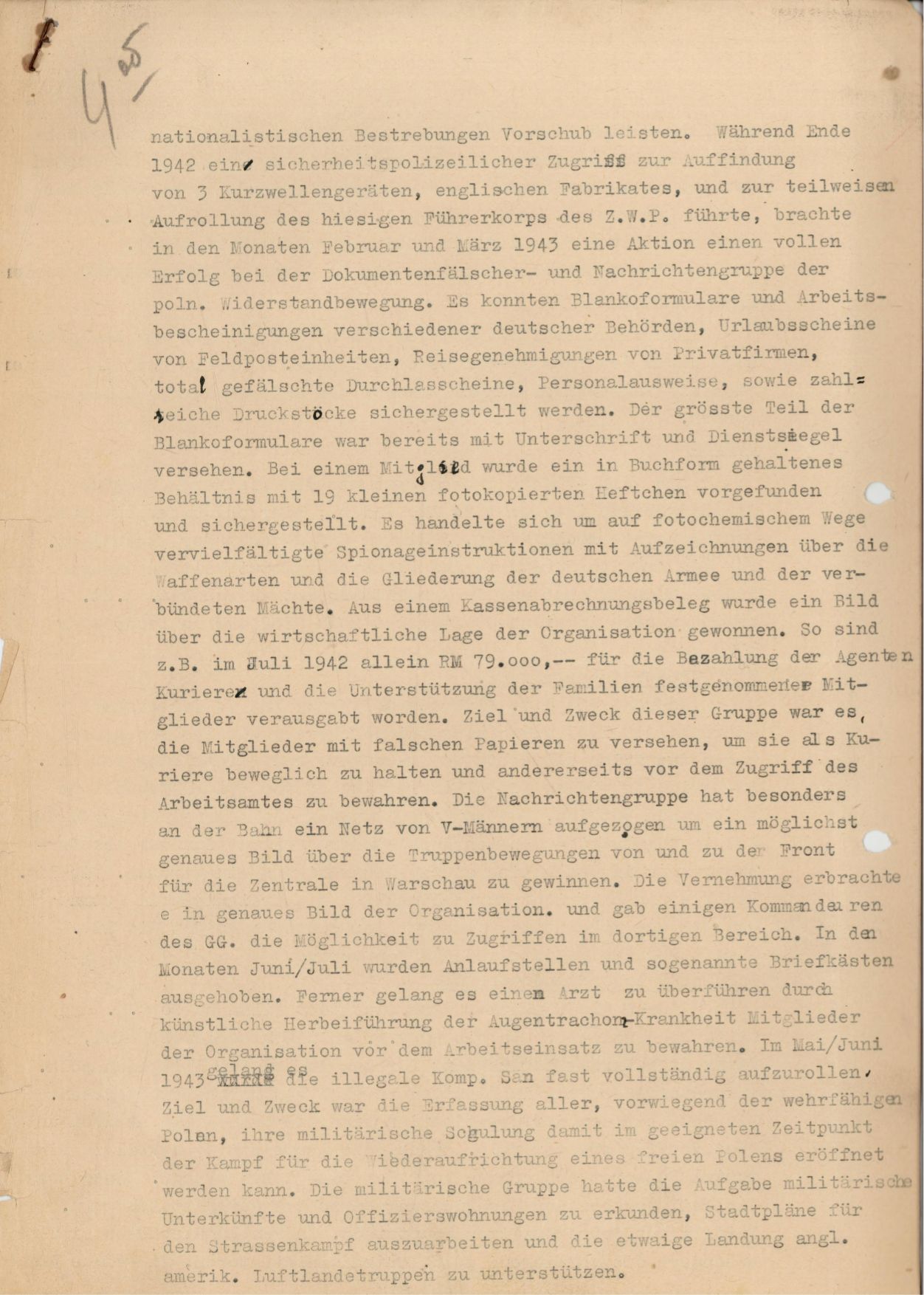
Durch die Tatsache, dass die Stadt Wilna zu 80 v.H. und weite Landgebiete zu 50 bis 90 v.H. polnisch besiedelt sind, waren die Voraussetzungen für den Aufbau der illegalen poln. Widerstandsbewegung im hiesigen Bereich von vorneherein gegeben. Die Hauptstützen der Organisation sind die ehemaligen aktiven und Reserveoffiziere der poln. Armee, die heute zum Grossteil in einer äusserst schlechten sozialen Lage leben müssen. Hinzu kommt ein Teil der bei der Beschiessung Warschaus geflüchteten poln. Intelligenz der ehemaligen Hauptstadt. In den Landgebieten sind es besonders die vorwiegend poln. Gutsadministratoren, die welche den nationalistischen Bestrebungen Vorschub leisten. Während Ende 1942 ein sicherheitspolizeilicher Zugriff zur Auffindung von 3 Kurzwellengeräten, englischen Fabrikates, und zur teilweisen Aufrollung des hiesigen Führerkorps des Z.W.P. führte, brachte in den Monaten Februar und März 1943 eine Aktion einen vollen Erfolg bei der Dokumentenfälscher- und Nachrichtengruppe der poln. Widerstandsbewegung. Es konnten Blankoformulare und Arbeitsbescheinigungen verschiedener deutscher Behörden, Urlaubsscheine von Feldposteinheiten, Reisegenehmigungen von Privatfirmen, total gefälschte Durchlasscheine, Personalausweise, sowie zahlreiche Druckstöcke sichergestellt werden. Der grösste Teil der Blankoformulare war bereits mit Unterschrift und Dienstsiegel versehen. Bei einem Mitglied wurde ein in Buchform gehaltenes Behältnis mit 19 kleinen fotokopierten Heftchen vorgefunden und sichergestellt. Es handelte sich um auf fotochemischem Wege vervielfältigte Spionageinstruktionen mit Aufzeichnungen über die Waffenarten und die Gliederung der deutschen Armee und der verbündeten Mächte. Aus einem Kassenabrechnungsbeleg wurde ein Bild über die wirtschaftliche Lage der Organisation gewonnen. So sind z.B. im Juli 1942 allein RM 79.000,– für die Bezahlung der Agenten, Kuriere und die Unterstützung der Familien festgenommener Mitglieder verausgabt worden. Ziel und Zweck dieser Gruppe war es, die Mitglieder mit falschen Papieren zu versehen, um sie als Kuriere beweglich zu halten und andererseits vor dem Zugriff des Arbeitsamtes zu bewahren. Die Nachrichtengruppe hat besonders an der Bahn ein Netz von V-Männern aufgezogen um ein möglichst genaüs Bild über die Truppenbewegungen von und zu der Front für die Zentrale in Warschau zu gewinnen. Die Vernehmung erbrachte ein genaüs Bild der Organisation. und gab einigen Kommandeuren des GG. die Möglichkeit zu Zugriffen im dortigen Bereich. In den Monaten Juni/Juli wurden Anlaufstellen und sogenannte Briefkästen ausgehoben. Ferner gelang es einen Arzt zu überführen durch künstliche Herbeiführung der Augentrachom-Krankheit Mitglieder der Organisation vor dem Arbeitseinsatz zu bewahren. Im Mai/Juni 1943 gelang es die illegale Komp. San fast vollständig aufzurollen. Ziel und Zweck war die Erfassung aller, vorwiegend der wehrfähigen Polen, ihre militärische Schulung damit im geeigneten Zeitpunkt der Kampf für die Wiederaufrichtung eines freien Polens eröffnet werden kann. Die militärische Gruppe hatte die Aufgabe militärische Unterkünfte und Offizierswohnungen zu erkunden, Stadtpläne für den Strassenkampf auszuarbeiten und die etwaige Landung angl. amerik. Luftlandetruppen zu unterstützen.
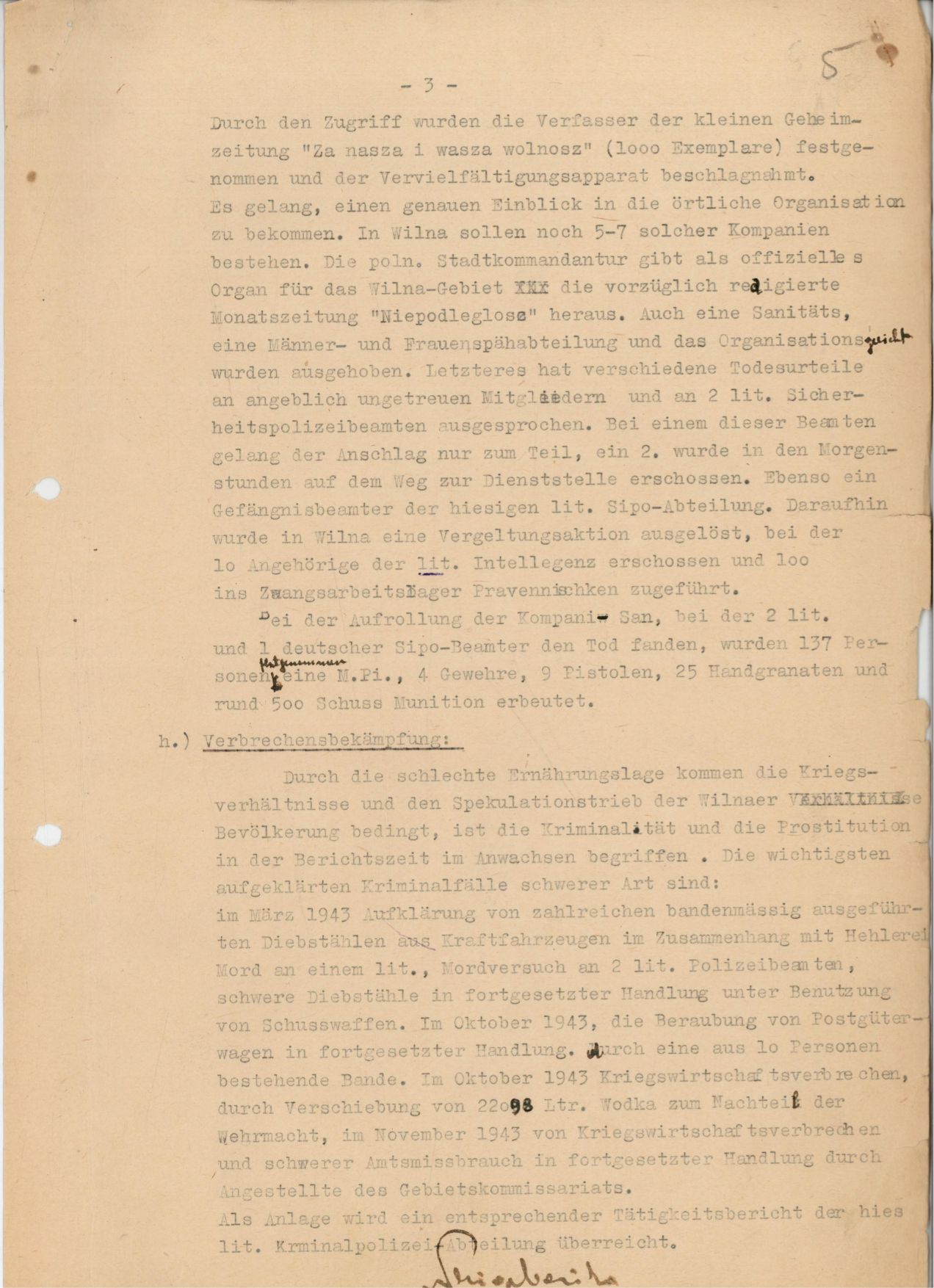
Durch den Zugriff wurden die Verfasser der kleinen Geheimzeitung “Za nasza i wasza wolnosz” (1000 Exemplare) festgenommen und der Vervielfältigungsapparat beschlagnahmt. Es gelang, einen genaün Einblick in die örtliche Organisation zu bekommen. In Wilna sollen noch 5-7 solcher Kompanien bestehen. Die poln. Stadtkommandantur gibt als offizielles Organ für das Wilna-Gebiet die vorzüglich redigierte Monatszeitung “Niepodleglose” heraus. Auch eine Sanitäts, eine Männer- und Fraünspionabteilung und das Organisationsgericht wurden ausgehoben. Letzteres hat verschiedene Todesurteile an angeblich ungetreün Mitgliedern und an 2 lit. Sicherheitspolizeibeamten ausgesprochen. Bei einem dieser Beamten gelang der Anschlag nur zum Teil, ein 2. wurde in den Morgenstunden auf dem Weg zur Dienststelle erschossen. Ebenso ein Gefängnisbeamter der hiesigen lit. Sipo-Abteilung. Daraufhin wurde in Wilna eine Vergeltungsaktion ausgelöst, bei der 10 Angehörige der lit. Intelligenz erschossen und 100 ins Zwangsarbeitslager Pravienischken zugeführt.
Bei der Aufrollung der Kompanie San, bei der 2 lit. und 1 deutscher Sipo-Beamter den Tod fanden, wurden 137 Personen, eine M.Pi., 4 Gewehre, 9 Pistolen, 25 Handgranaten und rund 500 Schuss Munition erbeutet.
h.) Verbrechensbekämpfung:
Durch die schlechte Ernährungslage kommen die Kriegsverhältnisse und den Spekulationstrieb der Wilnär Bevölkerung bedingt, ist die Kriminalität und die Prostitution in der Berichtszeit im Anwachsen begriffen. Die wichtigsten aufgeklärten Kriminalfälle schwerer Art sind: im März 1943 Aufklärung von zahlreichen bandenmässig ausgeführten Diebstählen aus Kraftfahrzeugen im Zusammenhang mit Hehlerei, Mord an einem lit., Mordversuch an 2 lit. Polizeibeamten, schwere Diebstähle in fortgesetzter Handlung unter Benutzung von Schusswaffen. Im Oktober 1943, die Beraubung von Postgüterwagen in fortgesetzter Handlung durch eine aus 10 Personen bestehende Bande. Im Oktober 1943 Kriegswirtschaftsverbrechen, durch Verschiebung von 22098 ltr. Wodka zum Nachteil der Wehrmacht, im November 1943 von Kriegswirtschaftsverbrechen und schwerer Amtsmissbrauch in fortgesetzter Handlung durch Angestellte des Gebietskommissariats.
Als Anlage wird ein entsprechender Tätigkeitsbericht der hies. lit. Kriminalpolizei-Abteilung überreicht.
[Unterschrift]
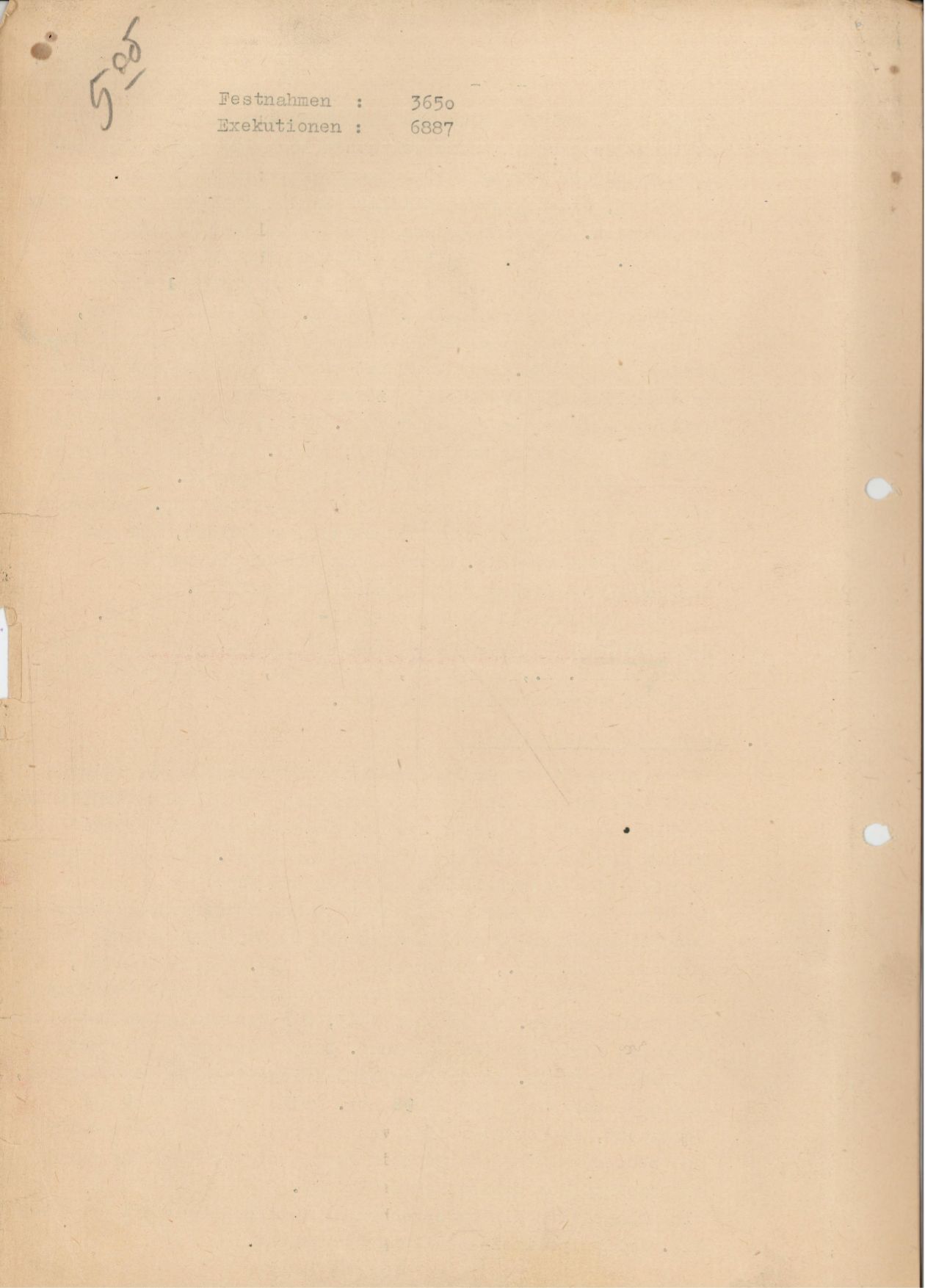
Festnahmen : 3650
Exekutionen : 6887
The Commander of the Security Police and the SD
Lithuania
Dispatched
Time Day Month Year
17:40 9.11.43
to / via
Wilna [?]
Teletype No. 8813
Telegram — Radio Message — Teletype — Telephone Message
1.) Teletype:
To the
Commander of the Security Police and SD
External Office Vilna
in Vilna.
Urgent — submit immediately!
Subject: Executive/security situation in Ostland.
By order of the BdS Riga, I am to prepare immediately an overview of the executive/security situation in all of Lithuania for the year 1943 up to the present. Of particular interest in this overview are parachutists, bandits, sabotage, and other important incidents. For your area of responsibility, the P.W. would be of primary relevance here. The overview is to be submitted by teletype no later than 12 November 1943, 12:00 noon. It is to be kept brief and concise.
Unrelated to this matter, I remind you of the immediate completion of my teletype no. 8678 of 5 November 1943 concerning the deployment of prisoners of war for coal mine construction.
The Commander of the Sipo and SD Lithuania
[signature]
SS Senior Leader and Colonel of Police.
2.) To be resubmitted to IV L.
The Commander of the Security Police and the SD, Lithuania
Main External Office Vilna
Vilna, 11 November 1943
Ref. No.
Report on the executive/security situation in the Vilna district from January to 11 November 1943.
a. Banditry
The year 1942 concluded with the finding of the anti-bandit reconnaissance that the Markov band, which is to be regarded as the most dangerous and largest in the immediate vicinity of the Vilna district, had taken up winter quarters in the area south of Lake Narocz. Due to lack of manpower, it was unfortunately not possible to drive the band, numbering approximately 2,000 men, out of the forest regions near Sviermszye = 2188. Only smaller operations could be carried out, in which the local office participated together with the motorized gendarmerie platoon of Captain Hahn.
In the first months of 1943, the activity of the identified bands was slight because of unfavorable weather conditions. Since April 1943, however, bandit activity has steadily increased and has now reached a level previously thought impossible. The Markov band and the bands in the Rudniki Forest (south of Vilna), which demonstrably operate under Soviet leadership, have begun conducting intensive political propaganda among the population.
The bandits of the Markov band, who are currently swarming throughout the Swir and Lentupi region (2172–1508) and are reaching as far as the Vilna–Dünaburg railway line, are blowing up railway tracks almost daily. The same is occurring on the Vilna–Kaunas line (1552), on the Vilna–Białystok, Vilna–Molodeczno, Vilna–Riga, and Grodno routes. In May 1943, near Lentvaris (1552), it proved possible through a Security Police operation to neutralize completely a band of bandits responsible for the demolitions, so that for two months no further attack occurred.
During operation “Fritz,” members of the local office succeeded in obtaining documents concerning a demolition commando of the Lithuanian partisan brigade Zalgiris, which was located in White Ruthenian territory in grid square 2111. Two band members were identified who had been involved in railway demolitions and road mining in the Svencionys district. Furthermore, the local office succeeded in destroying the remaining explosives depot and capturing all ammunition in a forest area (1455). Since then, the demolitions near Ignalino and Turmontas (1456–1443) have ceased. Investigations concerning another demolition column in = 1518 = near Pebrade are currently underway.
Whereas until recently only the eastern, southeastern, and southwestern parts of the Vilna district had been infested by bands, increasing bandit activity has also been observed during the last six weeks in the western and northwestern parts of the district. Vilna is now encircled by bands. Through this bandit menace, not only are broad sections of the civilian population terrorized and deliveries severely impeded, but front-line supply traffic is continuously disrupted. The local Reich Railway informed me that front-line supply traffic would shortly come to a standstill unless railway security could be activated. In my opinion, however, the evil would have to be tackled at its root, and the Order Police in the Vilna district would need to concentrate strong anti-bandit hunting detachments.
Bandit arrests:
Poles: 406
Russians: 415
Lithuanians: 82
Ukrainians: 21
b.) Weapons and explosives matters
House searches and arrests repeatedly prove that the native population is abundantly supplied with small firearms. No larger weapons depots were discovered during the reporting period. Illegal organizations complain especially about the lack of automatic weapons. The bandits, as could be clearly demonstrated, are being supplied with explosives by air. These are explosive devices of Russian and also British origin. This applies particularly to the Markov band in the Swir district and the Soviet bands in the Rudniki Forest in the Vilna district.
With the exception of nine explosive attacks carried out in October of this year against transmission lines of the waterworks and Wehrmacht residential buildings, no explosions have occurred in urban areas. It has not yet been conclusively determined from which circles the perpetrators originate. I am inclined to the view that Marxists are behind them.
c.) Marxism
A communist organization in fixed organizational form has not yet been identified in the Vilna district. Communist circles associate loosely together, spread word-of-mouth propaganda, and seek contact with bandits. Communist leaflet propaganda is slight. Only on 1 May 1943 did the P.P.S. distribute a primitive leaflet in small numbers. In the course of anti-sabotage operations, 74 persons were arrested.
d.) Parachutists
Recognized parachutist activity was significant only in the Rudniki Forest area. Five Russians and one Lithuanian were identified as parachutists and treated accordingly.
e.) Jews
The Vilna Ghetto, together with the smaller ghettos in the rural district, housed a total of 24,180 Jews. Of these, up to the present day, 8,019 Jews, Jewesses, and Jewish children have been executed. For labor deployment to the Vaivara oil shale region, 14,000 Jews were registered and dispatched in collective transports. At present there remain 2,382 Jews in the city district of Vilna and 1,720 in the rural district.
f.) Lithuanian resistance movement
Whereas during the first half of 1943 the Lithuanian resistance movement increasingly stirred up hostile and hateful propaganda against the Reich and, especially during the formation of the Lithuanian SS Legion, conducted openly pro-British propaganda in many leaflets—making retaliatory measures necessary—a strong sense of unease has arisen in recent months, particularly since the beginning of the withdrawals in the East. The Lithuanian population discusses exclusively the events in the East and has come to the realization that only the German soldier is capable of protecting the Lithuanian homeland against the Soviets.
g.) Polish resistance movement
Because the city of Vilna is inhabited by 80 percent Poles, and large rural areas by 50 to 90 percent Poles, the prerequisites for the development of the illegal Polish resistance movement in this area existed from the outset. The principal supports of the organization are former active and reserve officers of the Polish Army, most of whom today live under extremely poor social conditions. Added to this is part of the Polish intelligentsia that fled Warsaw during the shelling of the former capital. In the rural areas, it is especially the predominantly Polish estate administrators who promote nationalist aspirations.
Whereas at the end of 1942 a Security Police operation led to the discovery of three shortwave radios of English manufacture and to the partial roll-up of the local leadership corps of the Z.W.P., an operation in February and March 1943 achieved complete success against the document-forging and intelligence group of the Polish resistance movement. Blank forms and employment certificates from various German authorities, leave passes from field-post units, travel permits from private firms, completely forged transit passes, identity cards, and numerous printing plates were confiscated. The greater part of the blank forms already bore signatures and official seals.
In the possession of one member there was discovered and confiscated a book-shaped container holding 19 small photocopied booklets. These consisted of photochemically reproduced espionage instructions containing notes on weapon types and on the organization of the German Army and the allied powers.
From an accounting voucher a picture of the organization’s economic situation was obtained. Thus, for example, in July 1942 alone RM 79,000 were spent for the payment of agents and couriers and for supporting the families of arrested members. The aim and purpose of this group was to provide members with false papers in order to keep them mobile as couriers and at the same time protect them from seizure by the labor office.
The intelligence group especially established a network of informants on the railways in order to obtain as accurate a picture as possible of troop movements to and from the front for the central office in Warsaw. Interrogations yielded a precise picture of the organization and gave several commanders in the General Government the opportunity to conduct operations in their area.
In June and July, contact points and so-called dead letter boxes were uncovered. Furthermore, it proved possible to convict a doctor who had artificially induced trachoma eye disease in members of the organization in order to shield them from labor deployment.
In May and June 1943 it proved possible almost completely to roll up the illegal Company San. Its purpose was the registration of all, predominantly military-age Poles, and their military training so that, at the appropriate moment, the struggle for the reestablishment of a free Poland could begin. The military group had the task of reconnoitering military quarters and officers’ residences, preparing city maps for street fighting, and supporting the possible landing of Anglo-American airborne troops.
As a result of the operation, the authors of the small clandestine newspaper “Za nasza i wasza wolnosz” (1,000 copies) were arrested and the duplicating apparatus confiscated. It proved possible to gain precise insight into the local organization. In Vilna there are reportedly still five to seven such companies in existence.
The Polish city command publishes as the official organ for the Vilna district the excellently edited monthly newspaper “Niepodleglose.” A medical section, a male and female espionage section, and the organizational court were also uncovered. The latter pronounced various death sentences against allegedly disloyal members and against two Lithuanian Security Police officials. In the case of one of these officials, the attack succeeded only partially; a second was shot in the early morning hours on his way to the office. Likewise, a prison official of the local Lithuanian Sipo department was killed.
As a consequence, a retaliatory action was initiated in Vilna during which ten members of the Lithuanian intelligentsia were shot and 100 persons transferred to the Pravienischken forced labor camp.
During the roll-up of Company San, in which two Lithuanian and one German Sipo officials lost their lives, 137 persons, one submachine gun, four rifles, nine pistols, twenty-five hand grenades, and approximately 500 rounds of ammunition were captured.
h.) Crime control
As a consequence of the poor food situation, wartime conditions, and the speculative tendencies of the Vilna population, criminality and prostitution have increased during the reporting period. The most important solved serious criminal cases were:
In March 1943, the solution of numerous gang-organized thefts from motor vehicles in connection with receiving stolen goods; the murder of one Lithuanian; attempted murder of two Lithuanian police officials; and major thefts committed repeatedly with the use of firearms.
In October 1943, the robbery of postal freight wagons committed repeatedly by a gang consisting of ten persons.
In October 1943, war economy crimes through the diversion of 22,098 liters of vodka to the detriment of the Wehrmacht; in November 1943, war economy crimes and serious abuse of office committed repeatedly by employees of the District Commissariat.
As an attachment, a corresponding activity report of the local Lithuanian Criminal Police Department is submitted.
[signature]
Arrests: 3,650
Executions: 6,887
Archivial reference:
Lithuanian Central State Archives (LCVA), R-1399-1/33