Introduction
Willi Lenz, a Schutzpolizei officer born in 1894, was one of the most brutal perpetrators at the Kulmhof (Chełmno) extermination camp. Known as the “Doctor,” he supervised forced laborers in the forest camp, personally shot those who were exhausted or survived the gas vans, and later used his experience in operations to exhume and burn the bodies of Nazi victims. Returning to Kulmhof in 1944, he continued killing prisoners during the liquidation of the Łódź Ghetto. In January 1945, while helping to execute the camp’s remaining Jewish prisoners before the German retreat, Lenz was killed during their resistance in the granary.
The biography below is a shortened version of the longer article published on holocaustcontroversies blog: Willi Lenz: The “Doctor” of the Kulmhof (Chełmno) Extermination Camp
Facts Sheet
Name: Willi Lenz
Birth: 16.07.1894 in Smolarz mill (Orbonik)
Death: 18.01.1945
Function: Commander of Jewish Work Detail in the Forest Camp of Kulmhof extermination camp (December 1941 – April 1943 and in Summer 1944), Commander of Jewish Work Detail of the Wetterkommando exhuming graves in the Warthegau (ca. Autumn 1943 – ca. Spring 1944)
Agency: Schutzpolizei (Protective Police) Posen
Rank: Oberwachtmeiste d. Sch. (before 1926), Hauptwachtmeister d.Sch. (ca. 1937/1938), Meister d.Sch. (30.6.1941)
Memberships: NSDAP (01.05.1937 #424567)
Awards: KVK II m.Schw. (20.05.1944)
Education: ?
Profession: Police officer (since 07.08.1920)
Family: married (17.05.1923), at least 1 child (10.12.1926)

Quotes
Curriculum Vitae
[Note: The biography is a shortened version of the longer article published on holocaustcontroversies blog: Willi Lenz: The “Doctor” of the Kulmhof (Chełmno) Extermination Camp]
Willi Lenz was born on 16 July 1894 at Smolarz Mill in the district of Obornik, Province of Posen, the son of the mill owner Otto Lenz. During the First World War he served in the Silesian Dragoon Regiment “von Bredow” No. 4 on the Eastern and Western Fronts. After the war, when his home region became part of Poland, Lenz relocated to Silesia. In 1920 he entered the Schutzpolizei in Breslau, where he married Ida, a nurse, in 1923; their son Wolfgang was born in 1926.1
Lenz joined the NSDAP in 1937 and advanced within the police. In July 1941 he was transferred to Posen in the annexed Warthegau and promoted to Meister der Schutzpolizei. A few months later, he was selected for a police detachment assigned to SS-Sonderkommando Kulmhof, the extermination unit operating at Chełmno nad Nerem. After signing a secrecy declaration, he arrived there in late November 1941, shortly before mass killing by gas vans began on 8 December.2
At Kulmhof, Lenz became one of the principal perpetrators in the forest camp, where the bodies of murdered victims were unloaded, buried and later burned. He supervised the Jewish working detail and police guards. In the forest camp, he became known as the “Doctor”: Jewish laborers who were exhausted, sick or no longer able to work were sent to him and killed with shots to the back of the neck.3
The available testimony portrays Lenz not merely as an obedient subordinate but as an exceptionally brutal and self-motivated killer. Former colleagues described him as a sadist, a racial fanatic and a man “without inhibitions.” Witnesses recalled that he beat prisoners, threatened subordinate policemen and carried out shootings on his own initiative. Although other members of the Kulmhof staff also committed murders in the forest camp, numerous accounts identify Lenz as one of its most active killers.4
When the first phase of operations at Kulmhof ended in April 1943, Lenz returned to the Schutzpolizei in Posen. His experience in mass killing and corpse disposal soon led to another assignment. From late 1943 he served with the so-called Wetterkommando, a unit connected with Sonderkommando 1005, whose task was to exhume and burn the bodies of victims murdered in the Warthegau. Former members described Lenz as the unit’s practical specialist in locating mass graves and supervising cremation work. He was variously remembered as the “manager” of the commando and as holding a special position as “cremation master.”5
In 1944, Lenz returned to Kulmhof when Hans Bothmann reassembled the Sonderkommando for the destruction of the remaining Jews of the Łódź/Litzmannstadt Ghetto. Once again responsible for the forest-camp working detail, Lenz shot prisoners who could no longer work and victims who survived the gas vans. In postwar testimony, deputy commando leader Walter Piller estimated that Lenz personally killed between 450 and 500 Jews during this phase. On 20 May 1944, Lenz was awarded the War Merit Cross, Second Class with Swords, together with other former members of Sonderkommando Kulmhof. Later that year, he attended a police officer-candidate course at Pelplin.6
In January 1945, as Soviet forces approached, the Kulmhof staff prepared to evacuate and eliminate the remaining witnesses. Forty-seven Jewish prisoners were still confined in a granary near the ruins of the former mansion. During the night of 17–18 January, Lenz and Reserve Sergeant Ernst Haase entered the granary and ordered the prisoners outside in groups of five to be shot. Among the first victims was fourteen-year-old Szymon Srebrnik, who survived a gunshot wound to the head. After several groups had been led out, Mordka Żurawski forced his way through the door and escaped. In the resulting resistance, the remaining prisoners overpowered and killed Lenz and Haase. German guards then fired into the granary and set it on fire.7
Documents


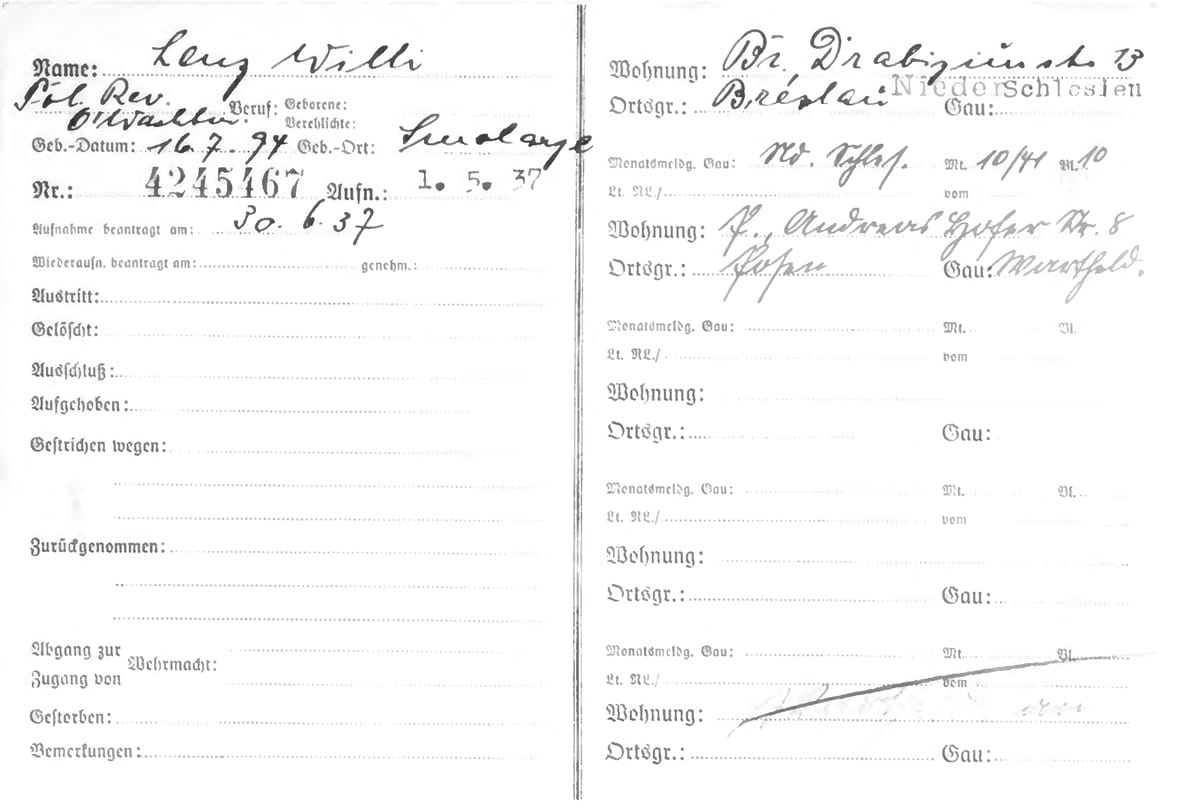
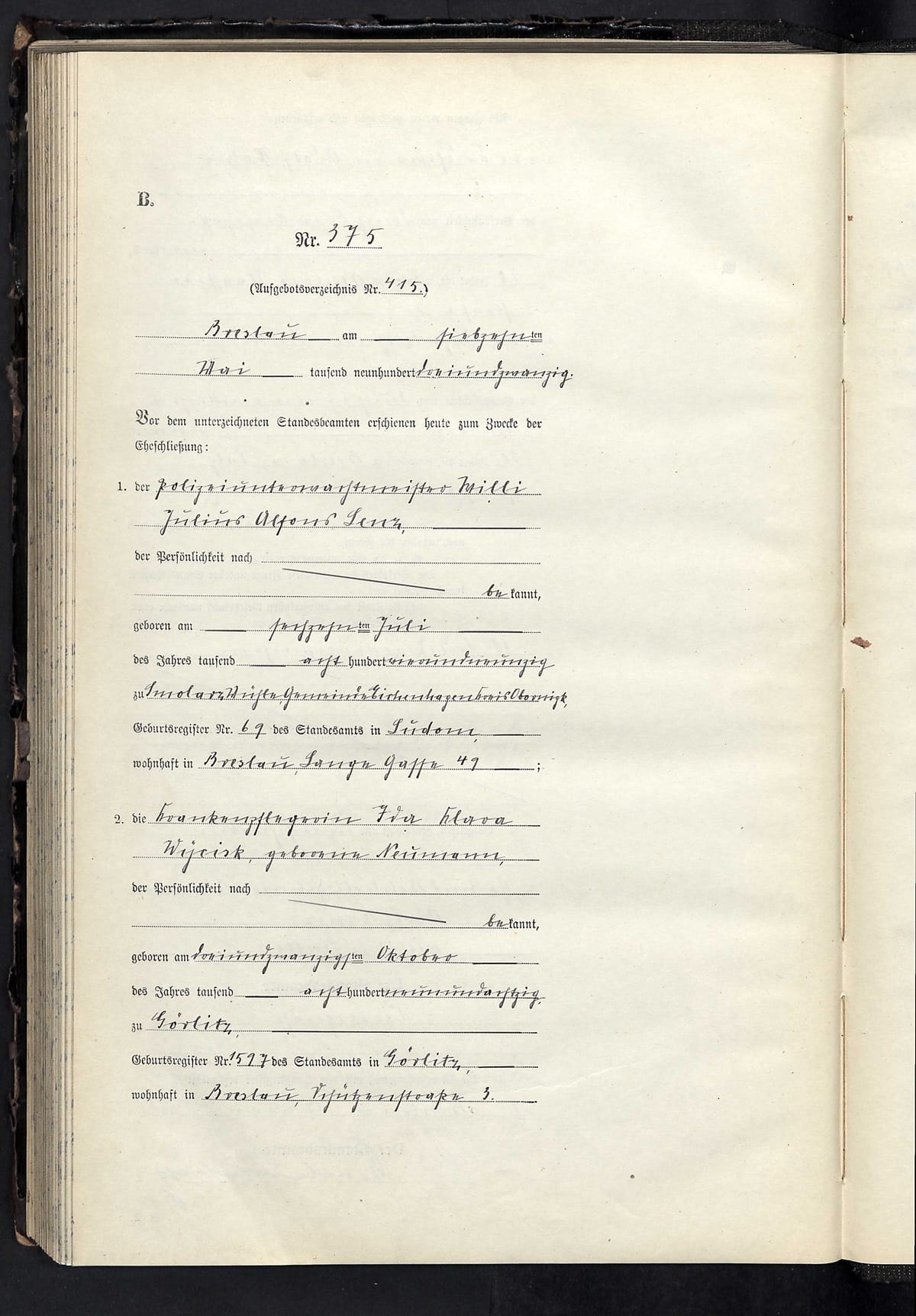
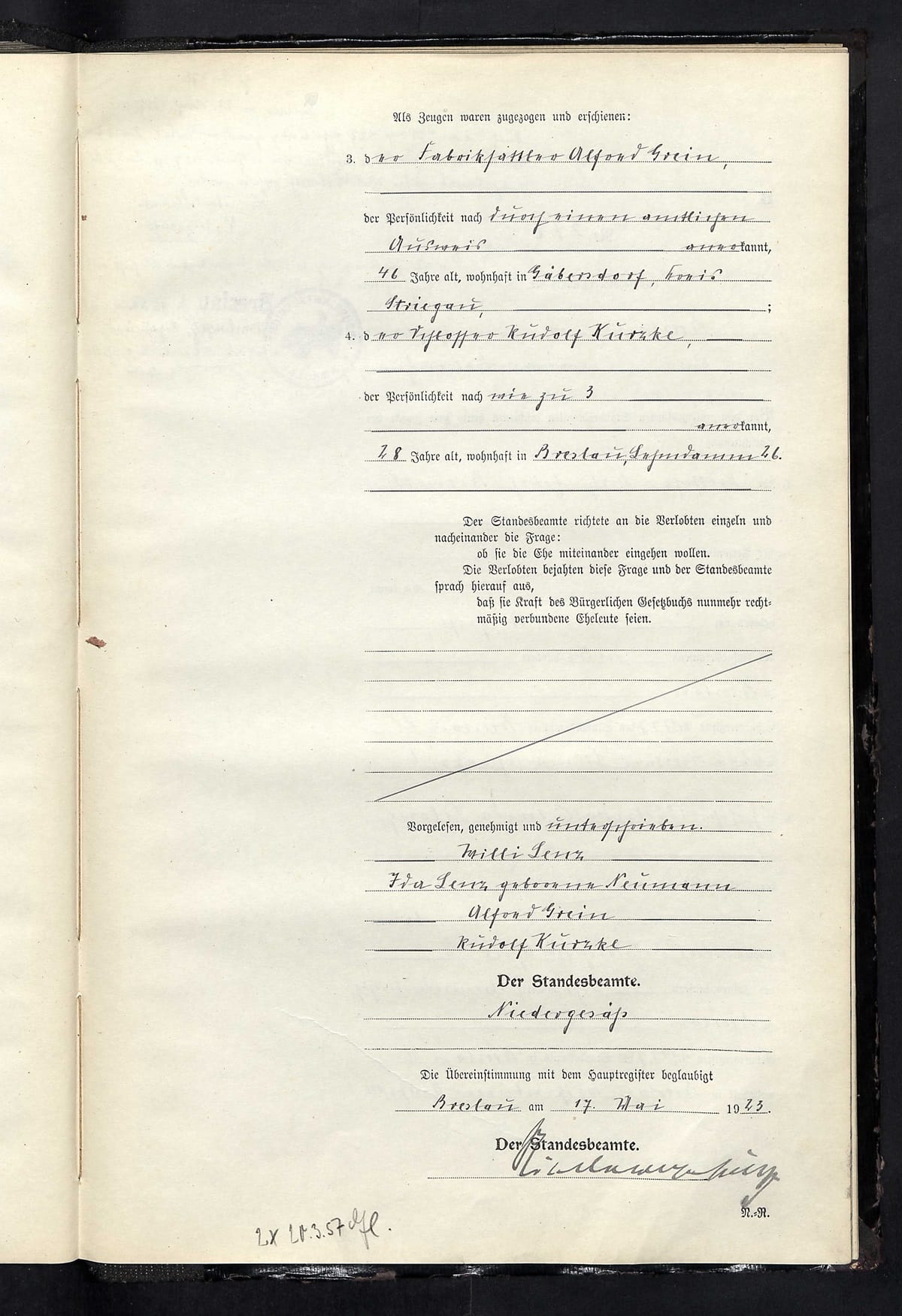


Footnotes
- LA Berlin, Östliche preußische Provinzen, Polen, Personenstandsregister 1874–1945, lfd. Nr. 7377, Urkunde Nr. 375; BArch R 601/2351, pp. 1–3; BArch B 578/28359, p. 9; BArch B 578/36886, p. 9; NSDAP-Gaukartei of Wolfgang Lenz, NARA microfilm N0026, frame 774. ↩︎
- NSDAP-Gaukartei, BArch R 9361-IX KARTEI/2553197; IPN GK 705-16, pp. 15, 30; LA SH, Abt. 352.3, Nr. 16509, statement of Siegfried Süß, 20 February 1963; BArch R 601/2445, pp. 63–64; AIPN GK 165/271, vol. 3, pp. 13, 102. ↩︎
- BArch B 162/3245, statement of Theodor Malzmüller, 27 June 1960; LA SH, Abt. 352.3, Nr. 16507, statement of Fritz Ismer, 5 July 1961; BArch B 162/3246, statement of Fritz Ismer, 9 November 1960; BArch B 162/3249, statement of Josef Islinger, 26 February 1962; LA SH, Abt. 352.3, Nr. 16490, statement of Josef Islinger, 6 May 1964. ↩︎
- AIPN GK 165/271, vol. 1, pp. 51–53, statement of Andrzej Miszczak, 14 June 1945; LA SH, Abt. 352.3, Nr. 15492, statements of Alois Häfele and Kurt Möbius, 3 November 1965; BArch B 162/3248, statement of Kurt Möbius, 23 November 1961; LA SH, Abt. 352.3, Nr. 16516, statement of Friedrich Hensen, 6 February 1964. ↩︎
- Andrej Angrick, »Aktion 1005« — Spurenbeseitigung von NS-Massenverbrechen 1942–1945; StA Hamburg 213-12/007, statement of Johann Legath, 2 April 1962; BArch B 162/25944, statement of Erich Michaelis, 1 February 1961; StA Hamburg 213-12/0597/007, statement of Wilhelm Schmerse, 6 April 1962; YVA O.53/12, statement of Walter Piller, 15 May 1945. ↩︎
- AIPN GK 165/271, vol. 4, pp. 67–70, statement of Bruno Israel, 29 October 1945; YVA O.53/12, statement of Walter Piller, 15 May 1945; BArch ZK-L 484-555; IPN GK 705/27, p. 23. ↩︎
- AIPN GK 165/271, vol. 1, pp. 51–53, statement of Andrzej Miszczak, 14 June 1945; vol. 2, pp. 67–70, statement of Szymon Srebrnik, 29 June 1945; vol. 3, pp. 42–45, statement of Mordka Żurawski, 31 July 1945; Łucja Pawlicka-Nowak, ed., Świadectwa Zagłady, testimonies of Szymon Srebrnik and Mordka Żurawski. ↩︎