Introduction
Interrogation of notorious Auschwitz perpetrator Otto Moll, conducted on April 15–16, 1946. In his statements to U.S. prosecutors at Nuremberg, Moll acknowledged supervising the cremation of bodies at Birkenau in the Summer of 1944. He described the arrival of transports from Hungary, the selection process carried out by SS doctors, and the transfer of those deemed unfit for work to the crematoria. At the same time, he maintained that responsibility for the killings themselves rested with doctors and higher-ranking SS officials. He denied committing any atrocities.
Document


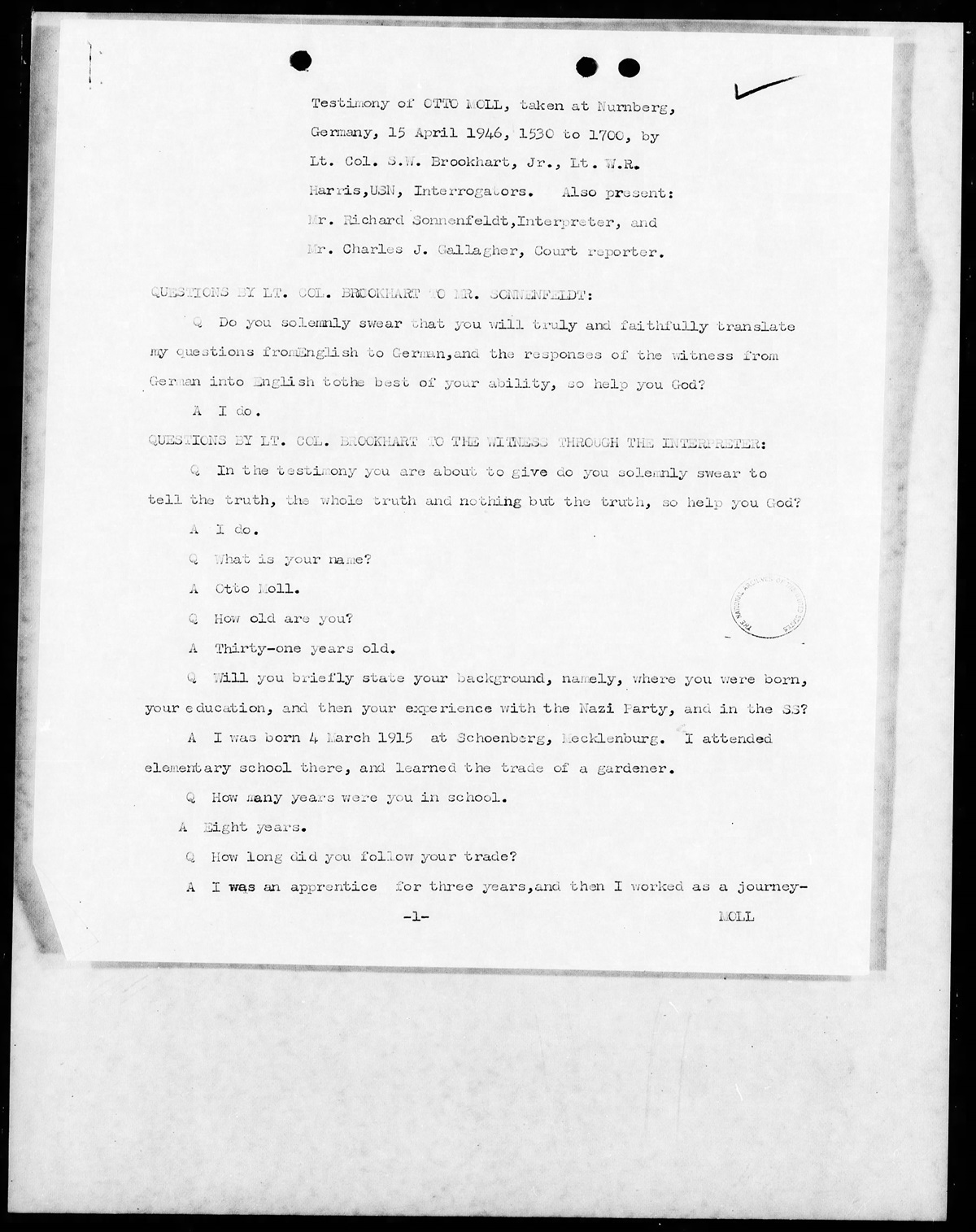
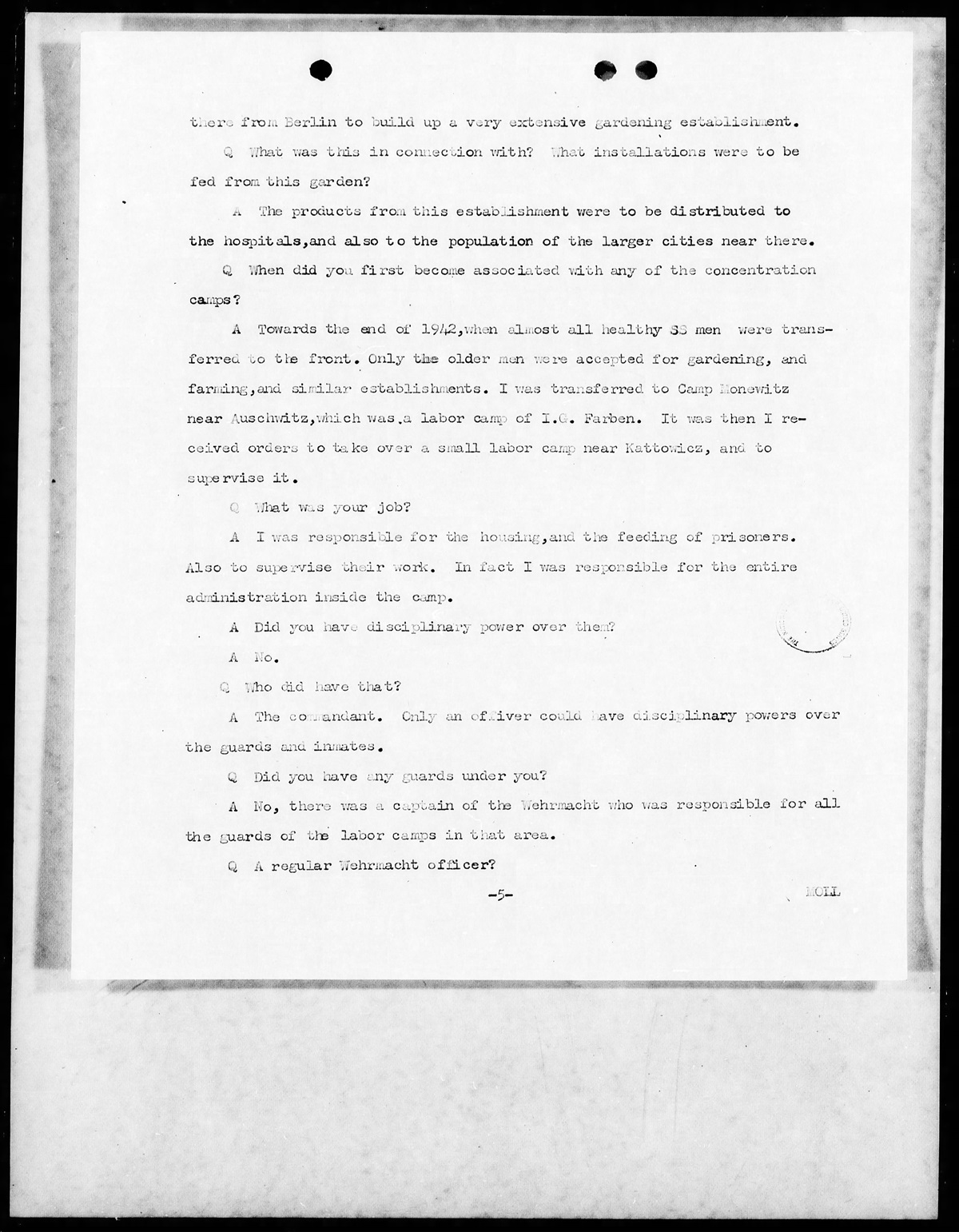
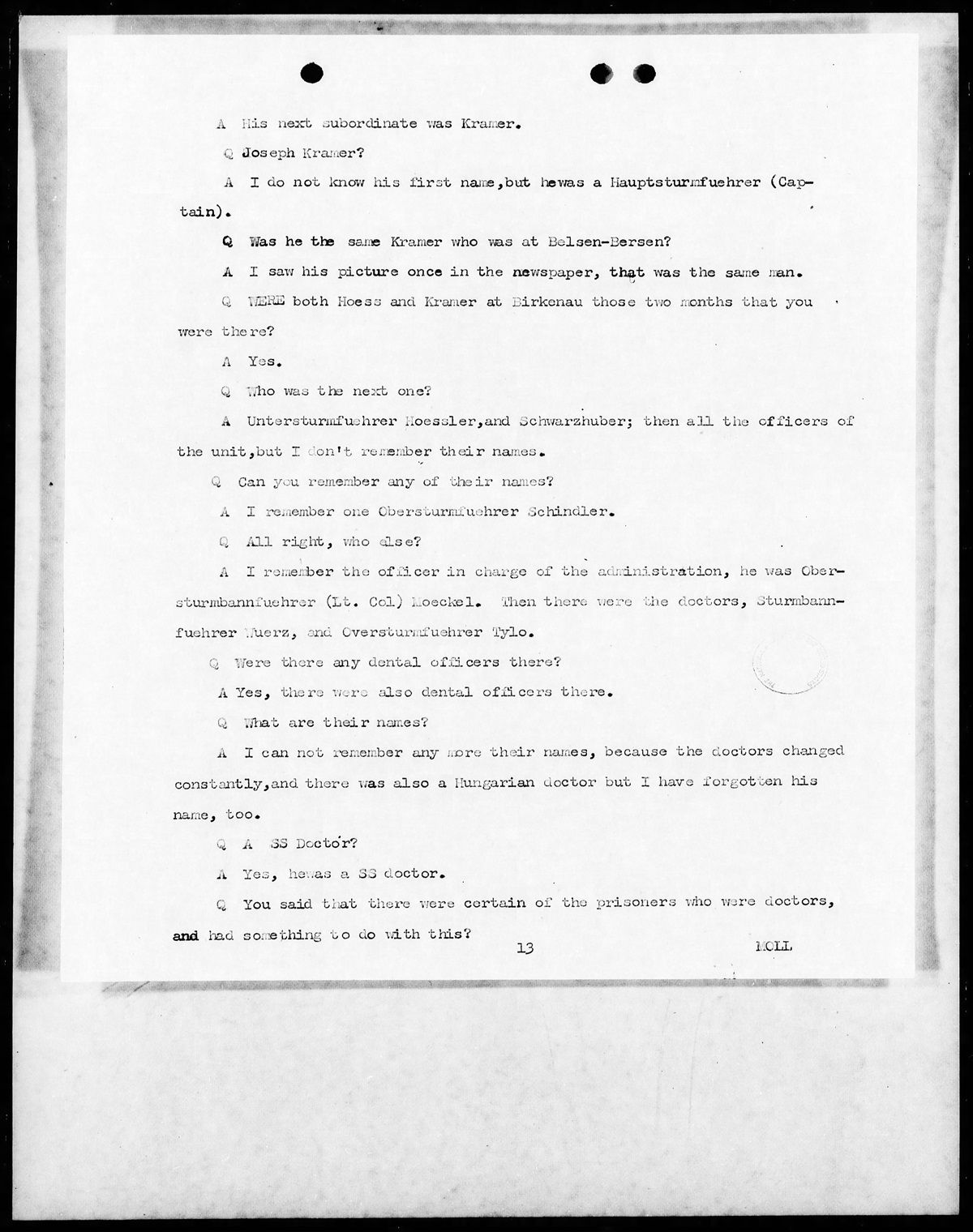
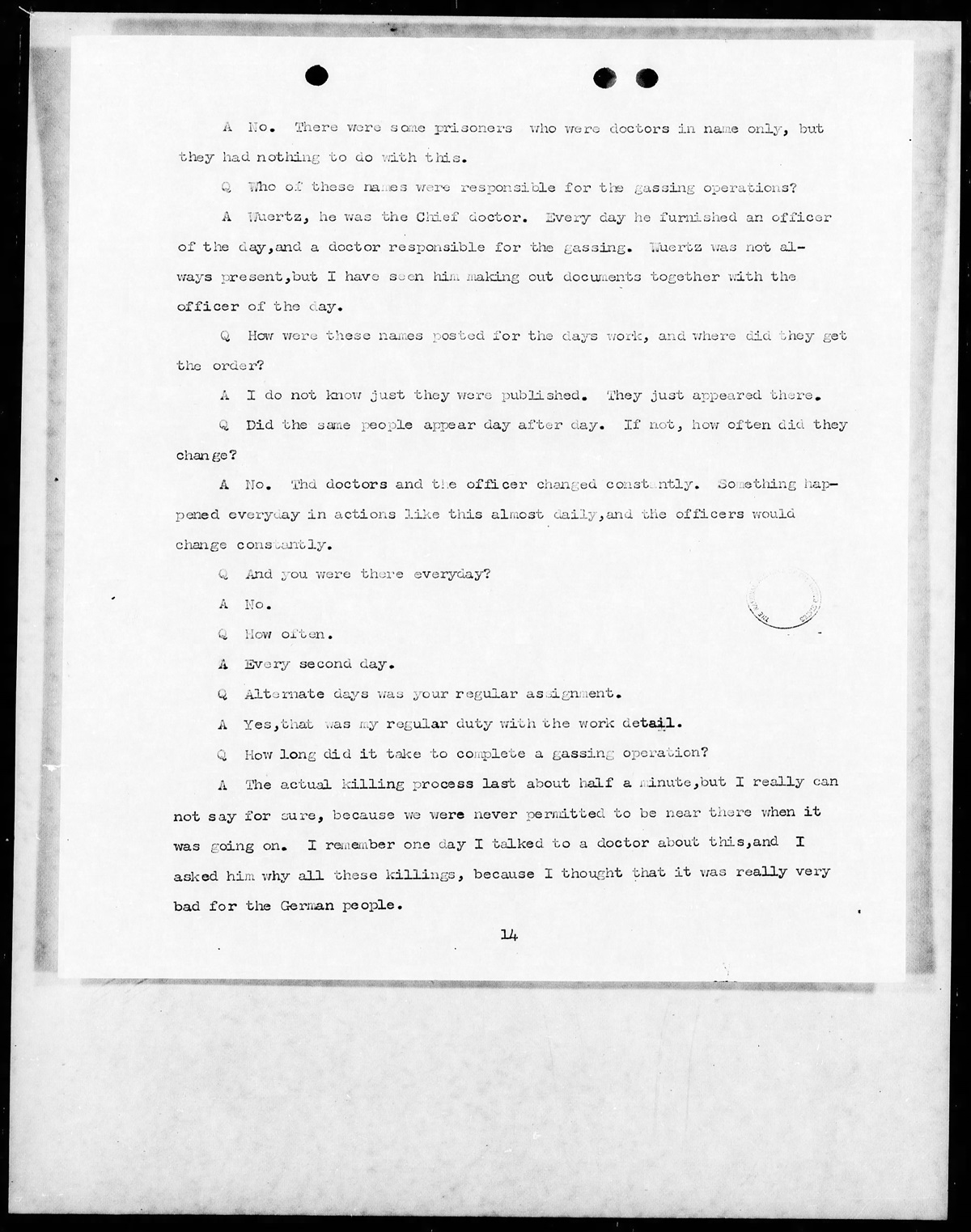
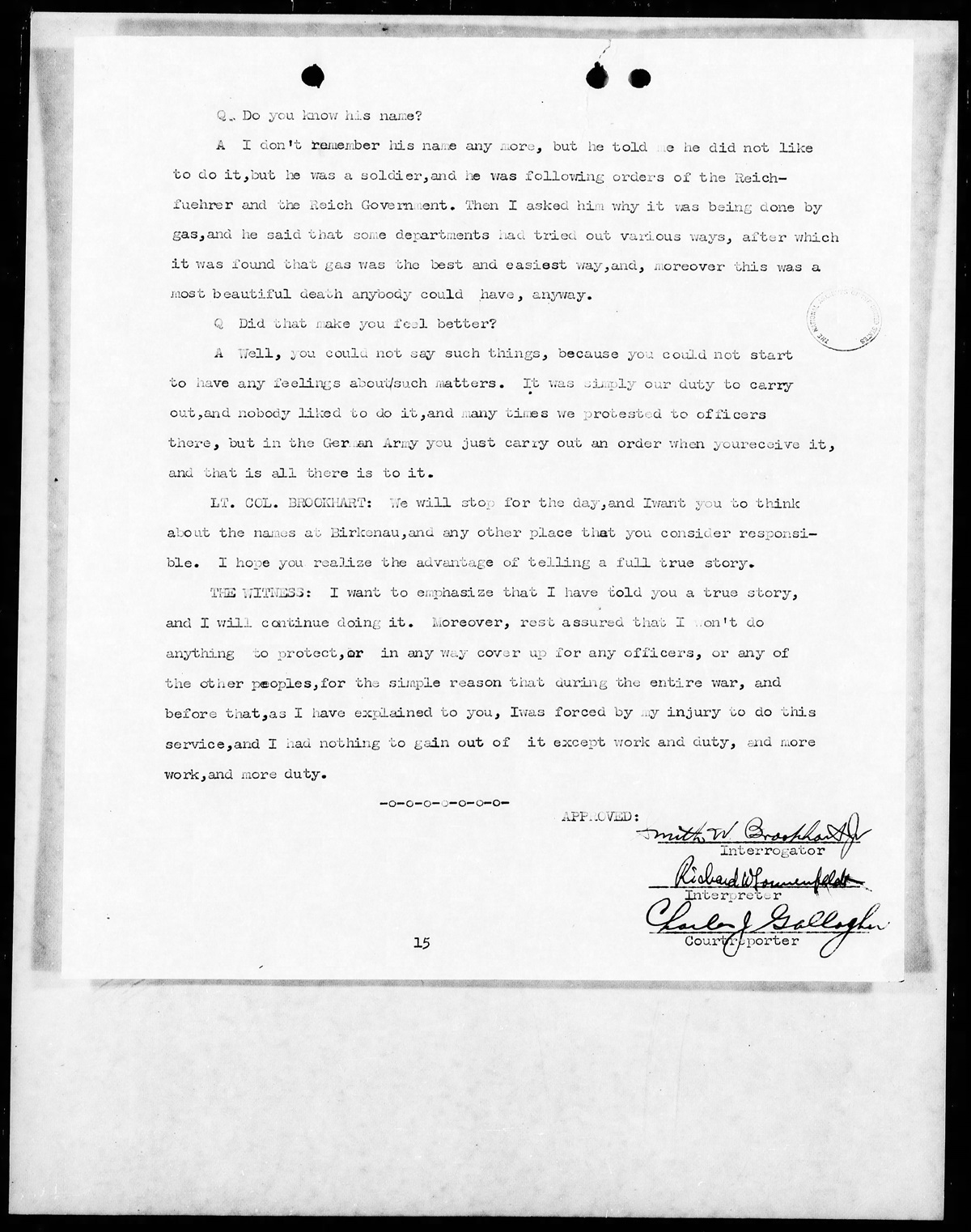


Testimony of OTTO MOLL, taken at Nurnberg, Germany, 15 April 1946, 1530 to 1700, by Lt. Col. S.W. Brookhart, Jr., Lt. W.R. Harris, USN, Interrogators. Also present: Mr. Richard Sonnenfeldt, Interpreter, and Mr. Charles J. Gallagher, Court reporter.
QUESTIONS BY LT. COL. BROOKHART TO MR. SONNENFELDT:
Q Do you solemnly swear that you will truly and faithfully translate my questions from English to German, and the responses of the witness from German into English to the best of your ability, so help you God?
A I do.
QUESTIONS BY LT. COL. BROOKHART TO THE WITNESS THROUGH THE INTERPRETER:
Q In the testimony you are about to give do you solemnly swear to tell the truth, the whole truth and nothing but the truth, so help you God?
A I do.
Q What is your name?
A Otto Moll.
Q How old are you?
A Thirty-one years old.
Q Will you briefly state your background, namely, where you were born, your education, and then your experience with the Nazi Party, and in the SS?
A I was born 4 March 1915 at Schoenberg, Mecklenburg. I attended elementary school there, and learned the trade of a gardener.
Q How many years were you in school.
A Eight years.
Q How long did you follow your trade?
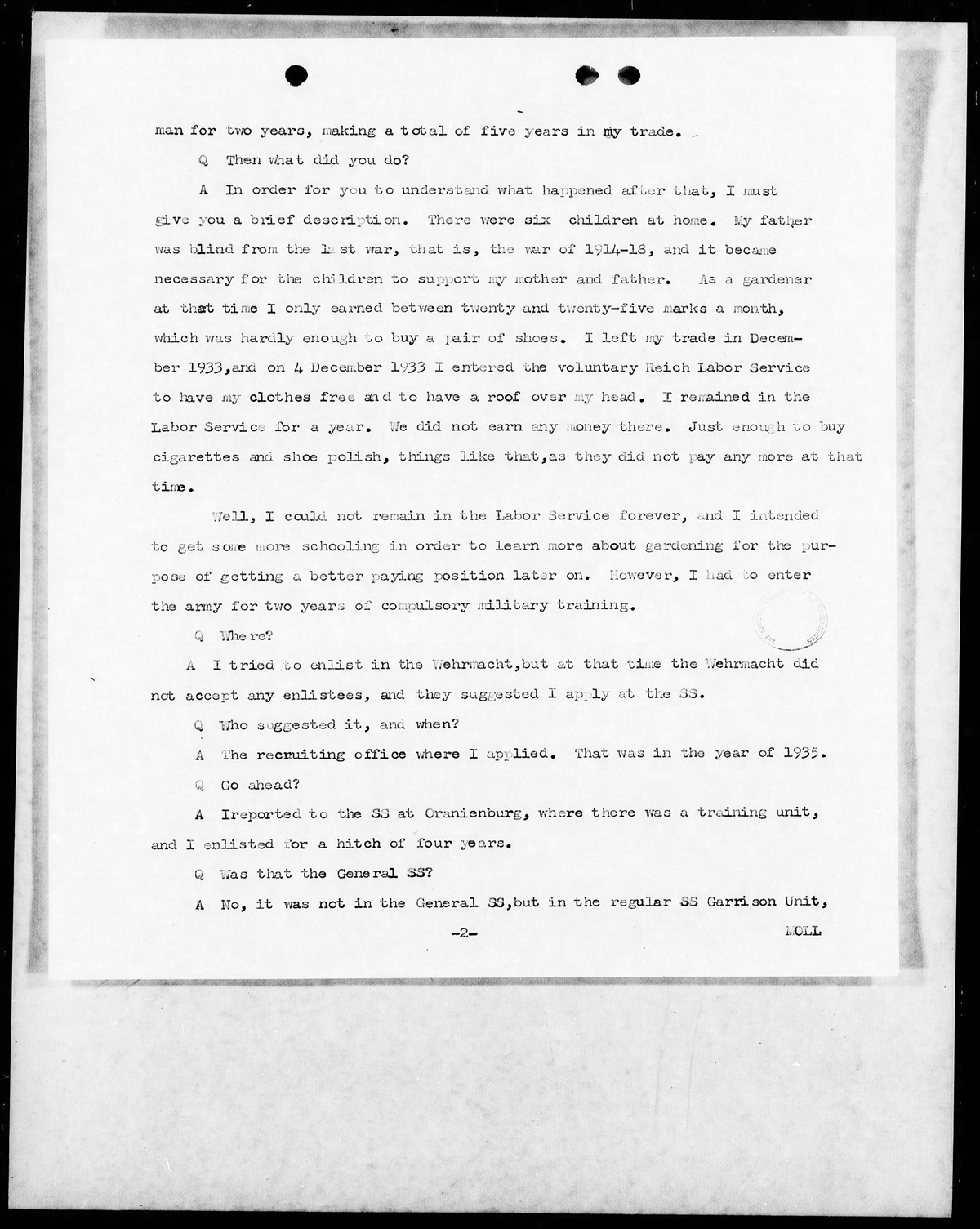
A I was an apprentice for three years, and then I worked as a journey-man for two years, making a total of five years in my trade.
Q Then what did you do?
A In order for you to understand what happened after that, I must give you a brief description. There were six children at home. My father was blind from the last war, that is, the war of 1914-18, and it became necessary for the children to support my mother and father. As a gardener at that time I only earned between twenty and twenty-five marks a month, which was hardly enough to buy a pair of shoes. I left my trade in December 1933, and on 4 December 1933 I entered the voluntary Reich Labor Service to have my clothes free and to have a roof over my head. I remained in the Labor Service for a year. We did not earn any money there. Just enough to buy cigarettes and shoe polish, things like that, as they did not pay any more at that time.
Well, I could not remain in the Labor Service forever, and I intended to get some more schooling in order to learn more about gardening for the purpose of getting a better paying position later on. However, I had to enter the army for two years of compulsory military training.
Q Where?
A I tried to enlist in the Wehrmacht, but at that time the Wehrmacht did not accept any enlistees, and they suggested I apply at the SS.
Q Who suggested it, and when?
A The recruiting office where I applied. That was in the year of 1935.
Q Go ahead?
A I reported to the SS at Oranienburg, where there was a training unit, and I enlisted for a hitch of four years.
Q Was that the General SS?
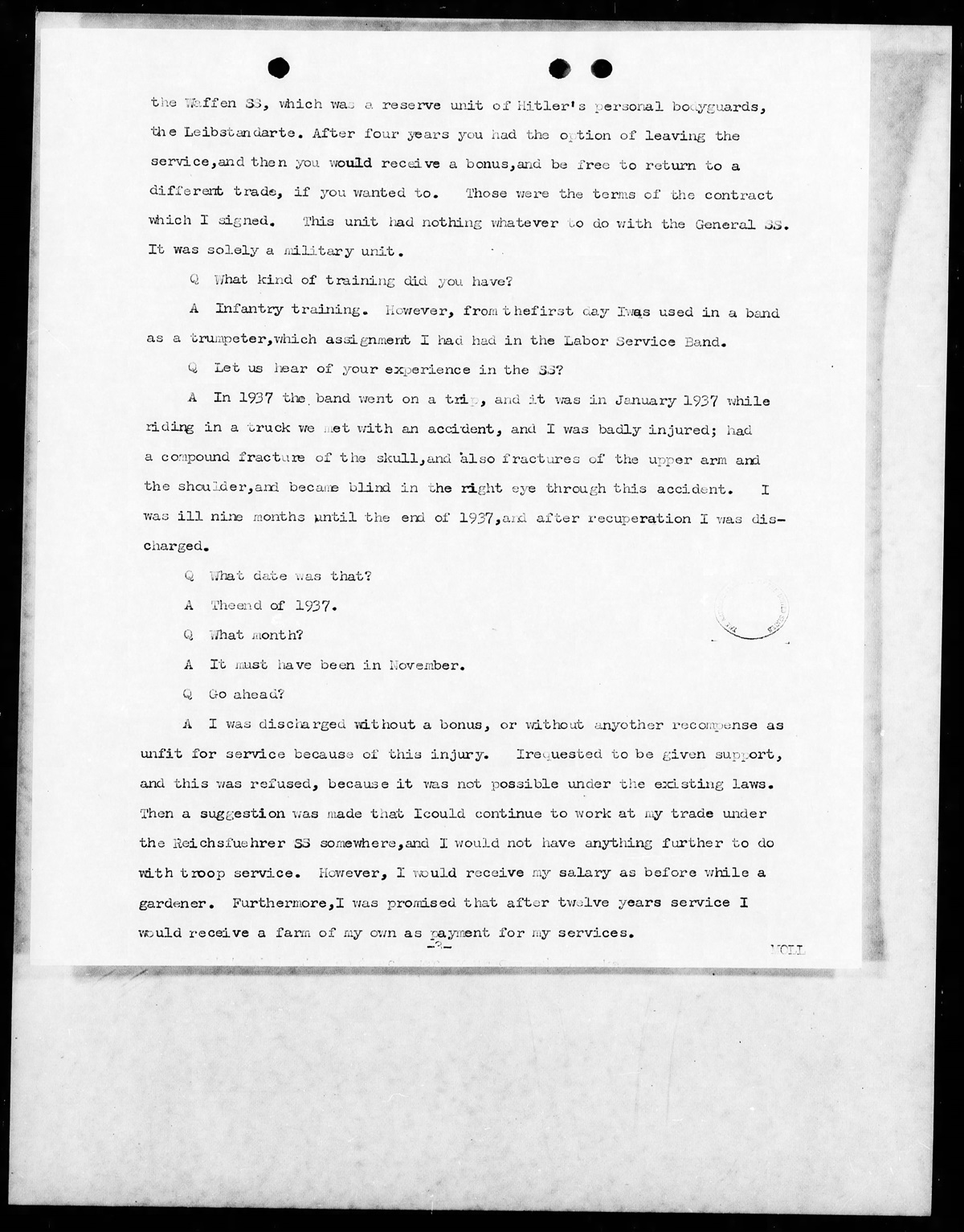
A No, it was not in the General SS, but in the regular SS Garrison Unit,the Waffen SS, which was a reserve unit of Hitler’s personal bodyguards, the Leibstandarte. After four years you had the option of leaving the service, and then you would receive a bonus, and be free to return to a different trade, if you wanted to. Those were the terms of the contract which I signed. This unit had nothing whatever to do with the General SS. It was solely a military unit.
Q What kind of training did you have?
A Infantry training. However, from the first day I was used in a band as a trumpeter, which assignment I had had in the Labor Service Band.
Q Let us hear of your experience in the SS?
A In 1937 the band went on a trip, and it was in January 1937 while riding in a truck we met with an accident, and I was badly injured; had a compound fracture of the skull, and also fractures of the upper arm and the shoulder, and became blind in the right eye through this accident. I was ill nine months until the end of 1937, and after recuperation I was discharged.
Q What date was that?
A The end of 1937.
Q What month?
A It must have been in November.
Q Go ahead?
A I was discharged without a bonus, or without any other recompense as unfit for service because of this injury. I requested to be given support, and this was refused, because it was not possible under the existing laws. Then a suggestion was made that I could continue to work at my trade under the Reichsfuehrer SS somewhere, and I would not have anything further to do with troop service. However, I would receive my salary as before while a gardener. Furthermore, I was promised that after twelve years service I would receive a farm of my own as payment for my services.
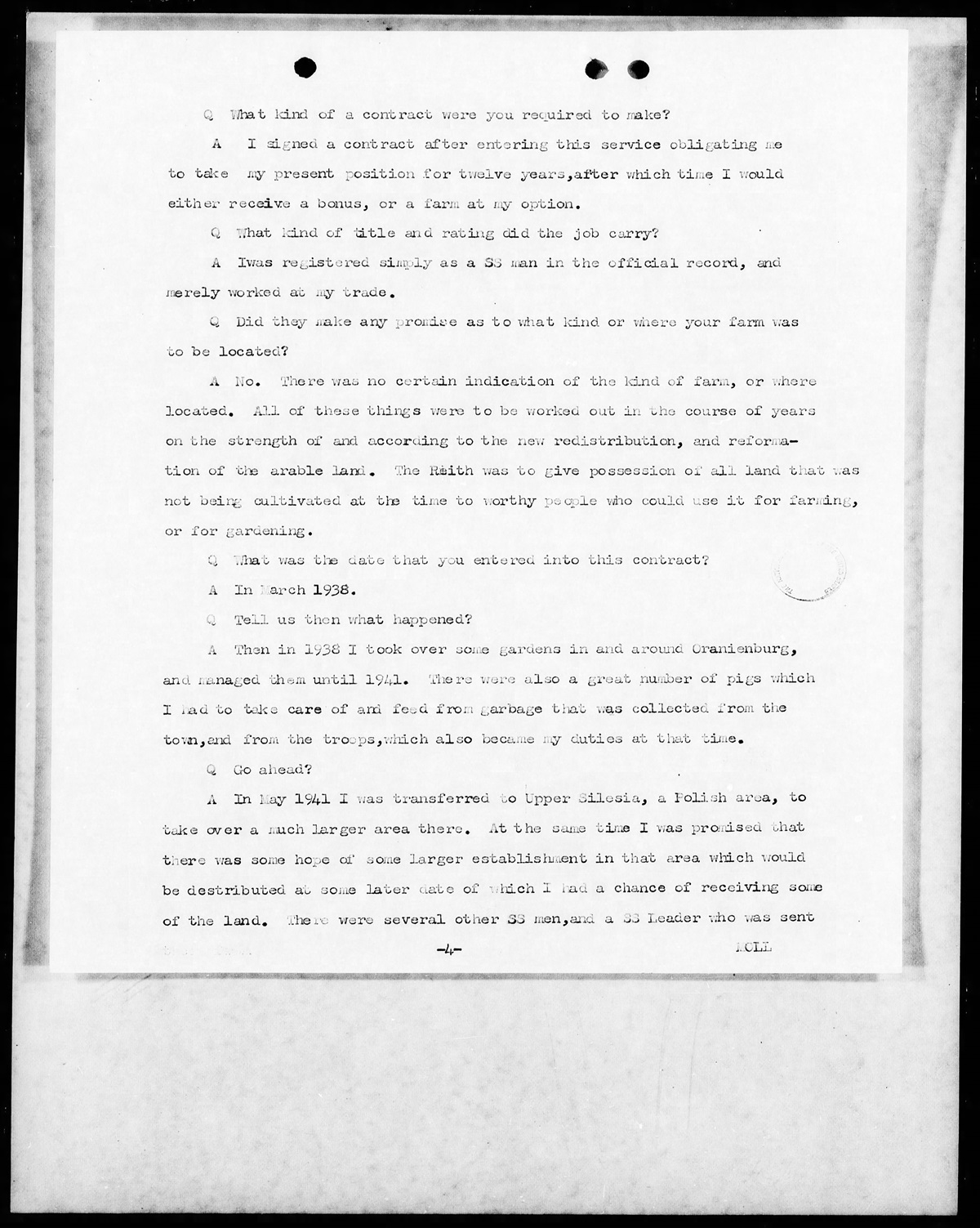
Q What kind of a contract were you required to make?
A I signed a contract after entering this service obligating me to take my present position for twelve years, after which time I would either receive a bonus, or a farm at my option.
Q What kind of title and rating did the job carry?
A I was registered simply as a SS man in the official record, and merely worked at my trade.
Q Did they make any promise as to what kind or where your farm was to be located?
A No. There was no certain indication of the kind of farm, or where located. All of these things were to be worked out in the course of years on the strength of and according to the new redistribution, and reformation of the arable land. The Reich was to give possession of all land that was not being cultivated at the time to worthy people who could use it for farming, or for gardening.
Q What was the date that you entered into this contract?
A In March 1938.
Q Tell us then what happened?
A Then in 1938 I took over some gardens in and around Oranienburg, and managed them until 1941. There were also a great number of pigs which I had to take care of and feed from garbage that was collected from the town, and from the troops, which also became my duties at that time.
Q Go ahead?
A In May 1941 I was transferred to Upper Silesia, a Polish area, to take over a much larger area there. At the same time I was promised that there was some hope of some larger establishment in that area which would be distributed at some later date of which I had a chance of receiving some of the land. There were several other SS men, and a SS leader who was sent there from Berlin to build up a very extensive gardening establishment.
Q What was this in connection with? What installations were to be fed from this garden?
A The products from this establishment were to be distributed to the hospitals, and also to the population of the larger cities near there.
Q When did you first become associated with any of the concentration camps?
A Towards the end of 1942, when almost all healthy SS men were transferred to the front. Only the older men were accepted for gardening, and farming, and similar establishments. I was transferred to Camp Monowitz near Auschwitz, which was a labor camp of I.G. Farben. It was then I received orders to take over a small labor camp near Kattowitz, and to supervise it.
Q What was your job?
A I was responsible for the housing, and the feeding of prisoners. Also to supervise their work. In fact I was responsible for the entire administration inside the camp.
Q Did you have disciplinary power over them?
A No.
Q Who did have that?
A The commandant. Only an officer could have disciplinary powers over the guards and inmates.
Q Did you have any guards under you?
A No, there was a captain of the Wehrmacht who was responsible for all the guards of the labor camps in that area.
Q A regular Wehrmacht officer?
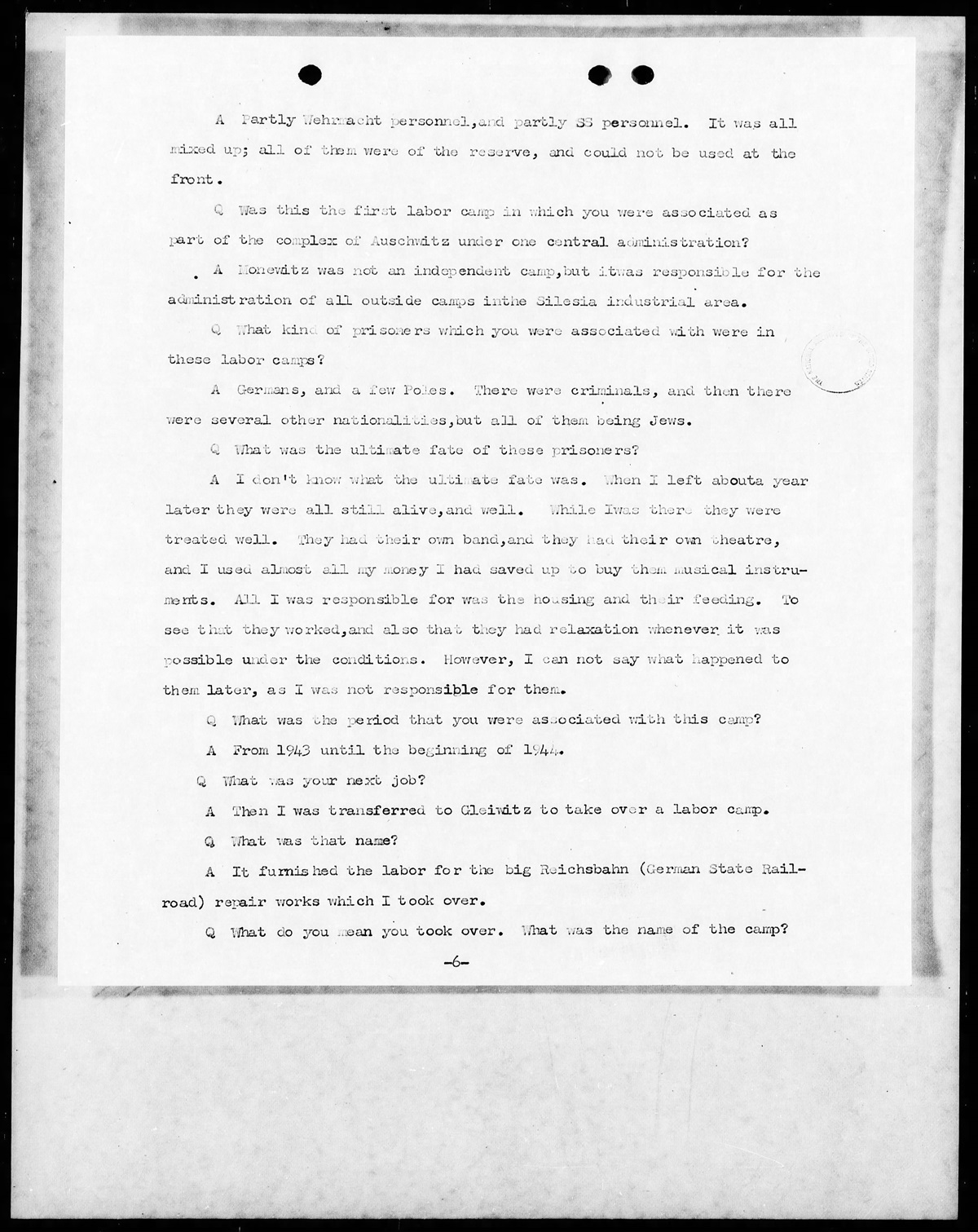
A Partly Wehrmacht personnel, and partly SS personnel. It was all mixed up; all of them were of the reserve, and could not be used at the front.
Q Was this the first labor camp in which you were associated as part of the complex of Auschwitz under one central administration?
A Monowitz was not an independent camp, but it was responsible for the administration of all outside camps in the Silesia industrial area.
Q What kind of prisoners which you were associated with were in these labor camps?
A Germans, and a few Poles. There were criminals, and then there were several other nationalities, but all of them being Jews.
Q What was the ultimate fate of these prisoners?
A I don’t know what the ultimate fate was. When I left about a year later they were all still alive, and well. While I was there they were treated well. They had their own band, and they had their own theatre, and I used almost all my money I had saved up to buy them musical instruments. All I was responsible for was the housing and their feeding. To see that they worked, and also that they had relaxation whenever it was possible under the conditions. However, I can not say what happened to them later, as I was not responsible for them.
Q What was the period that you were associated with this camp?
A From 1943 until the beginning of 1944.
Q What was your next job?
A Then I was transferred to Gleiwitz to take over a labor camp.
Q What was that name?
A It furnished the labor for the big Reichsbahn (German State Railroad) repair works which I took over.
Q What do you mean you took over. What was the name of the camp?
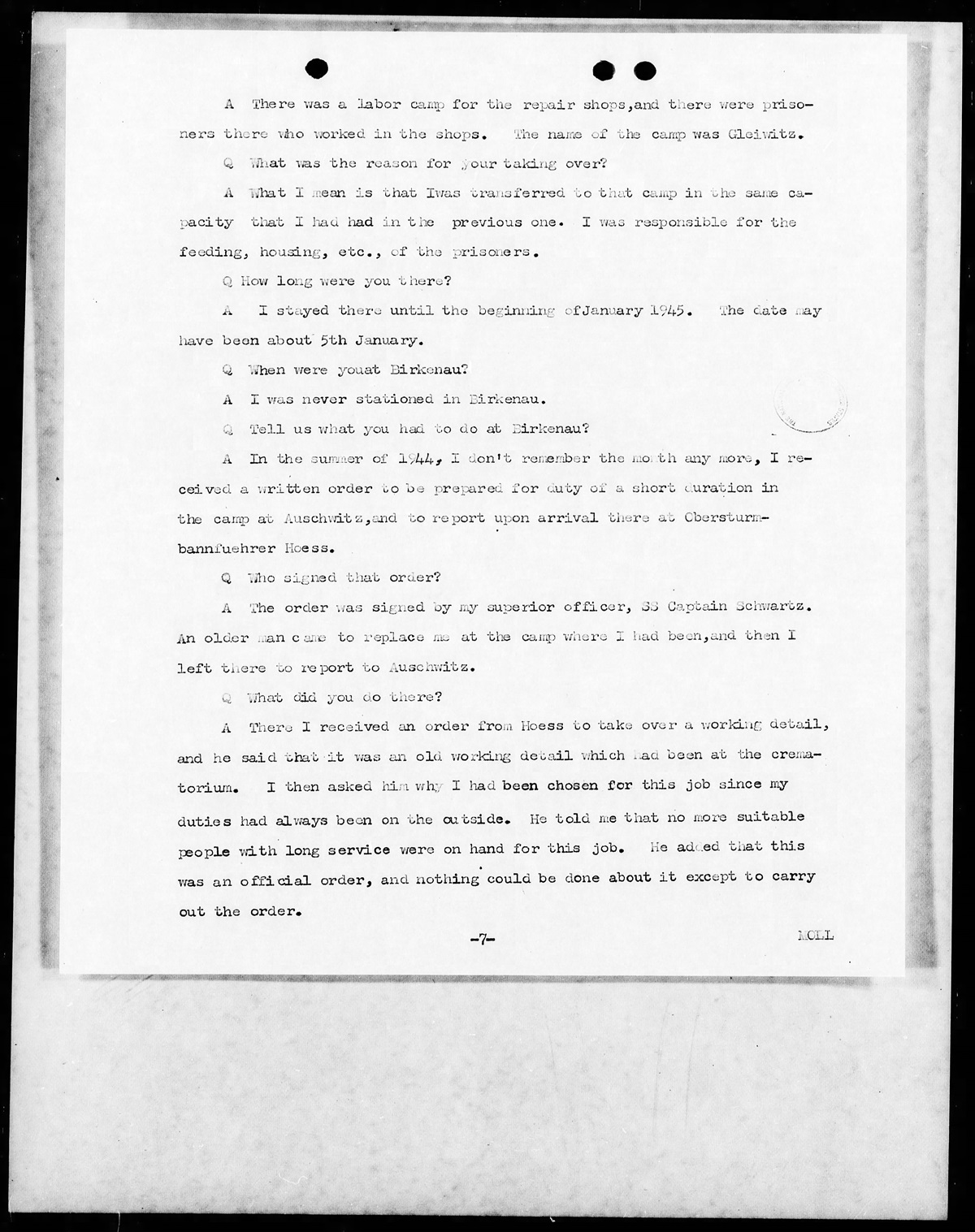
A There was a labor camp for the repair shops, and there were prisoners there who worked in the shops. The name of the camp was Gleiwitz.
Q What was the reason for your taking over?
A What I mean is that I was transferred to that camp in the same capacity that I had had in the previous one. I was responsible for the feeding, housing, etc., of the prisoners.
Q How long were you there?
A I stayed there until the beginning of January 1945. The date may have been about 5th January.
Q When were you at Birkenau?
A I was never stationed in Birkenau.
Q Tell us what you had to do at Birkenau?
A In the summer of 1944, I don’t remember the month any more, I received a written order to be prepared for duty of a short duration in the camp at Auschwitz, and to report upon arrival there at Obersturmbannfuehrer Hoess.
Q Who signed that order?
A The order was signed by my superior officer, SS Captain Schwartz. An older man came to replace me at the camp where I had been, and then I left there to report to Auschwitz.
Q What did you do there?
A There I received an order from Hoess to take over a working detail, and he said that it was an old working detail which had been at the crematorium. I then asked him why I had been chosen for this job since my duties had always been on the outside. He told me that no more suitable people with long service were on hand for this job. He added that this was an official order, and nothing could be done about it except to carry out the order.
Q All right. Tell us about what you did?
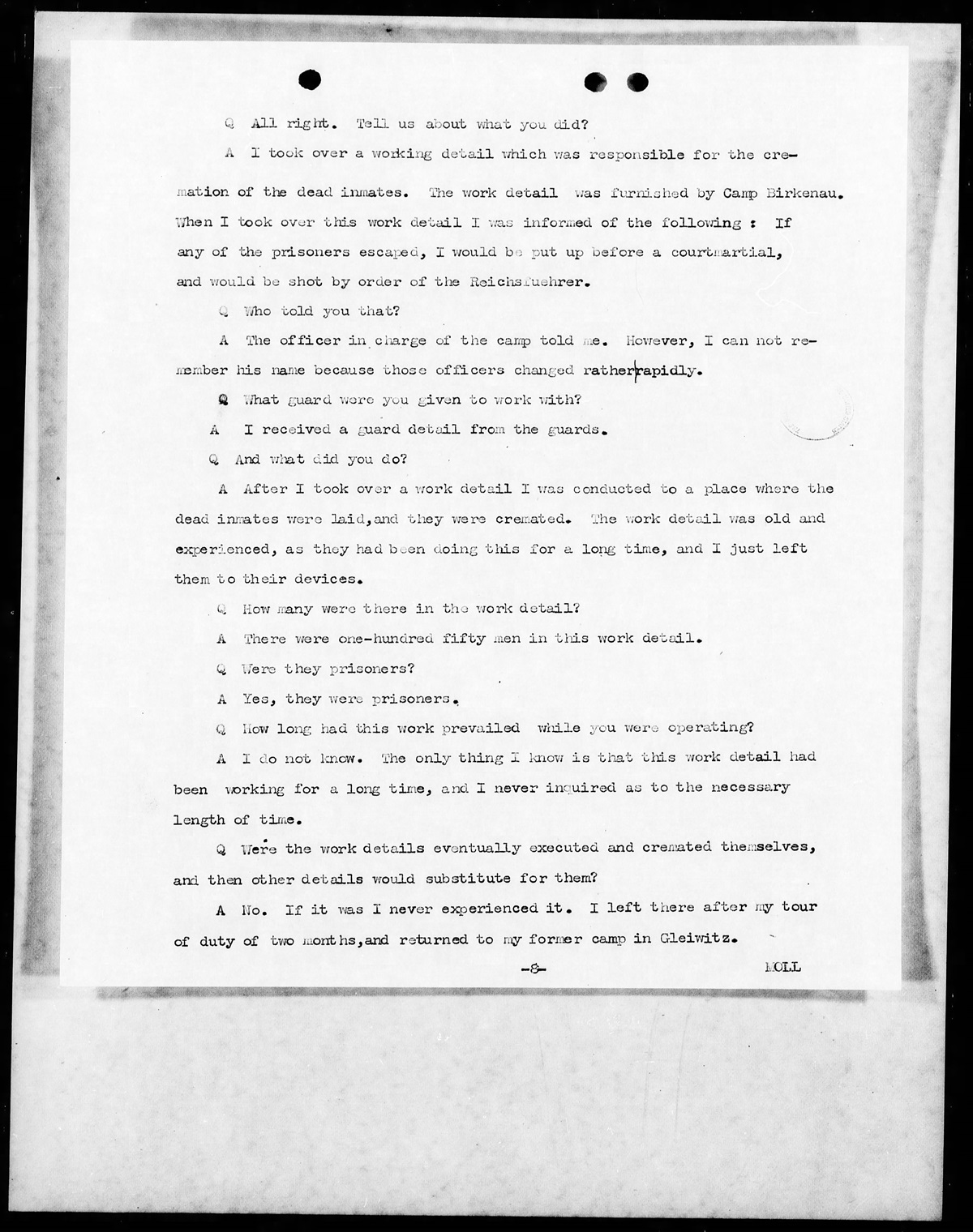
A I took over a working detail which was responsible for the cremation of the dead inmates. The work detail was furnished by Camp Birkenau. When I took over this work detail I was informed of the following: If any of the prisoners escaped, I would be put up before a courtmartial, and would be shot by order of the Reichsfuehrer.
Q Who told you that?
A The officer in charge of the camp told me. However, I can not remember his name because those officers changed rather rapidly.
Q What guard were you given to work with?
A I received a guard detail from the guards.
Q And what did you do?
A After I took over a work detail I was conducted to a place where the dead inmates were laid, and they were cremated. The work detail was old and experienced, as they had been doing this for a long time, and I just left them to their devices.
Q How many were there in the work detail?
A There were one-hundred fifty men in this work detail.
Q Were they prisoners?
A Yes, they were prisoners.
Q How long had this work prevailed while you were operating?
A I do not know. The only thing I know is that this work detail had been working for a long time, and I never inquired as to the necessary length of time.
Q Were the work details eventually executed and cremated themselves, and then other details would substitute for them?
A No. If it was I never experienced it. I left there after my tour of duty of two months, and returned to my former camp in Gleiwitz.
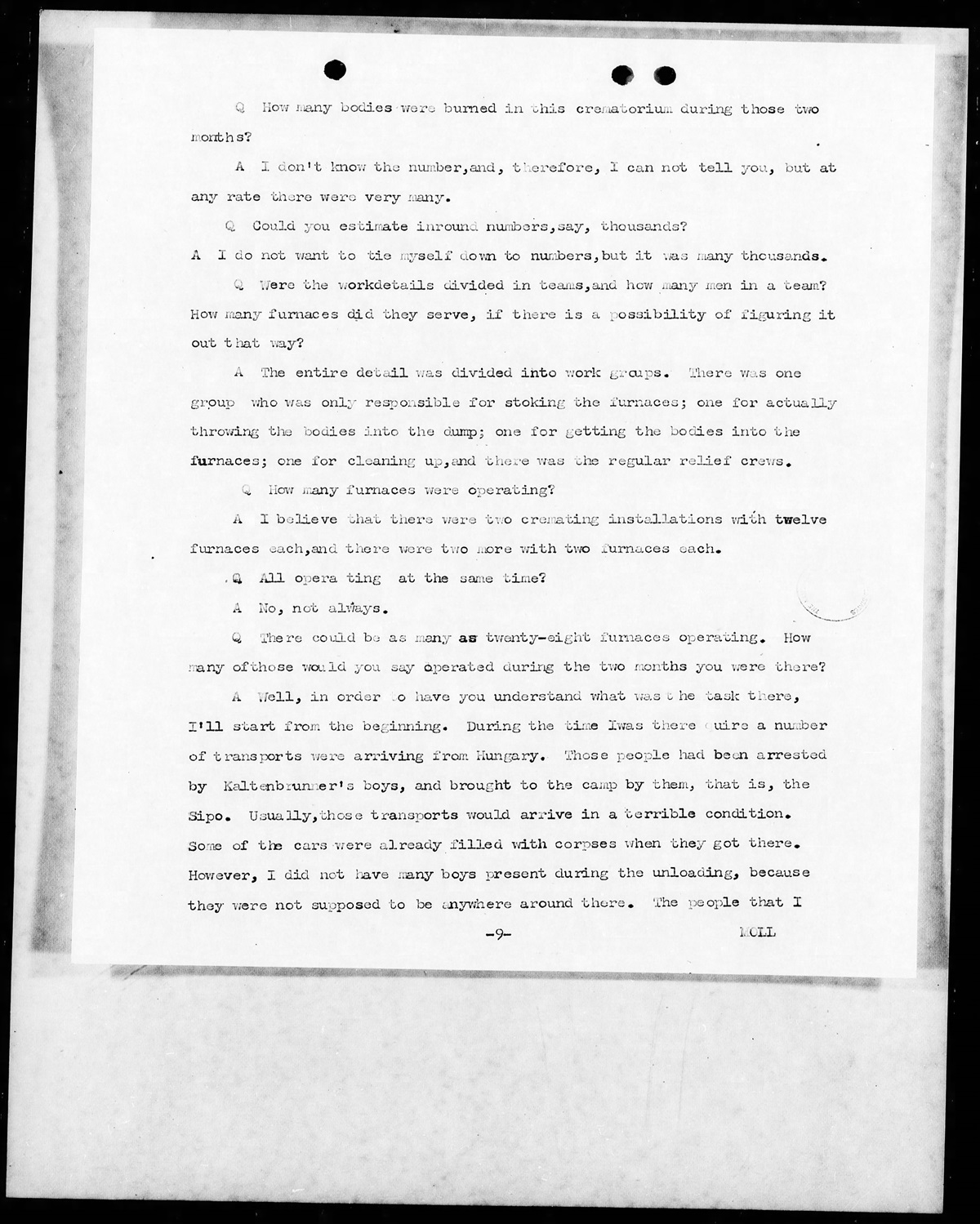
Q How many bodies were burned in this crematorium during those two months?
A I don’t know the number, and, therefore, I can not tell you, but at any rate there were very many.
Q Could you estimate in round numbers, say, thousands?
A I do not want to tie myself down to numbers, but it was many thousands.
Q Were the workdetails divided in teams, and how many men in a team? How many furnaces did they serve, if there is a possibility of figuring it out that way?
A The entire detail was divided into work groups. There was one group who was only responsible for stoking the furnaces; one for actually throwing the bodies into the dump; one for getting the bodies into the furnaces; one for cleaning up, and there was the regular relief crews.
Q How many furnaces were operating?
A I believe that there were two cremating installations with twelve furnaces each, and there were two more with two furnaces each.
Q All operating at the same time?
A No, not always.
Q There could be as many as twenty-eight furnaces operating. How many of those would you say operated during the two months you were there?
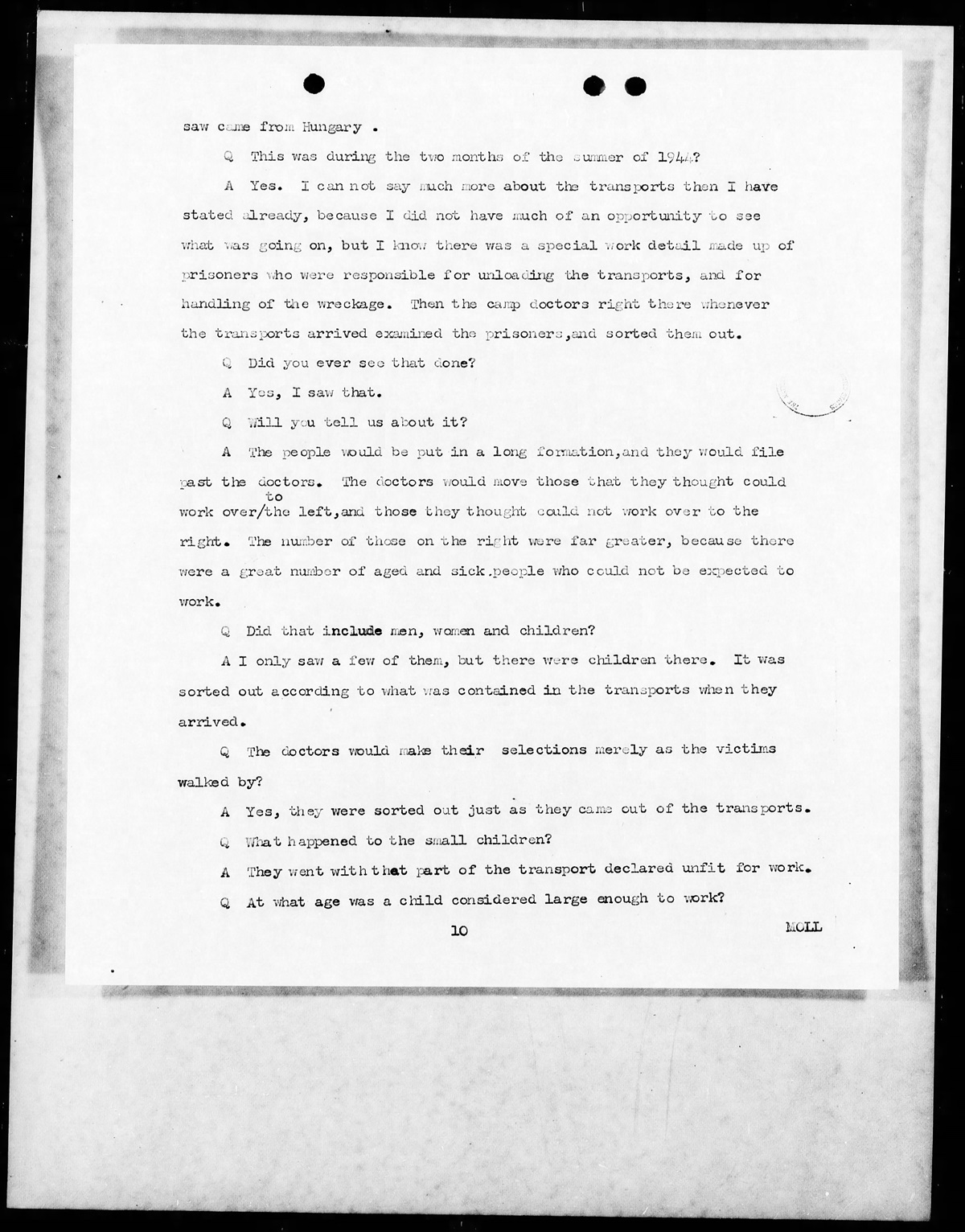
A Well, in order to have you understand what was the task there, I’ll start from the beginning. During the time I was there quite a number of transports were arriving from Hungary. Those people had been arrested by Kaltenbrunner’s boys, and brought to the camp by them, that is, the Sipo. Usually, those transports would arrive in a terrible condition. Some of the cars were already filled with corpses when they got there. However, I did not have many boys present during the unloading, because they were not supposed to be anywhere around there. The people that I saw came from Hungary.
Q This was during the two months of the summer of 1944?
A Yes. I can not say much more about the transports then I have stated already, because I did not have much of an opportunity to see what was going on, but I know there was a special work detail made up of prisoners who were responsible for unloading the transports, and for handling of the wreckage. Then the camp doctors right there whenever the transports arrived examined the prisoners, and sorted them out.
Q Did you ever see that done?
A Yes, I saw that.
Q Will you tell us about it?
A The people would be put in a long formation, and they would file past the doctors. The doctors would move those that they thought could work over to the left, and those they thought could not work over to the right. The number of those on the right were far greater, because there were a great number of aged and sick people who could not be expected to work.
Q Did that include men, women and children?
A I only saw a few of them, but there were children there. It was sorted out according to what was contained in the transports when they arrived.
Q The doctors would make their selections merely as the victims walked by?
A Yes, they were sorted out just as they came out of the transports.
Q What happened to the small children?
A They went with that part of the transport declared unfit for work.
Q At what age was a child considered large enough to work?
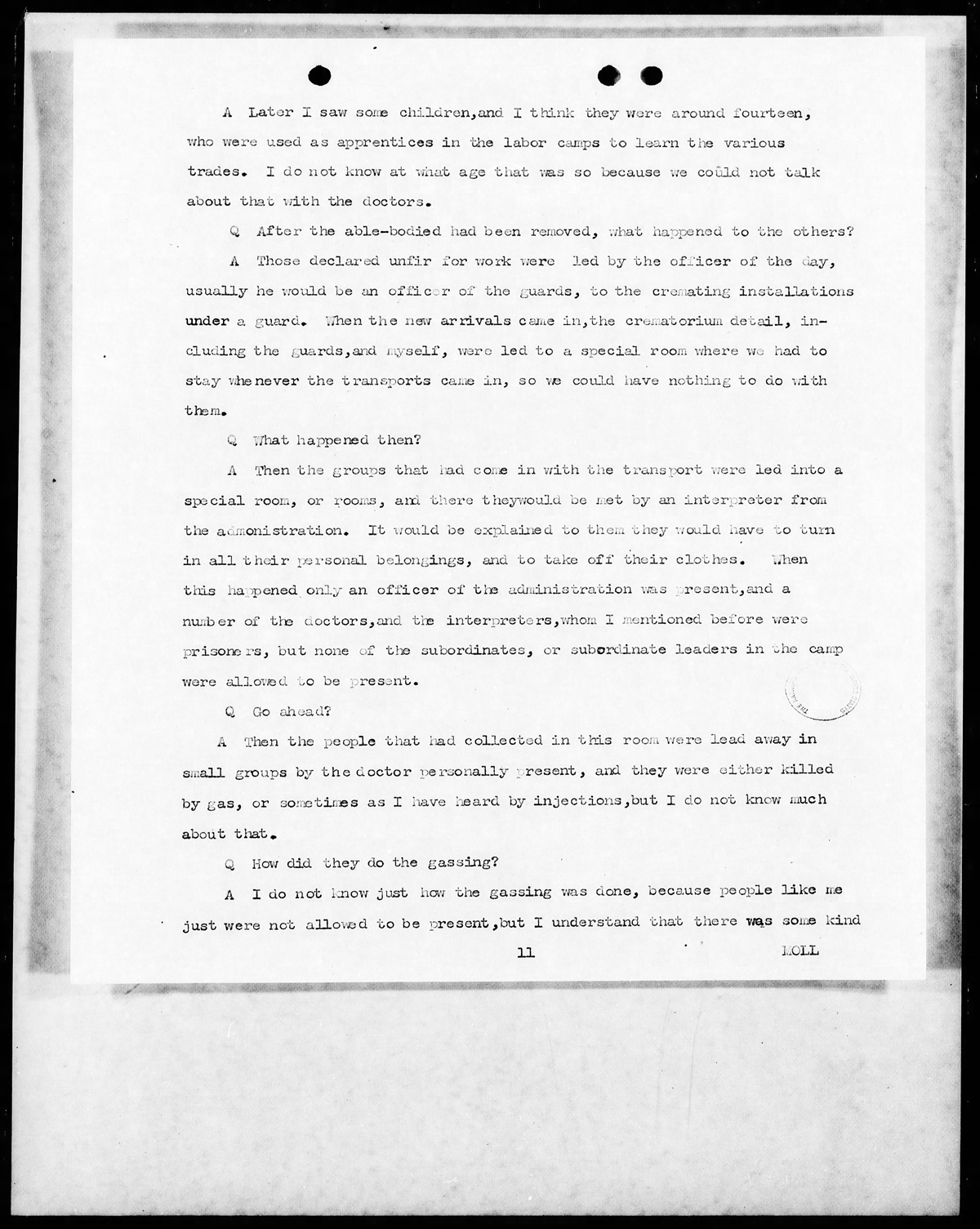
A Later I saw some children, and I think they were around fourteen, who were used as apprentices in the labor camps to learn the various trades. I do not know at what age that was so because we could not talk about that with the doctors.
Q After the able-bodied had been removed, what happened to the others?
A Those declared unfit for work were led by the officer of the day, usually he would be an officer of the guards, to the cremating installations under a guard. When the new arrivals came in, the crematorium detail, including the guards, and myself, were led to a special room where we had to stay whenever the transports came in, so we could have nothing to do with them.
Q What happened then?
A Then the groups that had come in with the transport were led into a special room, or rooms, and there they would be met by an interpreter from the administration. It would be explained to them they would have to turn in all their personal belongings, and to take off their clothes. When this happened only an officer of the administration was present, and a number of the doctors, and the interpreters, whom I mentioned before were prisoners, but none of the subordinates, or subordinate leaders in the camp were allowed to be present.
Q Go ahead?
A Then the people that had collected in this room were lead away in small groups by the doctor personally present, and they were either killed by gas, or sometimes as I have heard by injections, but I do not know much about that.
Q How did they do the gassing?
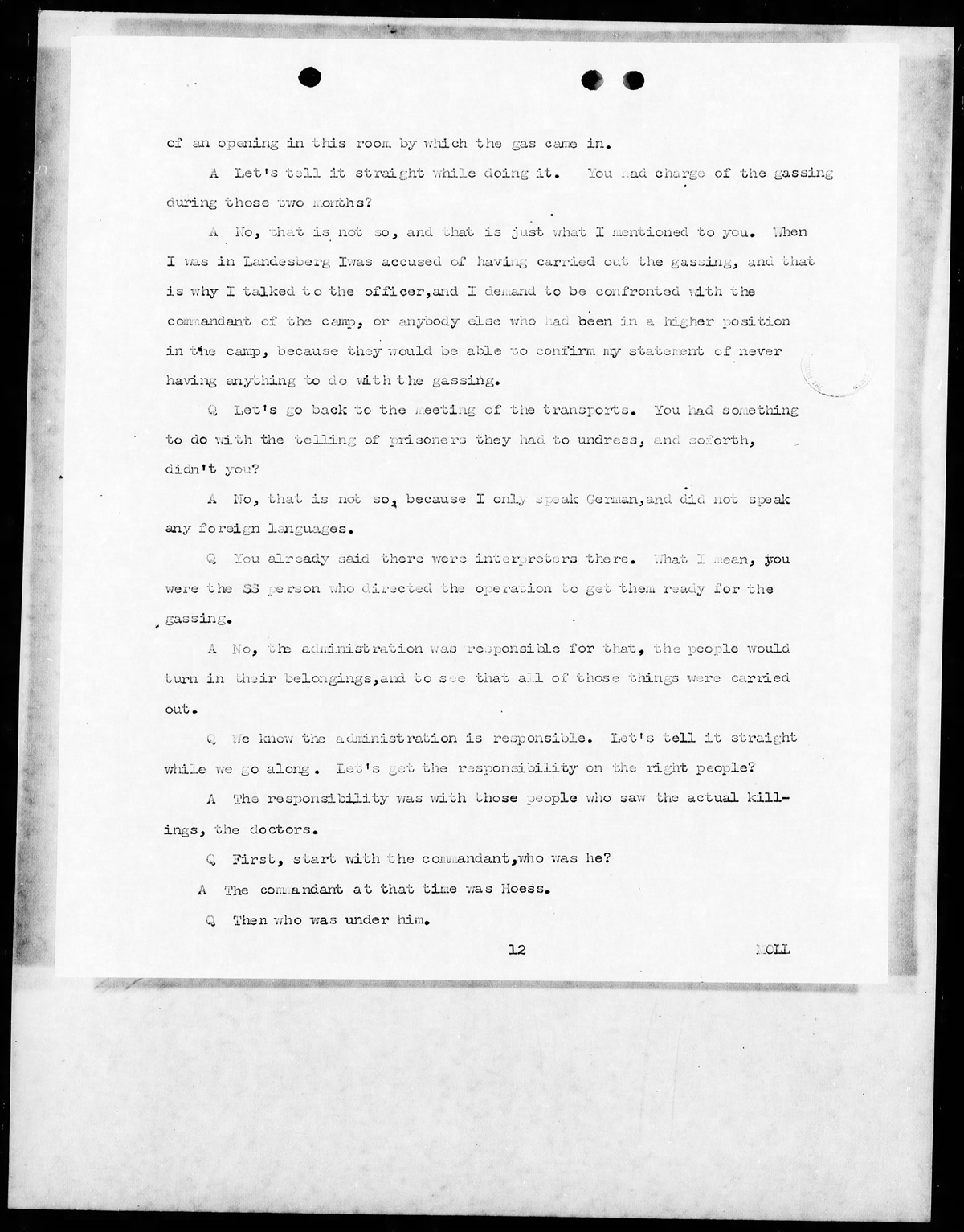
A I do not know just how the gassing was done, because people like me just were not allowed to be present, but I understand that there was some kind of an opening in this room by which the gas came in.
Q Let’s tell it straight while doing it. You had charge of the gassing during those two months?
A No, that is not so, and that is just what I mentioned to you. When I was in Landsberg I was accused of having carried out the gassing, and that is why I talked to the officer, and I demand to be confronted with the commandant of the camp, or anybody else who had been in a higher position in the camp, because they would be able to confirm my statement of never having anything to do with the gassing.
Q Let’s go back to the meeting of the transports. You had something to do with the telling of prisoners they had to undress, and so forth, didn’t you?
A No, that is not so, because I only speak German, and did not speak any foreign languages.
Q You already said there were interpreters there. What I mean, you were the SS person who directed the operation to get them ready for the gassing.
A No, the administration was responsible for that, the people would turn in their belongings, and to see that all of those things were carried out.
Q We know the administration is responsible. Let’s tell it straight while we go along. Let’s get the responsibility on the right people?
A The responsibility was with those people who saw the actual killings, the doctors.
Q First, start with the commandant, who was he?
A The commandant at that time was Hoess.
Q Then who was under him.
A His next subordinate was Kramer.
Q Joseph Kramer?
A I do not know his first name, but he was a Hauptsturmfuehrer (Captain).
Q Was he the same Kramer who was at Belsen-Bersen?
A I saw his picture once in the newspaper, that was the same man.
Q WERE both Hoess and Kramer at Birkenau those two months that you were there?
A Yes.
Q Who was the next one?
A Untersturmfuehrer Hoessler, and Schwarzuhber; then all the officers of the unit, but I don’t remember their names.
Q Can you remember any of their names?
A I remember one Obersturmfuehrer Schindler.
Q All right, who else?
A I remember the officer in charge of the administration, he was Obersturmbannfuehrer (Lt. Col.) Moeckel. Then there were the doctors, Sturmbannfuehrer Muers, and Obersturmfuehrer Tylo.
Q Were there any dental officers there?
A Yes, there were also dental officers there.
Q What are their names?
A I can not remember any more their names, because the doctors changed constantly, and there was also a Hungarian doctor but I have forgotten his name, too.
Q A SS Doctor?
A Yes, he was a SS doctor.
Q You said that there were certain of the prisoners who were doctors, and had something to do with this?
A No. There were some prisoners who were doctors in name only, but they had nothing to do with this.
Q Who of these names were responsible for the gassing operations?
A Muertz, he was the Chief doctor. Every day he furnished an officer of the day, and a doctor responsible for the gassing. Muertz was not always present, but I have seen him making out documents together with the officer of the day.
Q How were these names posted for the days work, and where did they get the order?
A I do not know just they were published. They just appeared there.
Q Did the same people appear day after day. If not, how often did they change?
A No. The doctors and the officer changed constantly. Something happened everyday in actions like this almost daily, and the officers would change constantly.
Q And you were there everyday?
A No.
Q How often.
A Every second day.
Q Alternate days was your regular assignment.
A Yes, that was my regular duty with the work detail.
Q How long did it take to complete a gassing operation?
A The actual killing process last about half a minute, but I really can not say for sure, because we were never permitted to be near there when it was going on. I remember one day I talked to a doctor about this, and I asked him why all these killings, because I thought that it was really very bad for the German people.
Q Do you know his name?
A I don’t remember his name any more, but he told me he did not like to do it, but he was a soldier, and he was following orders of the Reichsfuehrer and the Reich Government. Then I asked him why it was being done by gas, and he said that some departments had tried out various ways, after which it was found that gas was the best and easiest way, and, moreover this was a most beautiful death anybody could have, anyway.
Q Did that make you feel better?
A Well, you could not say such things, because you could not start to have any feelings about such matters. It was simply our duty to carry out, and nobody liked to do it, and many times we protested to officers there, but in the German Army you just carry out an order when you receive it, and that is all there is to it.
LT. COL. BROOKHART: We will stop for the day, and I want you to think about the names at Birkenau, and any other place that you consider responsible. I hope you realize the advantage of telling a full true story.
THE WITNESS: I want to emphasize that I have told you a true story, and I will continue doing it. Moreover, rest assured that I won’t do anything to protect, or in any way cover up for any officers, or any of the other peoples, for the simple reason that during the entire war, and before that, as I have explained to you, I was forced by my injury to do this service, and I had nothing to gain out of it except work and duty, and more work, and more duty.
APPROVED:
Smith W. Brookhart
Interrogator
Richard W. Sonnenfeldt
Interpreter
Charles J. Gallagher
Court Reporter
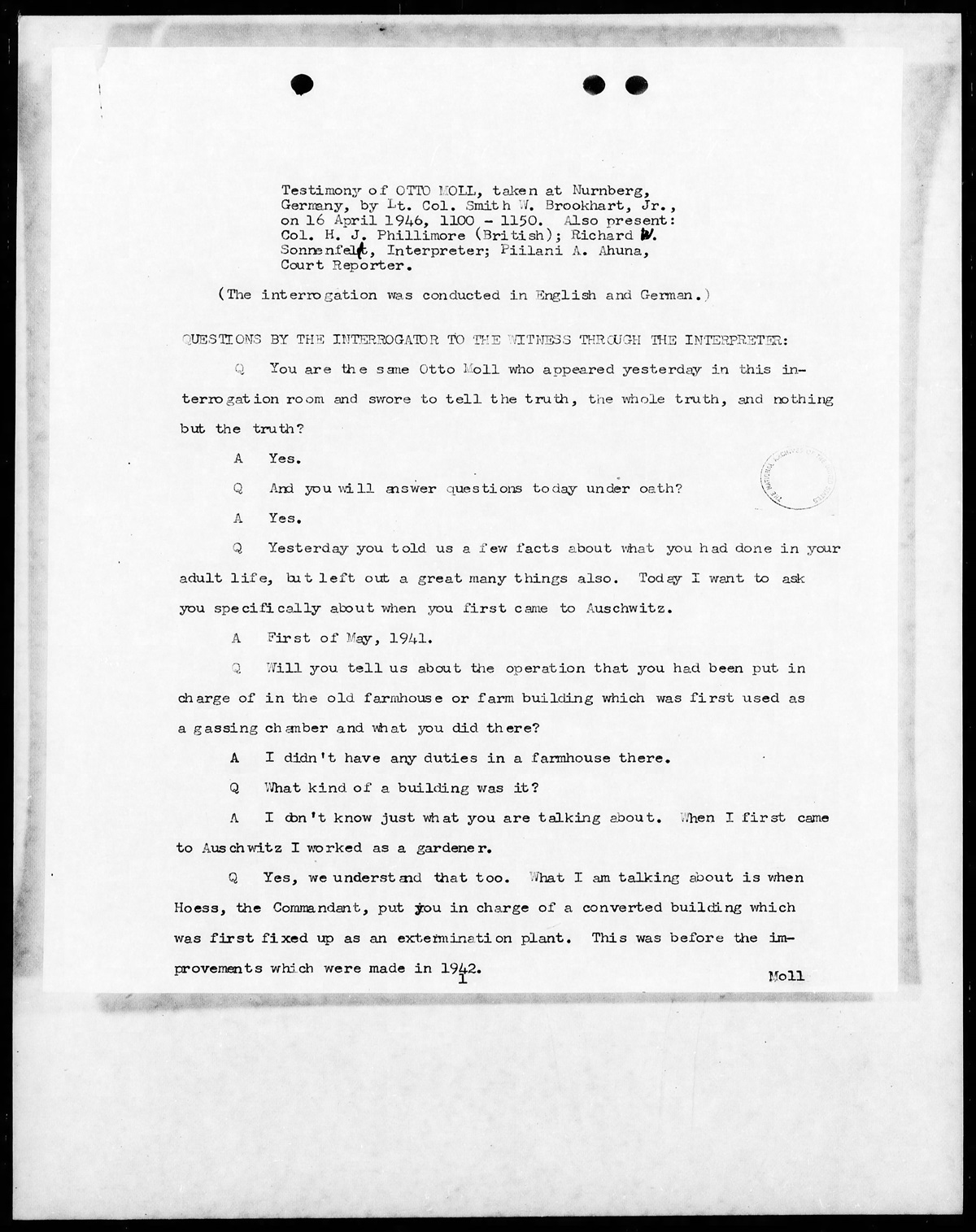
Testimony of OTTO MOLL, taken at Nurnberg, Germany, by Lt. Col. Smith W. Brookhart, Jr., on 16 April 1946, 1100 – 1150. Also present: Col. H. J. Phillimore (British); Richard W. Sonnenfeldt, Interpreter; Piliani A. Ahuna, Court Reporter.
(The interrogation was conducted in English and German.)
QUESTIONS BY THE INTERROGATOR TO THE WITNESS THROUGH THE INTERPRETER:
Q You are the same Otto Moll who appeared yesterday in this interrogation room and swore to tell the truth, the whole truth, and nothing but the truth?
A Yes.
Q And you will answer questions today under oath?
A Yes.
Q Yesterday you told us a few facts about what you had done in your adult life, but left out a great many things also. Today I want to ask you specifically about when you first came to Auschwitz.
A First of May, 1941.
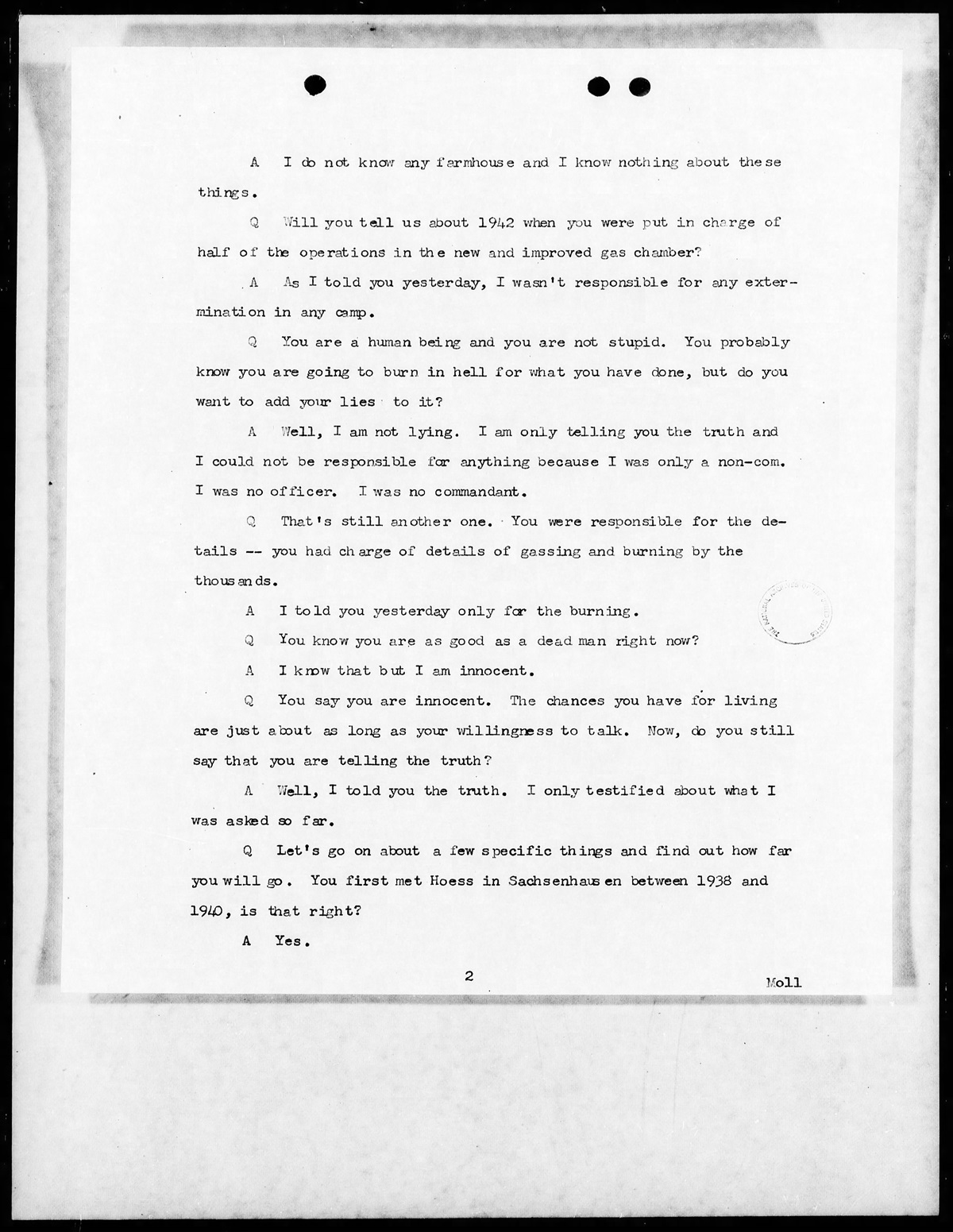
Q Will you tell us about the operation that you had been put in charge of in the old farmhouse or farm building which was first used as a gassing chamber and what you did there?
A I didn’t have any duties in a farmhouse there.
Q What kind of a building was it?
A I don’t know just what you are talking about. When I first came to Auschwitz I worked as a gardener.
Q Yes, we understand that too. What I am talking about is when Hoess, the Commandant, put you in charge of a converted building which was first fixed up as an extermination plant. This was before the improvements which were made in 1942.
A I do not know any farmhouse and I know nothing about these things.
Q Will you tell us about 1942 when you were put in charge of half of the operations in the new and improved gas chamber?
A As I told you yesterday, I wasn’t responsible for any extermination in any camp.
Q You are a human being and you are not stupid. You probably know you are going to burn in hell for what you have done, but do you want to add your lies to it?
A Well, I am not lying. I am only telling you the truth and I could not be responsible for anything because I was only a non-com. I was no officer. I was no commandant.
Q That’s still another one. You were responsible for the details — you had charge of details of gassing and burning by the thousands.
A I told you yesterday only for the burning.
Q You know you are as good as a dead man right now?
A I know that but I am innocent.
Q You say you are innocent. The chances you have for living are just about as long as your willingness to talk. Now, do you still say that you are telling the truth?
A Well, I told you the truth. I only testified about what I was asked so far.
Q Let’s go on about a few specific things and find out how far you will go. You first met Hoess in Sachsenhausen between 1938 and 1940, is that right?
A Yes.
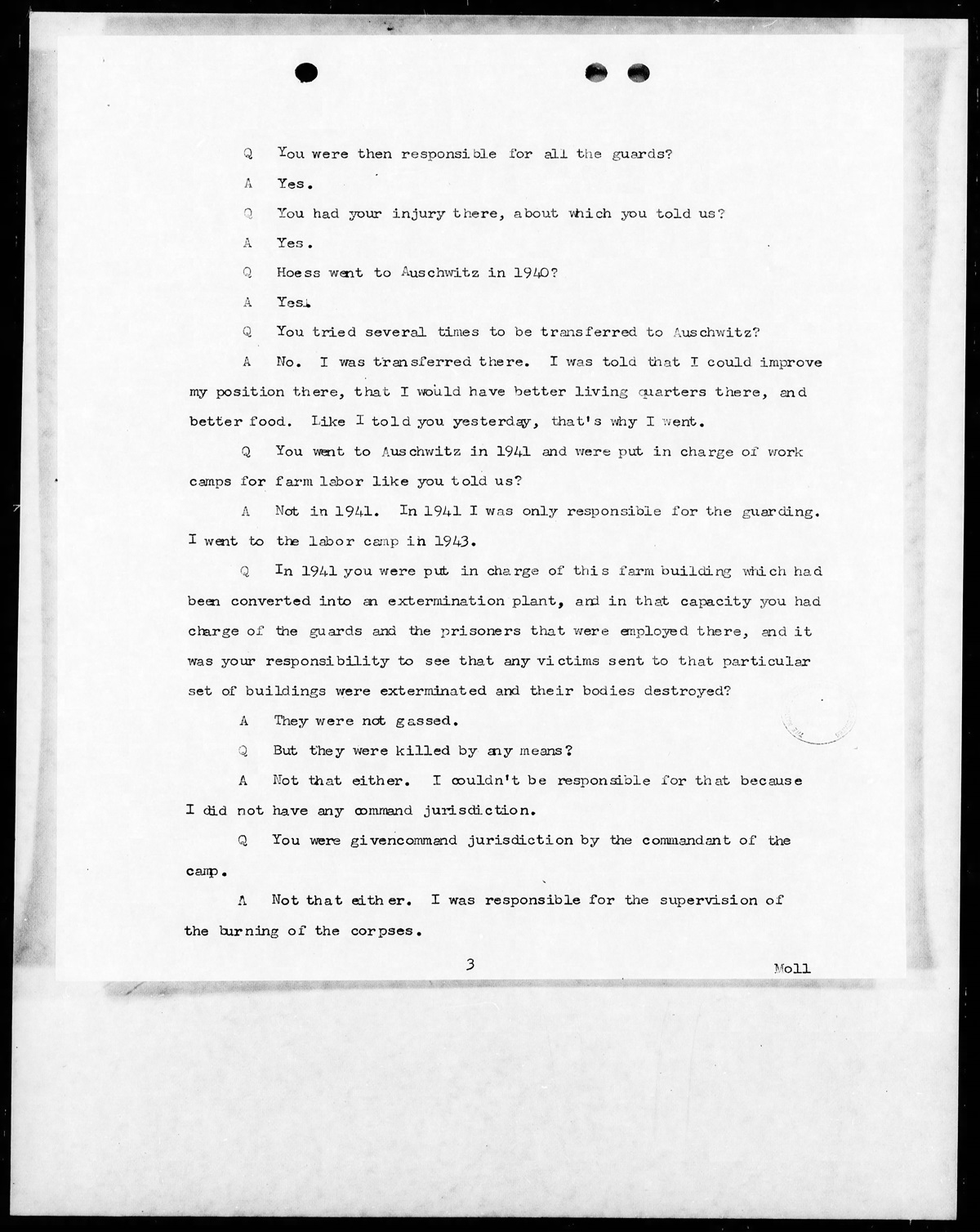
Q You were then responsible for all the guards?
A Yes.
Q You had your injury there, about which you told us?
A Yes.
Q Hoess went to Auschwitz in 1940?
A Yes.
Q You tried several times to be transferred to Auschwitz?
A No. I was transferred there. I was told that I could improve my position there, that I would have better living quarters there, and better food. Like I told you yesterday, that’s why I went.
Q You went to Auschwitz in 1941 and were put in charge of work camps for farm labor like you told us?
A Not in 1941. In 1941 I was only responsible for the guarding. I went to the labor camp in 1943.
Q In 1941 you were put in charge of this farm building which had been converted into an extermination plant, and in that capacity you had charge of the guards and the prisoners that were employed there, and it was your responsibility to see that any victims sent to that particular set of buildings were exterminated and their bodies destroyed?
A They were not gassed.
Q But they were killed by any means?
A Not that either. I couldn’t be responsible for that because I did not have any command jurisdiction.
Q You were given command jurisdiction by the commandant of the camp.
A Not that either. I was responsible for the supervision of the burning of the corpses.
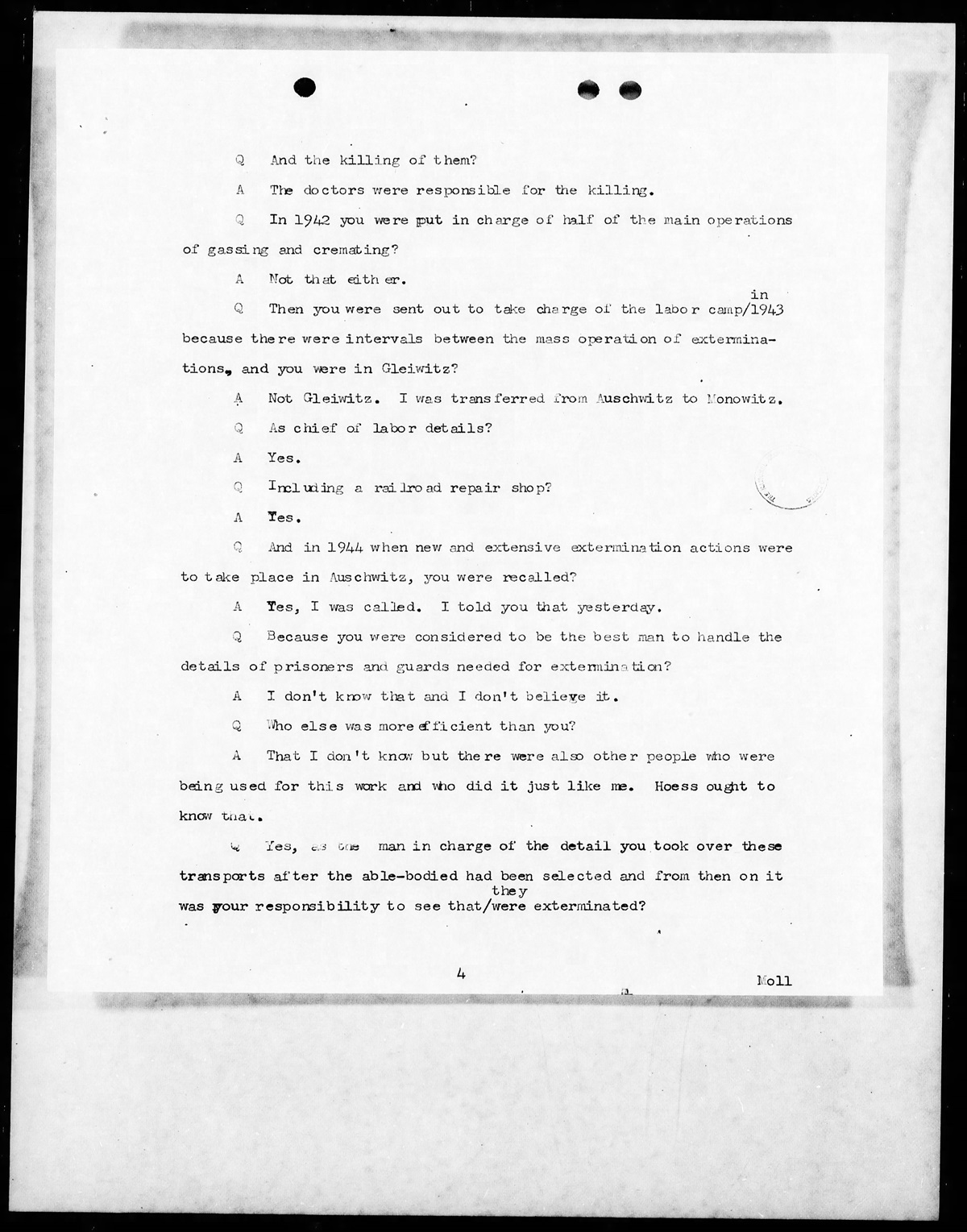
Q And the killing of them?
A The doctors were responsible for the killing.
Q In 1942 you were put in charge of half of the main operations of gassing and cremating?
A Not that either.
Q Then you were sent out to take charge of the labor camp in 1943 because there were intervals between the mass operation of exterminations, and you were in Gleiwitz?
A Not Gleiwitz. I was transferred from Auschwitz to Monowitz.
Q As chief of labor details?
A Yes.
Q Including a railroad repair shop?
A Yes.
Q And in 1944 when new and extensive extermination actions were to take place in Auschwitz, you were recalled?
A Yes, I was called. I told you that yesterday.
Q Because you were considered to be the best man to handle the details of prisoners and guards needed for extermination?
A I don’t know that and I don’t believe it.
Q Who else was more efficient than you?
A That I don’t know but there were also other people who were being used for this work and who did it just like me. Hoess ought to know that.
Q Yes, as one man in charge of the detail you took over these transports after the able-bodied had been selected and from then on it was your responsibility to see that they were exterminated?
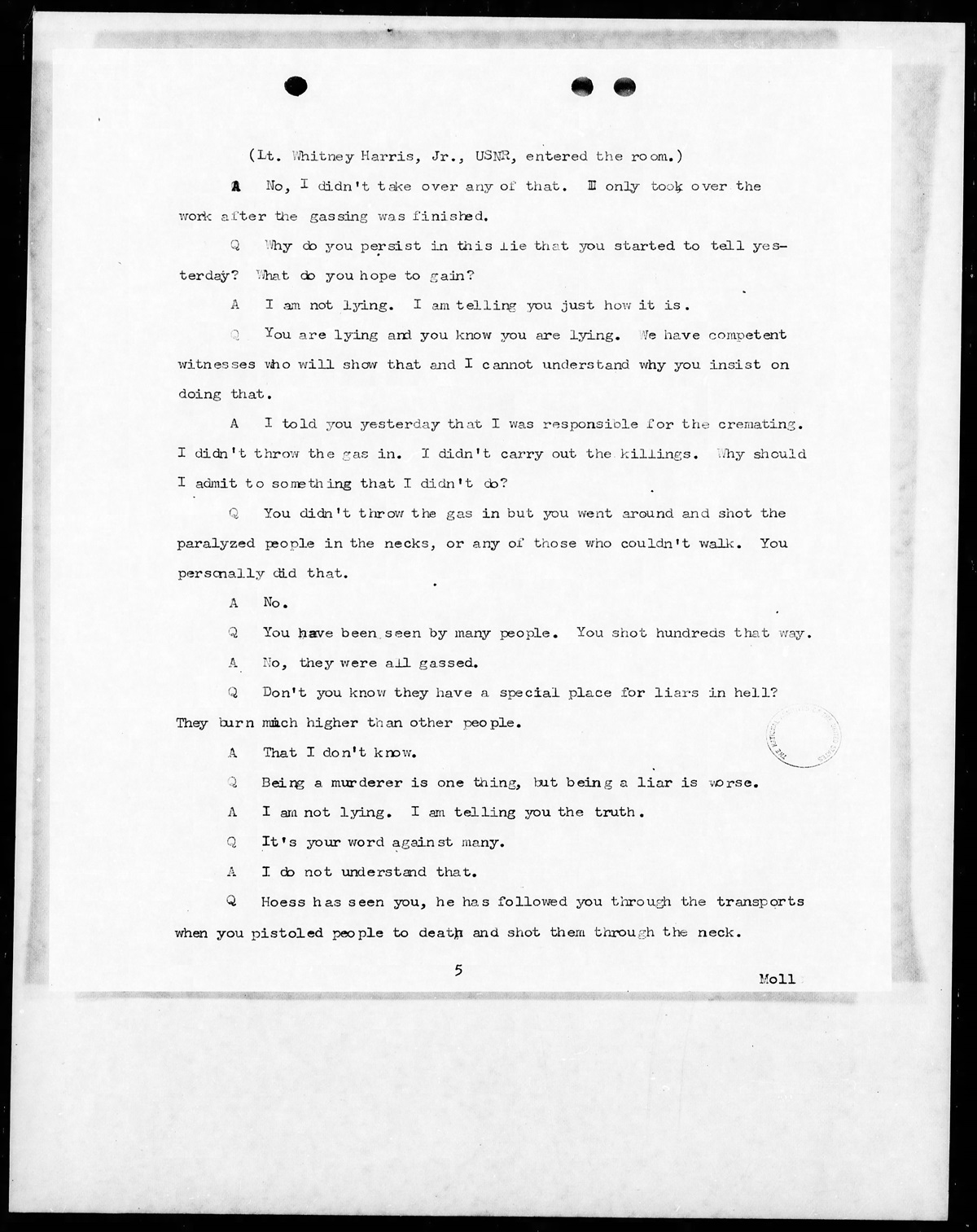
(Lt. Whitney Harris, Jr., USNR, entered the room.)
A No, I didn’t take over any of that. I only took over the work after the gassing was finished.
Q Why do you persist in this lie that you started to tell yesterday? What do you hope to gain?
A I am not lying. I am telling you just how it is.
Q You are lying and you know you are lying. We have competent witnesses who will show that and I cannot understand why you insist on doing that.
A I told you yesterday that I was responsible for the cremating. I didn’t throw the gas in. I didn’t carry out the killings. Why should I admit to something that I didn’t do?
Q You didn’t throw the gas in but you went around and shot the paralyzed people in the necks, or any of those who couldn’t walk. You personally did that.
A No.
Q You have been seen by many people. You shot hundreds that way.
A No, they were all gassed.
Q Don’t you know they have a special place for liars in hell? They burn much higher than other people.
A That I don’t know.
Q Being a murderer is one thing, but being a liar is worse.
A I am not lying. I am telling you the truth.
Q It’s your word against many.
A I do not understand that.
Q Hoess has seen you, he has followed you through the transports when you pistoled people to death and shot them through the neck.
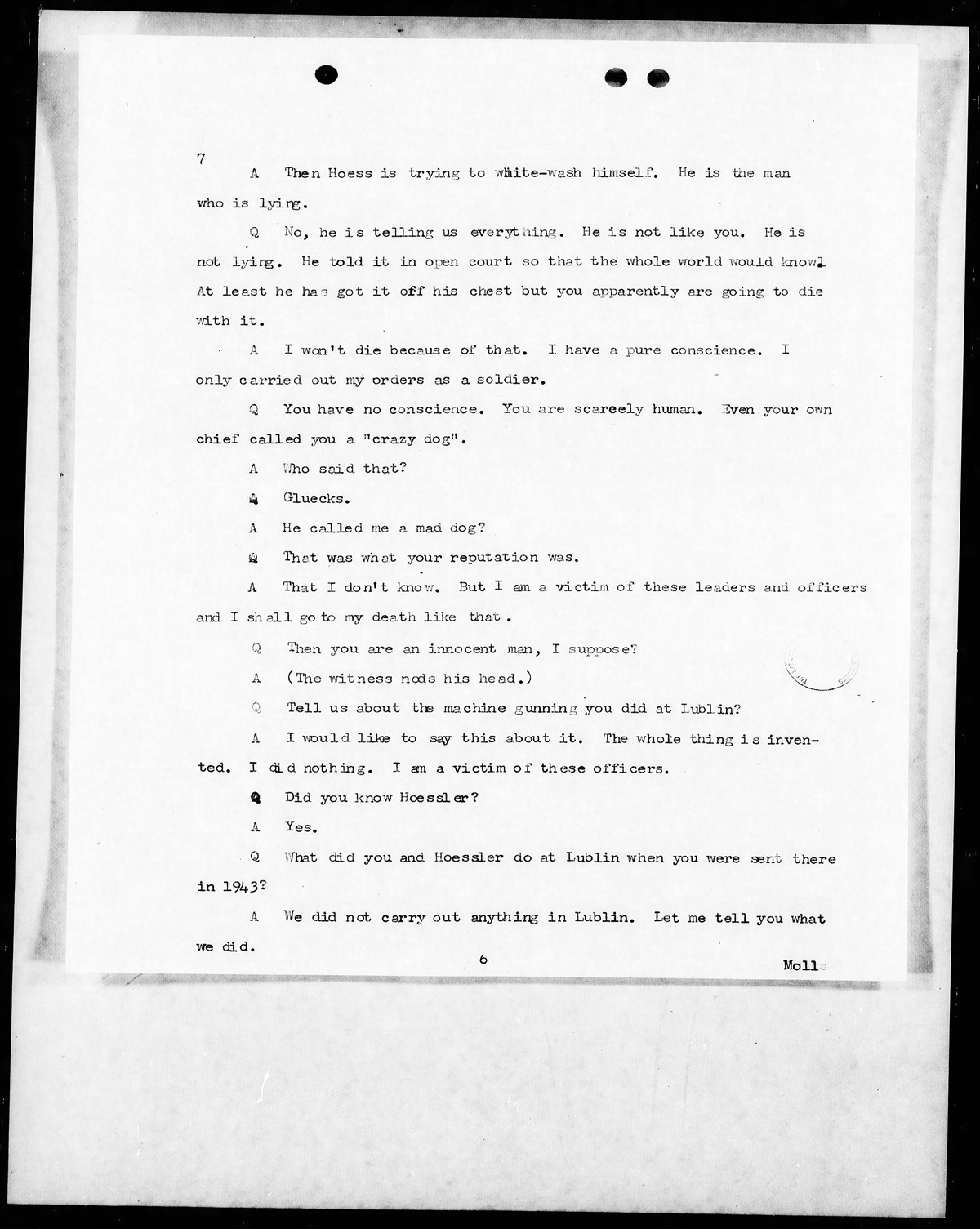
A Then Hoess is trying to white-wash himself. He is the man who is lying.
Q No, he is telling us everything. He is not like you. He is not lying. He told it in open court so that the whole world would know. At least he has got it off his chest but you apparently are going to die with it.
A I won’t die because of that. I have a pure conscience. I only carried out my orders as a soldier.
Q You have no conscience. You are scarcely human. Even your own chief called you a “crazy dog”.
A Who said that?
A Gluecks.
A He called me a mad dog?
A That was what your reputation was.
A That I don’t know. But I am a victim of these leaders and officers and I shall go to my death like that.
Q Then you are an innocent man, I suppose?
A (The witness nods his head.)
Q Tell us about the machine gunning you did at Lublin?
A I would like to say this about it. The whole thing is invented. I did nothing. I am a victim of these officers.
Q Did you know Hoessler?
A Yes.
Q What did you and Hoessler do at Lublin when you were sent there in 1943?
A We did not carry out anything in Lublin. Let me tell you what we did.
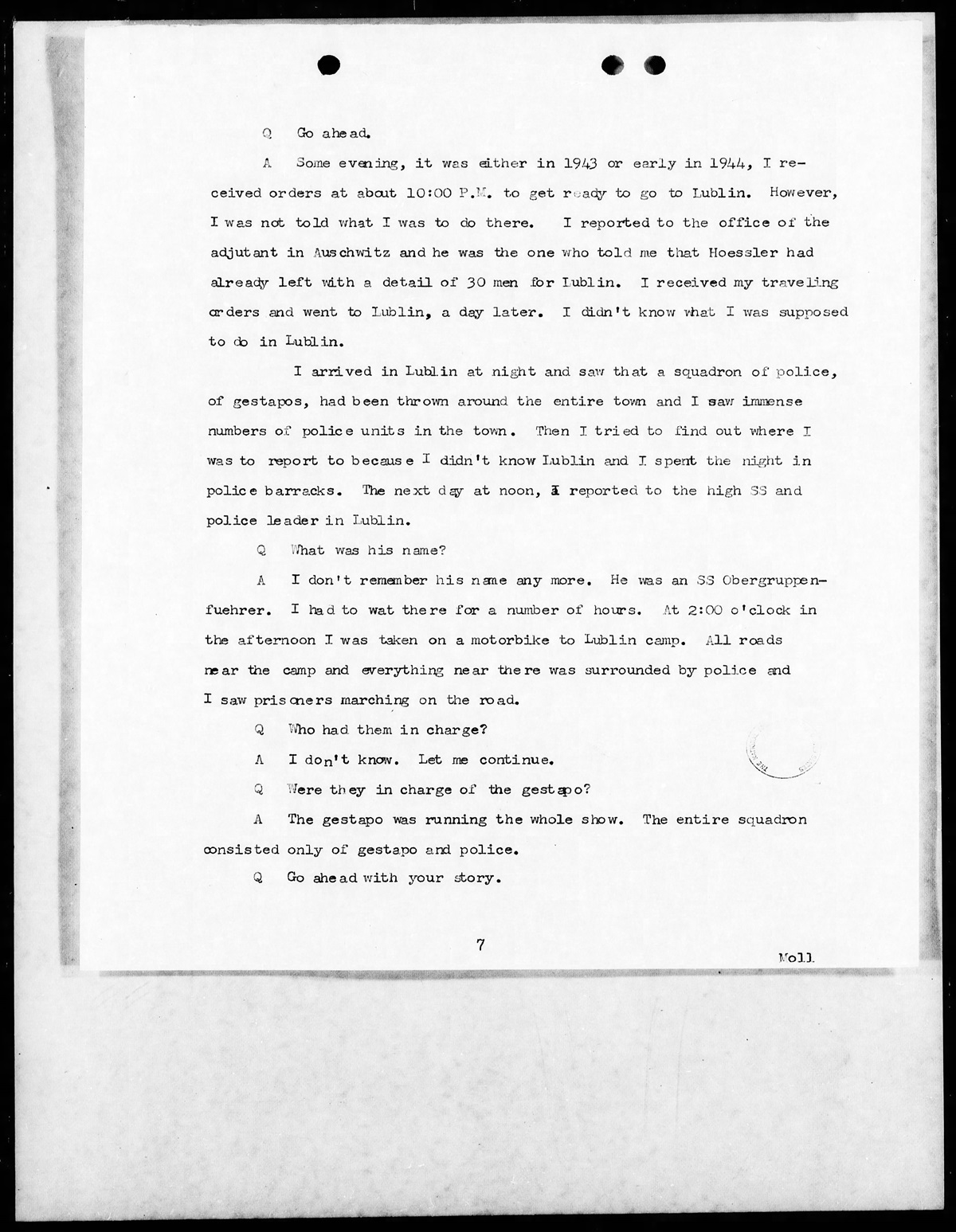
Q Go ahead.
A Some evening, it was either in 1943 or early in 1944, I received orders at about 10:00 P.M. to get ready to go to Lublin. However, I was not told what I was to do there. I reported to the office of the adjutant in Auschwitz and he was the one who told me that Hoessler had already left with a detail of 30 men for Lublin. I received my traveling orders and went to Lublin, a day later. I didn’t know what I was supposed to do in Lublin.
I arrived in Lublin at night and saw that a squadron of police, of gestapos, had been thrown around the entire town and I saw immense numbers of police units in the town. Then I tried to find out where I was to report to because I didn’t know Lublin and I spent the night in police barracks. The next day at noon, I reported to the high SS and police leader in Lublin.
Q What was his name?
A I don’t remember his name any more. He was an SS Obergruppenfuehrer. I had to wait there for a number of hours. At 2:00 o’clock in the afternoon I was taken on a motorbike to Lublin camp. All roads near the camp and everything near there was surrounded by police and I saw prisoners marching on the road.
Q Who had them in charge?
A I don’t know. Let me continue.
Q Were they in charge of the gestapo?
A The gestapo was running the whole show. The entire squadron consisted only of gestapo and police.
Q Go ahead with your story.
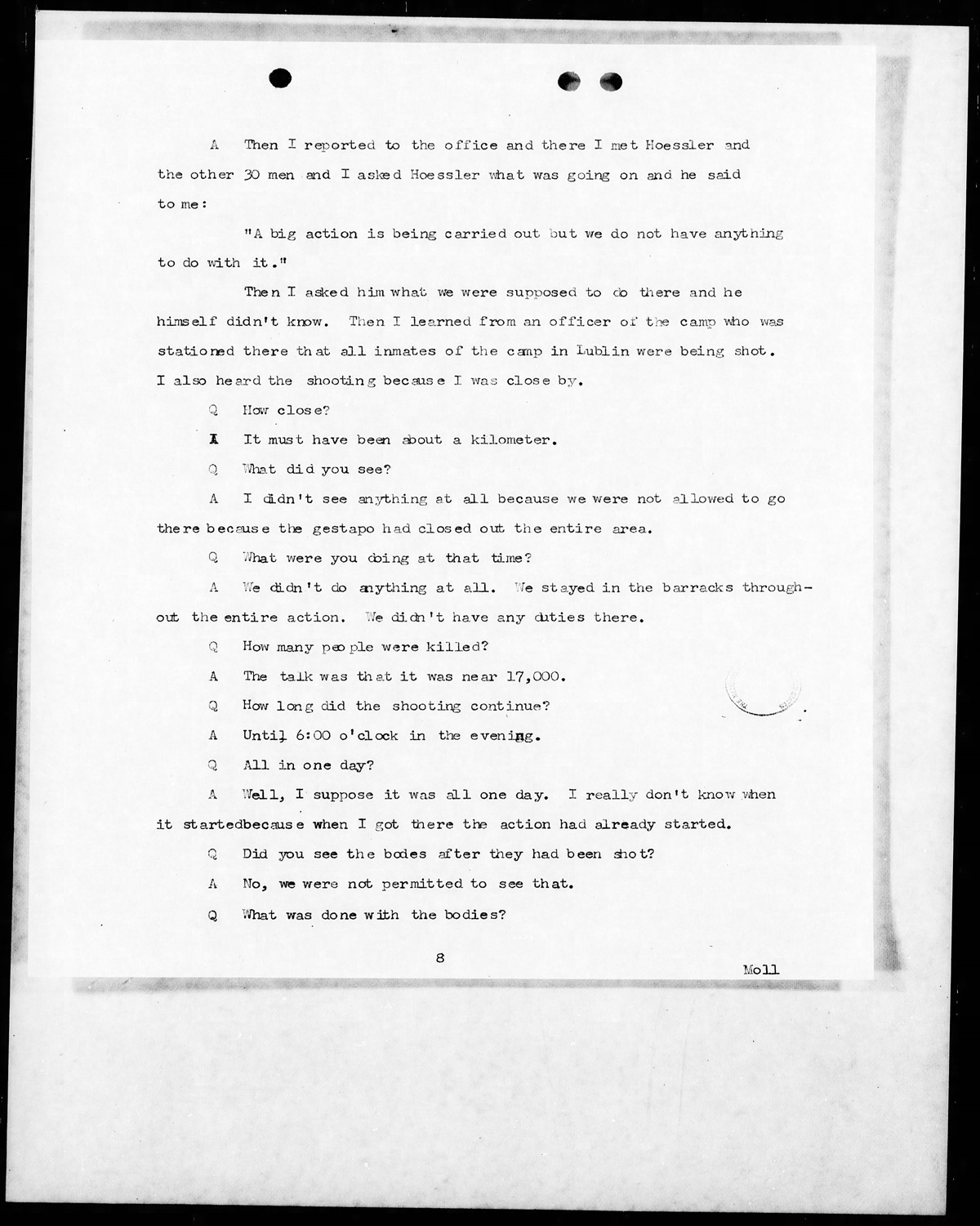
A Then I reported to the office and there I met Hoessler and the other 30 men and I asked Hoessler what was going on and he said to me:
“A big action is being carried out but we do not have anything to do with it.”
Then I asked him what we were supposed to do there and he himself didn’t know. Then I learned from an officer of the camp who was stationed there that all inmates of the camp in Lublin were being shot. I also heard the shooting because I was close by.
Q How close?
A It must have been about a kilometer.
Q What did you see?
A I didn’t see anything at all because we were not allowed to go there because the gestapo had closed out the entire area.
Q What were you doing at that time?
A We didn’t do anything at all. We stayed in the barracks throughout the entire action. We didn’t have any duties there.
Q How many people were killed?
A The talk was that it was near 17,000.
Q How long did the shooting continue?
A Until 6:00 o’clock in the evening.
Q All in one day?
A Well, I suppose it was all one day. I really don’t know when it started because when I got there the action had already started.
Q Did you see the bodies after they had been shot?
A No, we were not permitted to see that.
Q What was done with the bodies?
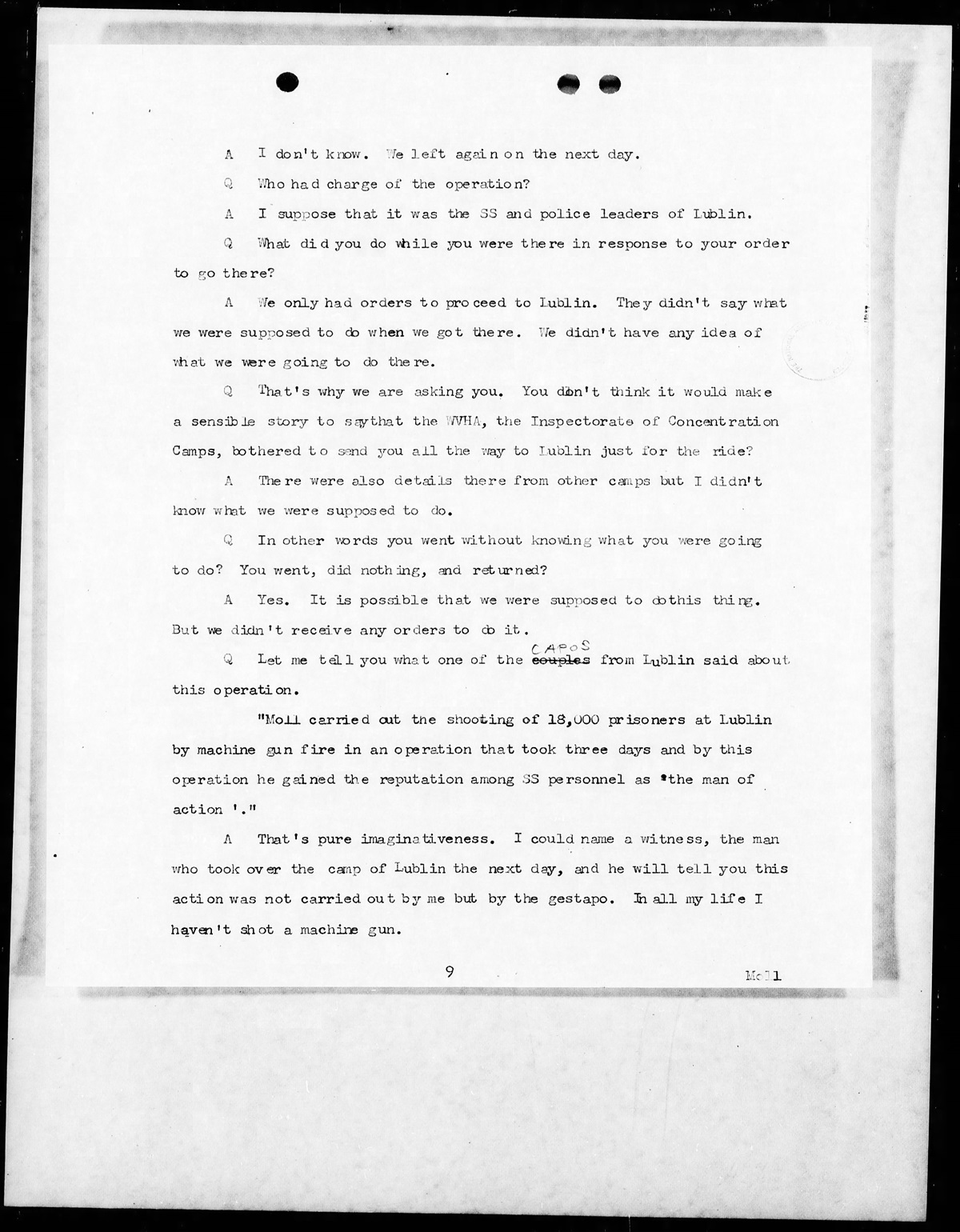
A I don’t know. We left again on the next day.
Q Who had charge of the operation?
A I suppose that it was the SS and police leaders of Lublin.
Q What did you do while you were there in response to your order to go there?
A We only had orders to proceed to Lublin. They didn’t say what we were supposed to do when we got there. We didn’t have any idea of what we were going to do there.
Q That’s why we are asking you. You don’t think it would make a sensible story to say that the WVHA, the Inspectorate of Concentration Camps, bothered to send you all the way to Lublin just for the ride?
A There were also details there from other camps but I didn’t know what we were supposed to do.
Q In other words you went without knowing what you were going to do? You went, did nothing, and returned?
A Yes. It is possible that we were supposed to do this thing. But we didn’t receive any orders to do it.
Q Let me tell you what one of the cases from Lublin said about this operation.
“Moll carried out the shooting of 18,000 prisoners at Lublin by machine gun fire in an operation that took three days and by this operation he gained the reputation among SS personnel as ‘the man of action’.”
A That’s pure imaginativeness. I could name a witness, the man who took over the camp of Lublin the next day, and he will tell you this action was not carried out by me but by the gestapo. In all my life I haven’t shot a machine gun.
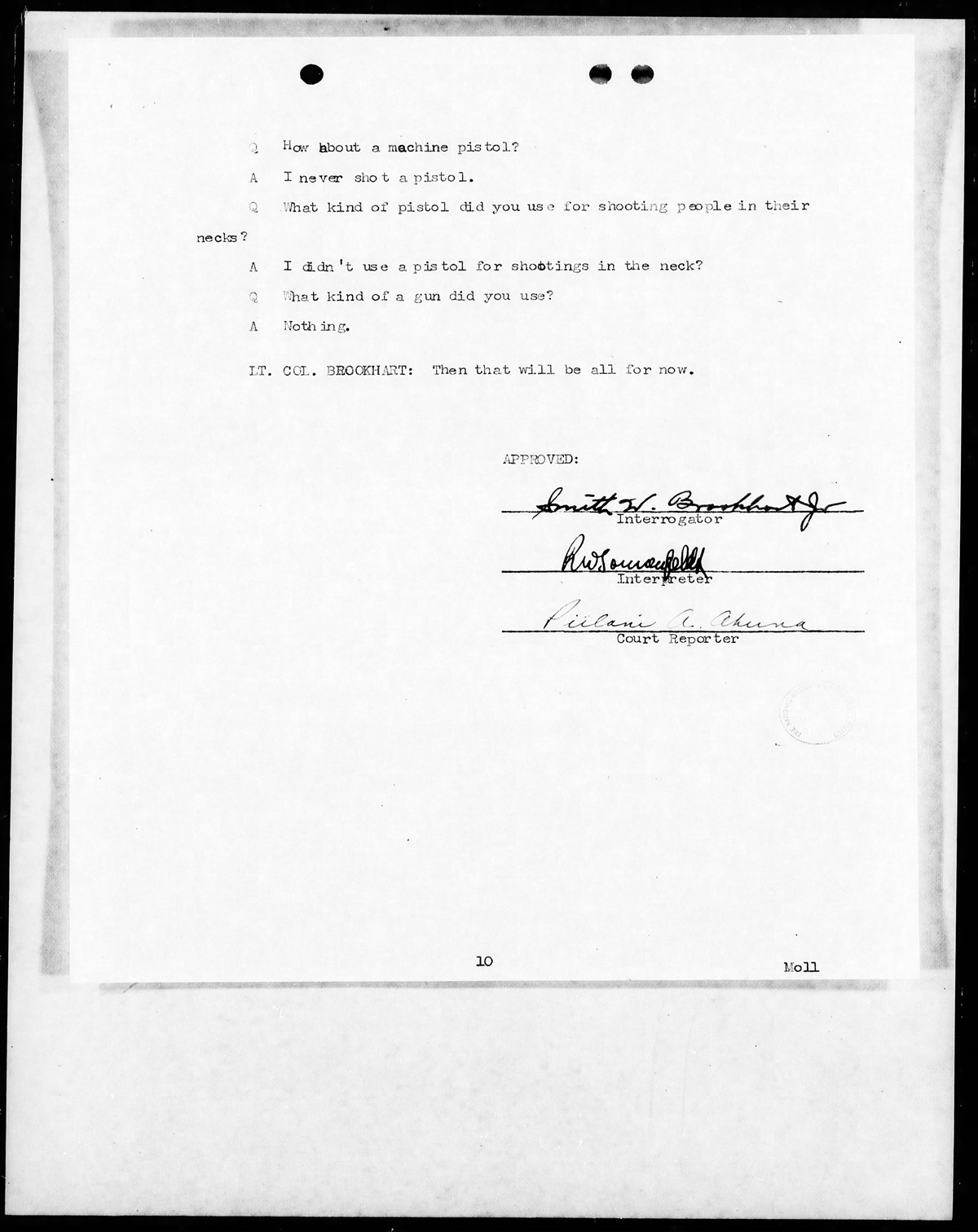
Q How about a machine pistol?
A I never shot a pistol.
Q What kind of pistol did you use for shooting people in their necks?
A I didn’t use a pistol for shootings in the neck?
Q What kind of a gun did you use?
A Nothing.
LT. COL. BROOKHART: Then that will be all for now.
APPROVED:
Smith W. Brookhart Jr
Interrogator
Richard Sonnenfeldt
Interpreter
Piilani A. Ahuna
Court Reporter
Archivial reference:
National Archives and Records Administration (NARA), Record Group 238, Series Interrogations, Summaries of Interrogations, and Related Records (NAID: 57328333)