Introduction
Joint interrogation of Otto Moll and Auschwitz commandant Rudolf Höß on April 16, 1946. Höss stated that it “was the responsibility of the subordinates, like Moll, to see that the people actually got into the gas chambers under the doctors and then to see that their bodies were burned” and that”those that were too weak to be moved to the gas chamber, or who could not be moved for some other reason, were shot thru the neck by him”. Moll testified that “we put between 30,000 and 40,000 people in those mass graves” of the Bunker extermination sites in 1942, whereas Höss gave a higher figure, “the people buried in the two big mass graves of the so-called dugouts: one and two, amounted to 106,000 or 107,000 people”.
See also Testimony of Otto Moll, Head of Auschwitz Crematoria
Document


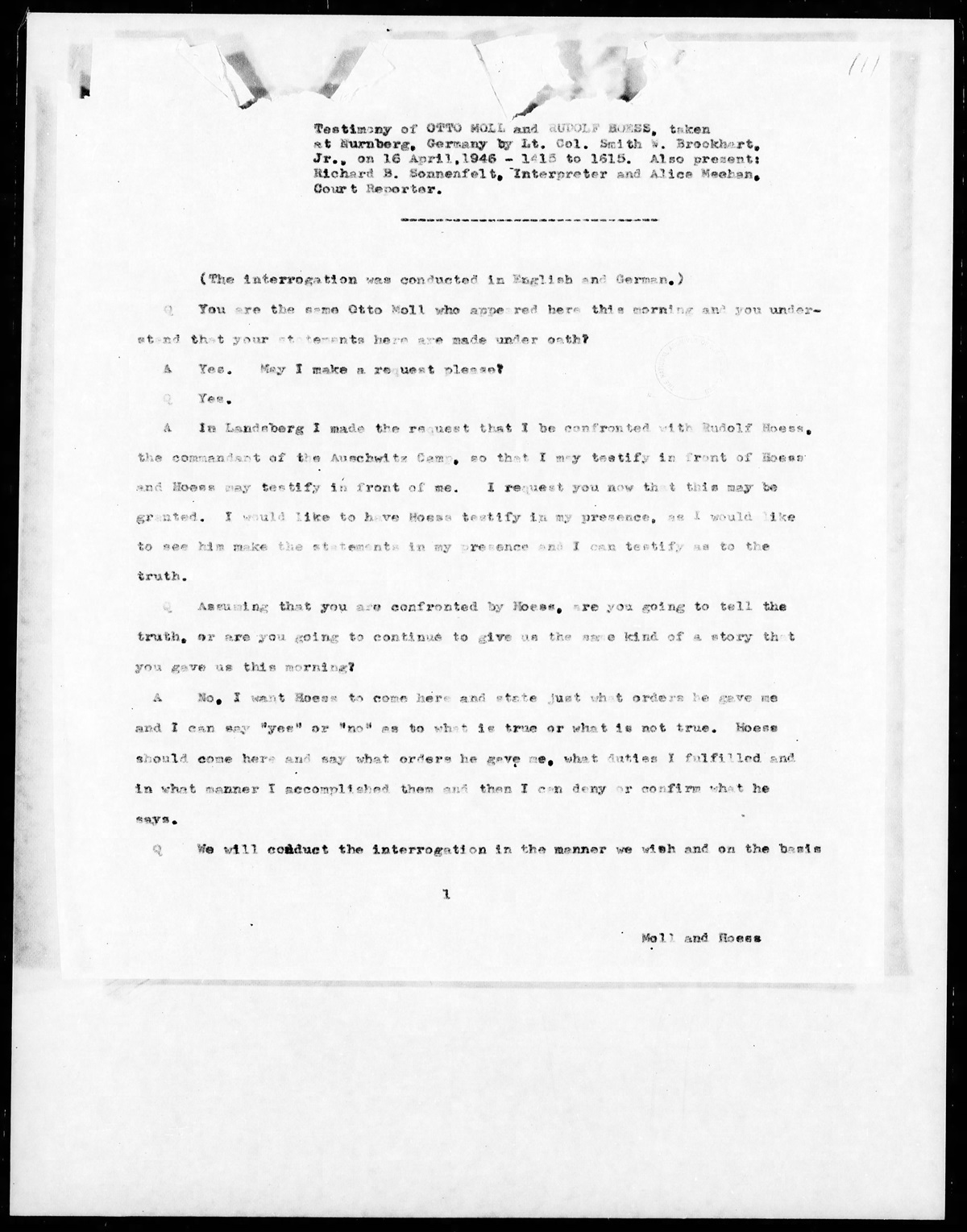
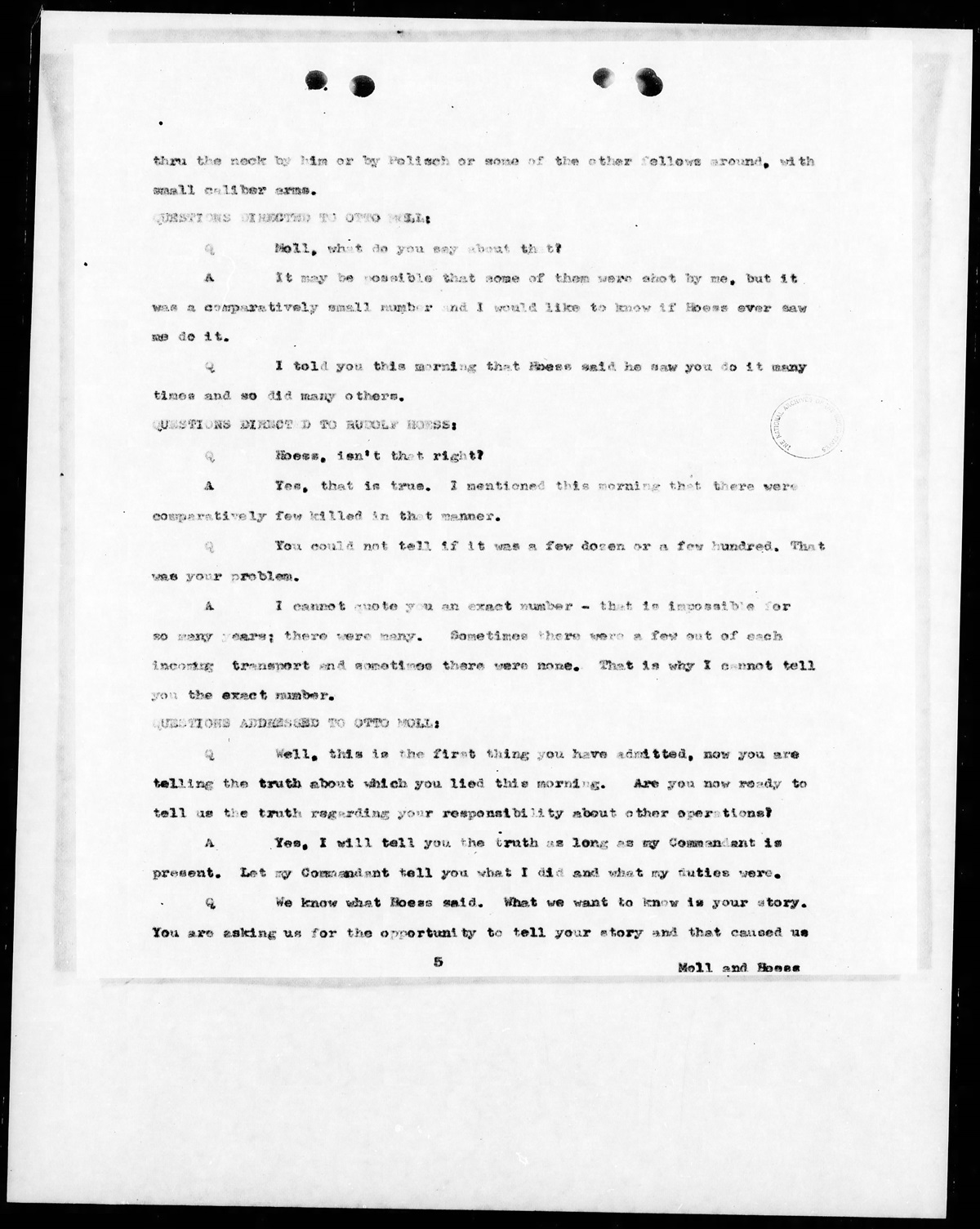
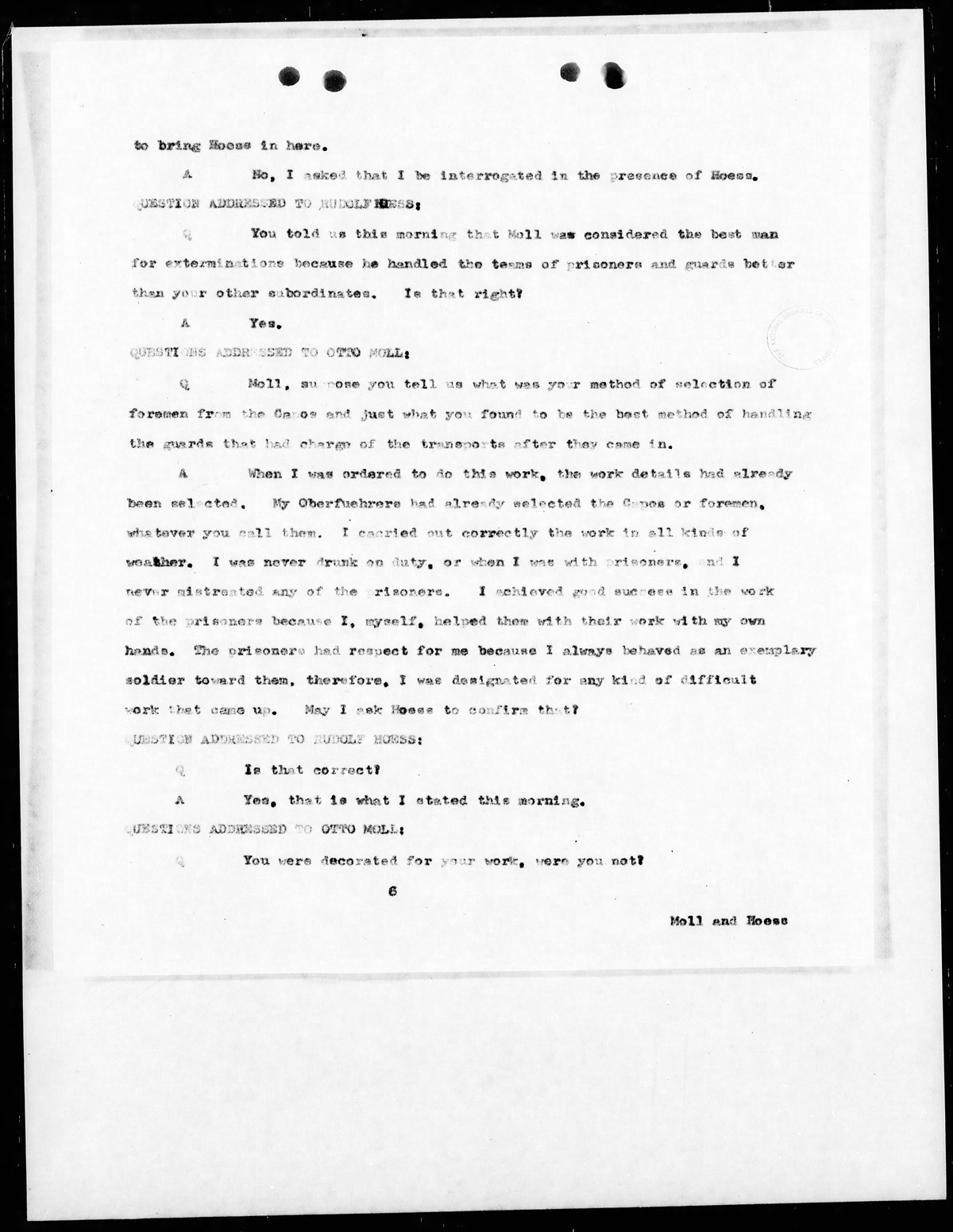
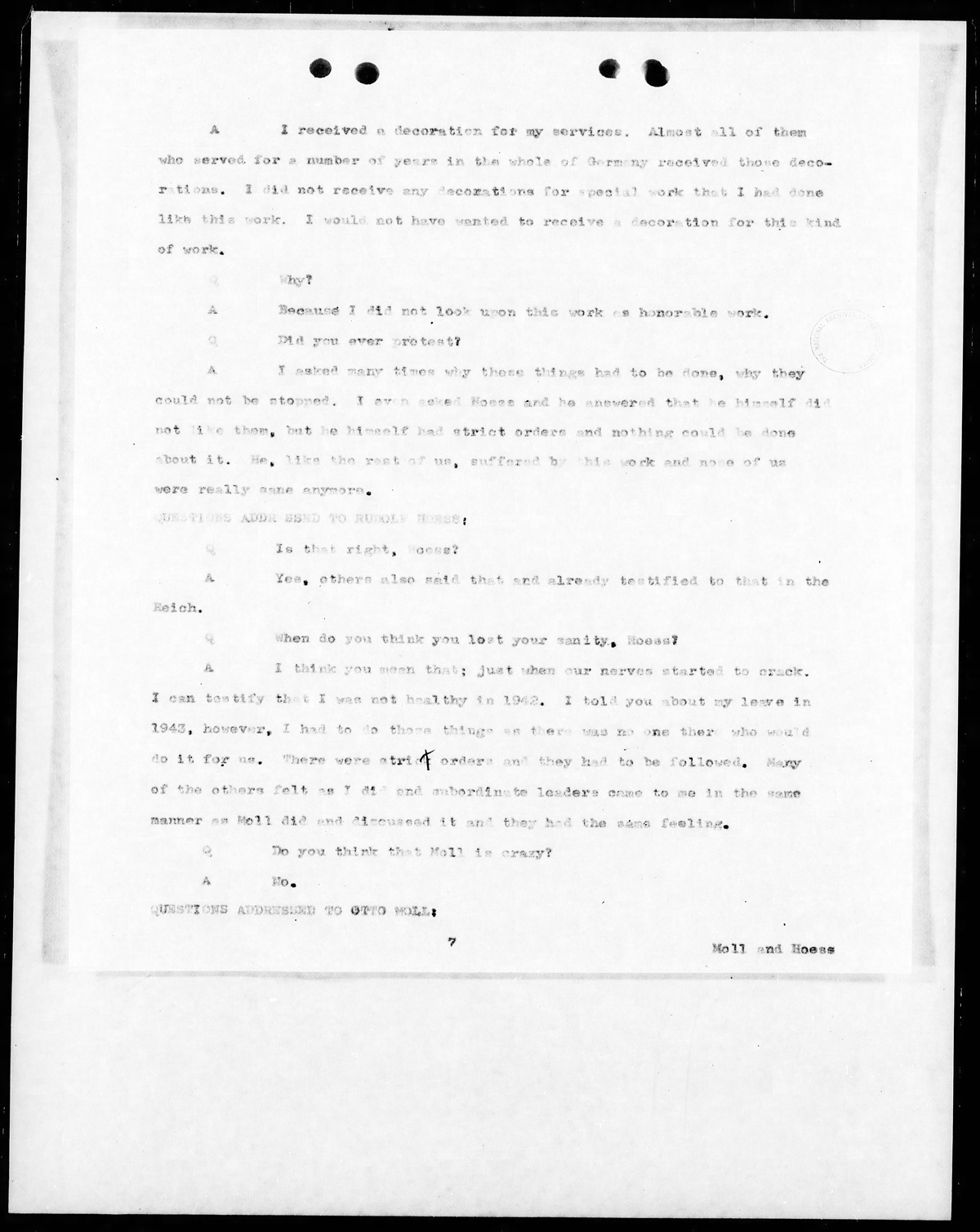
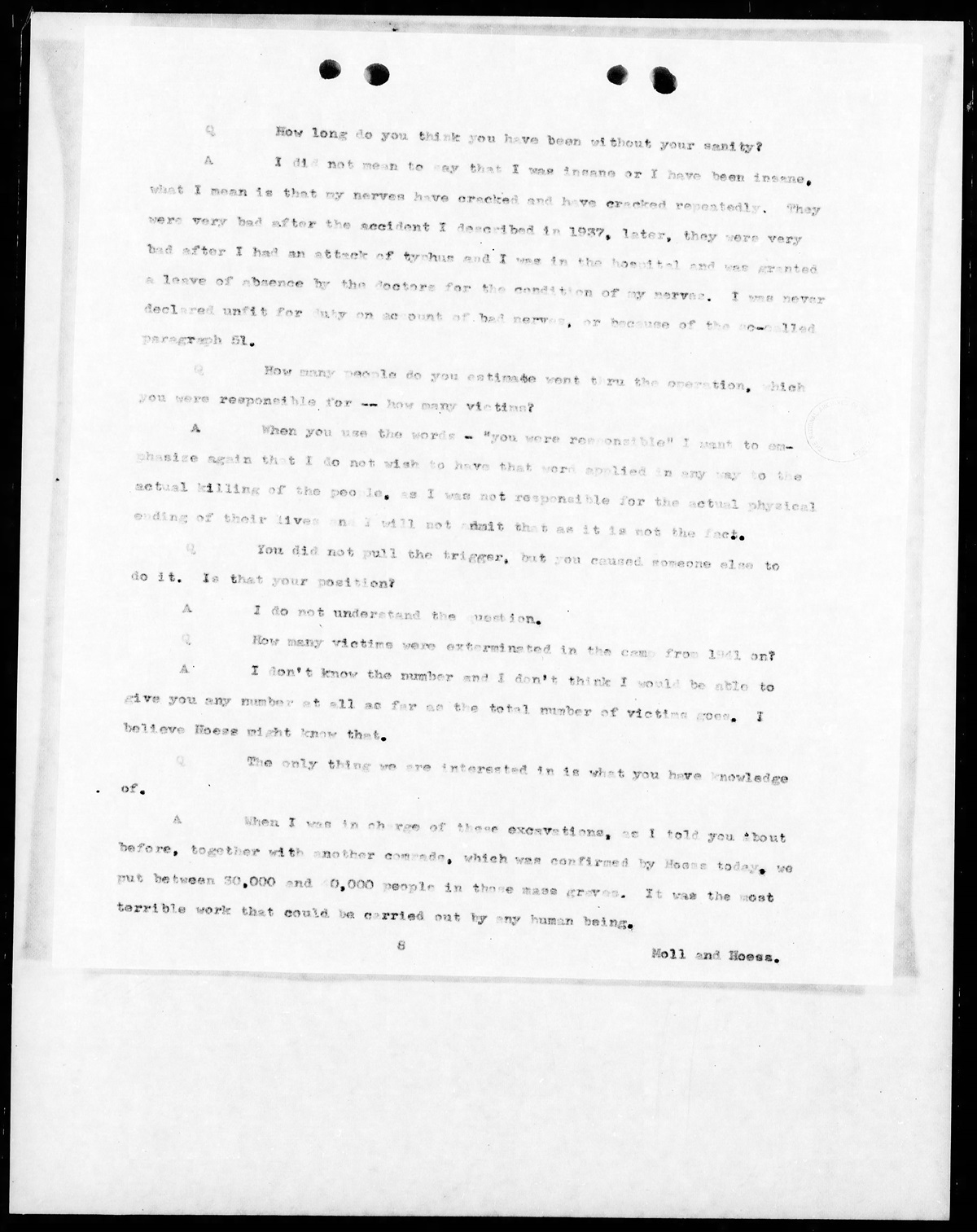
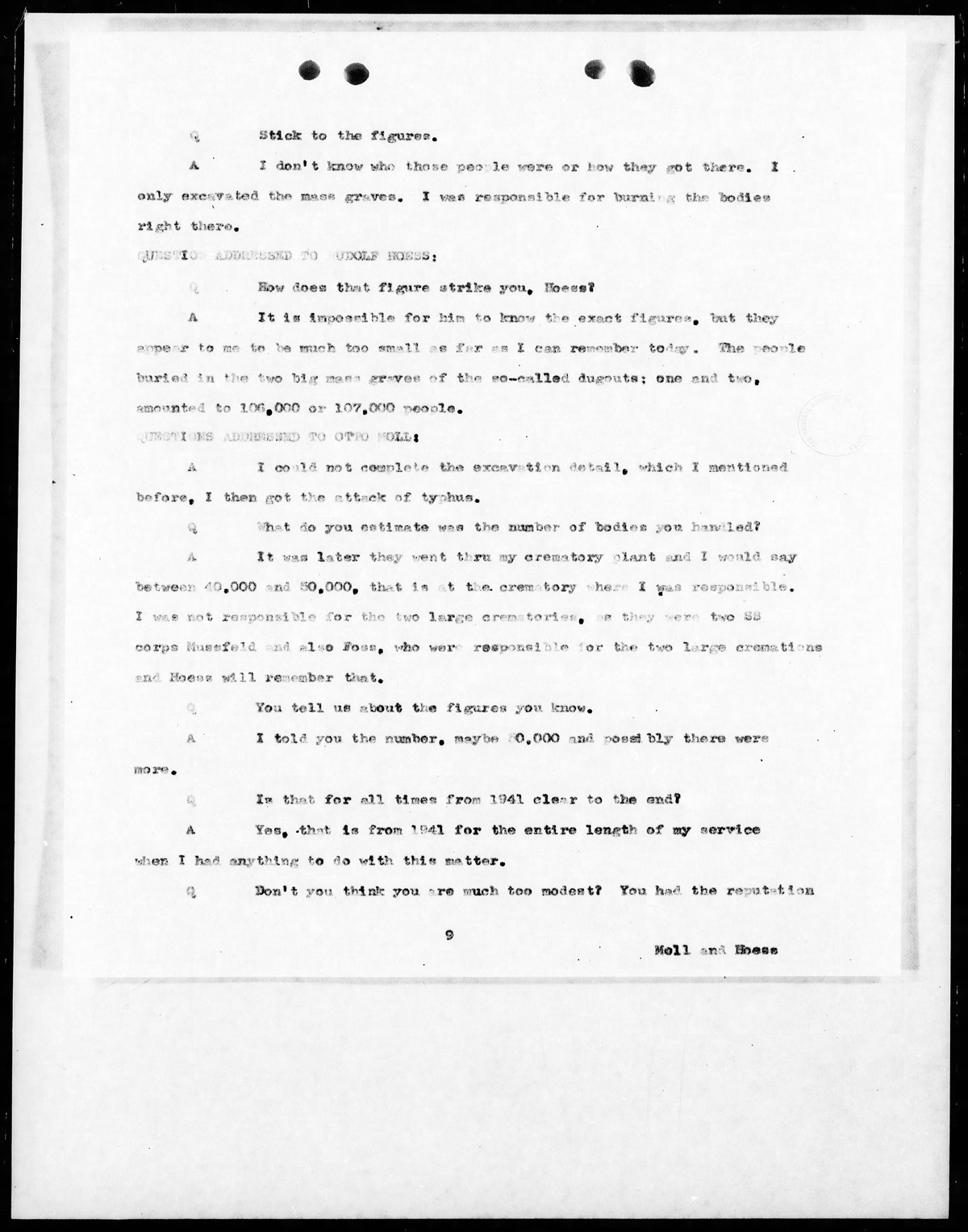
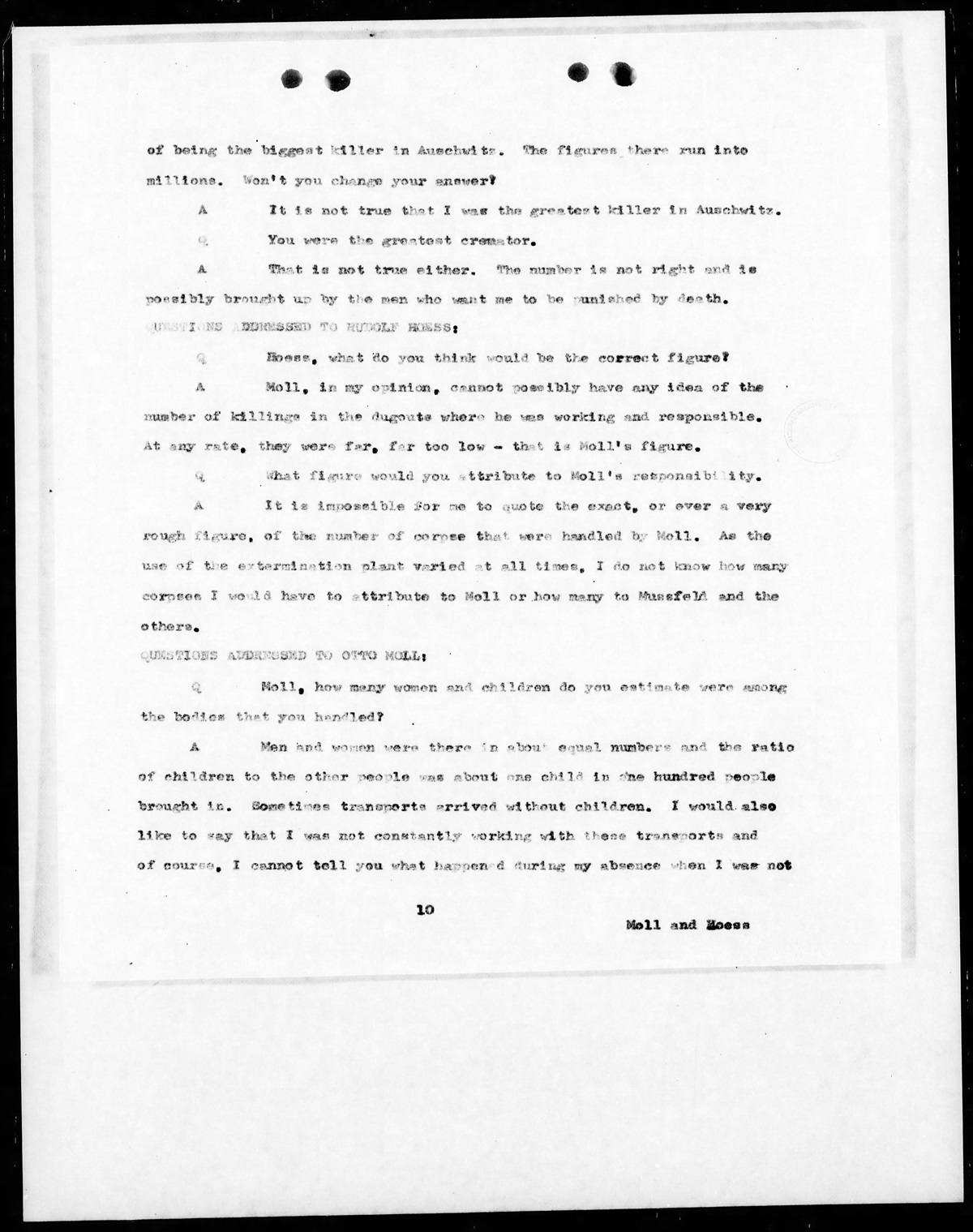
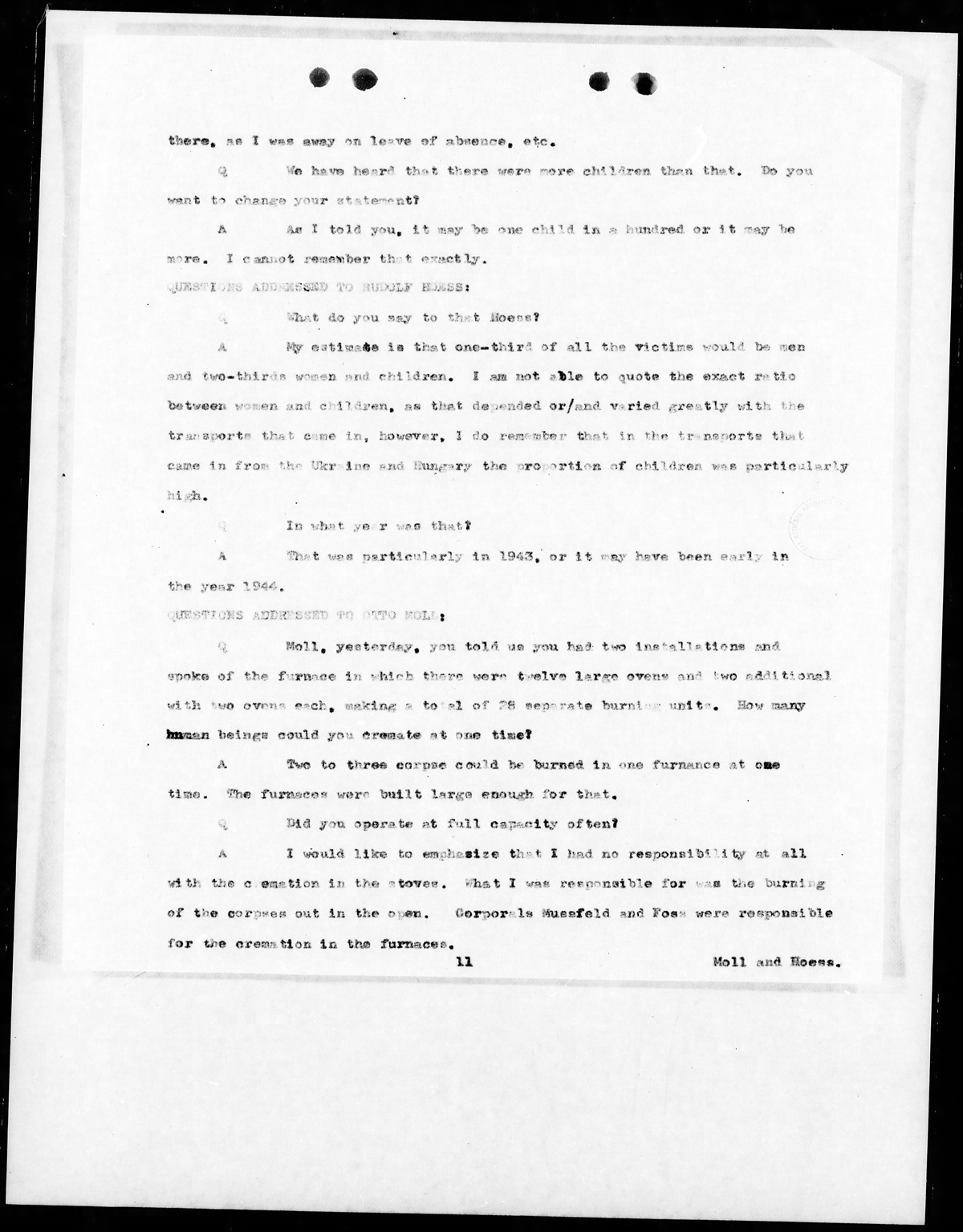
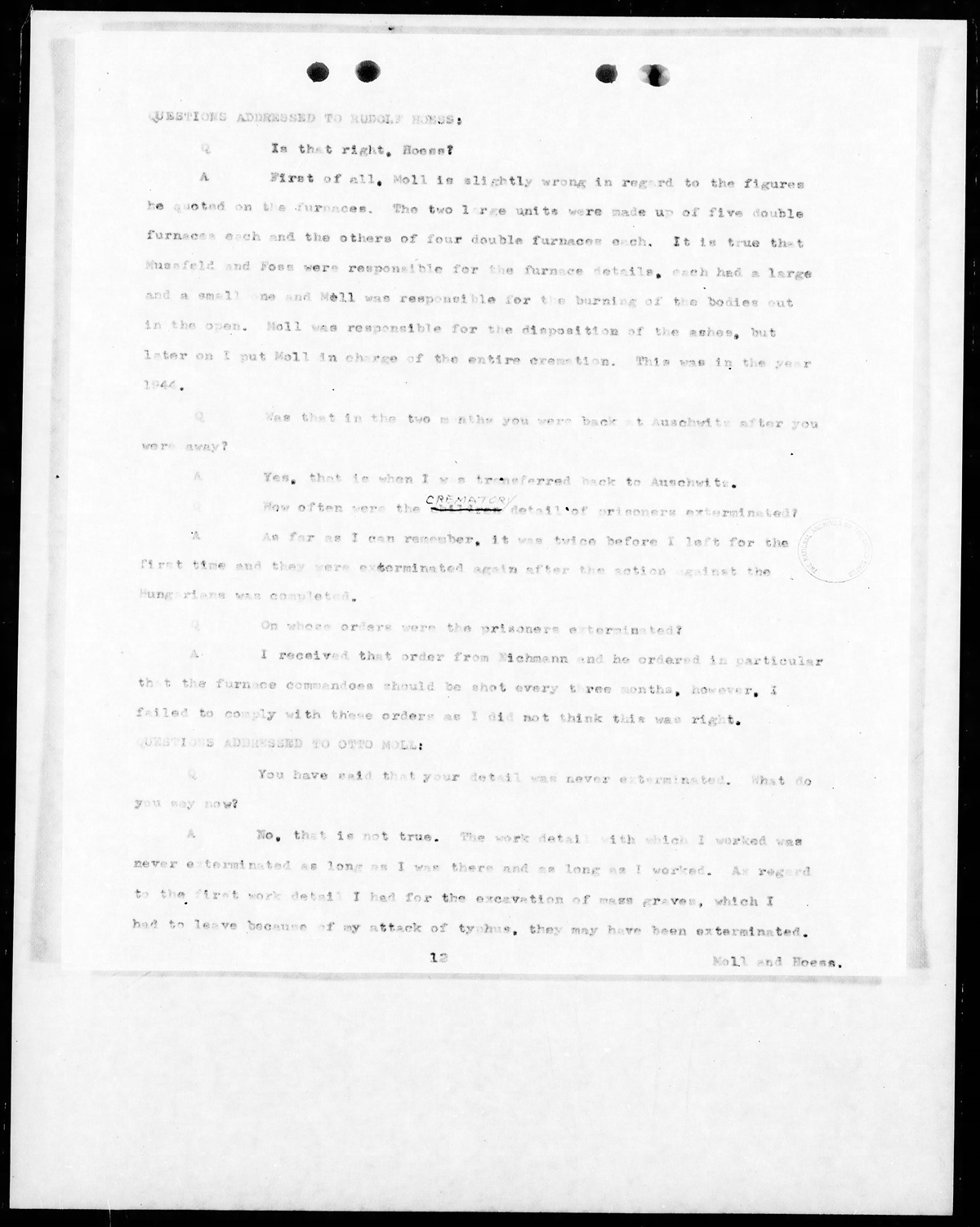
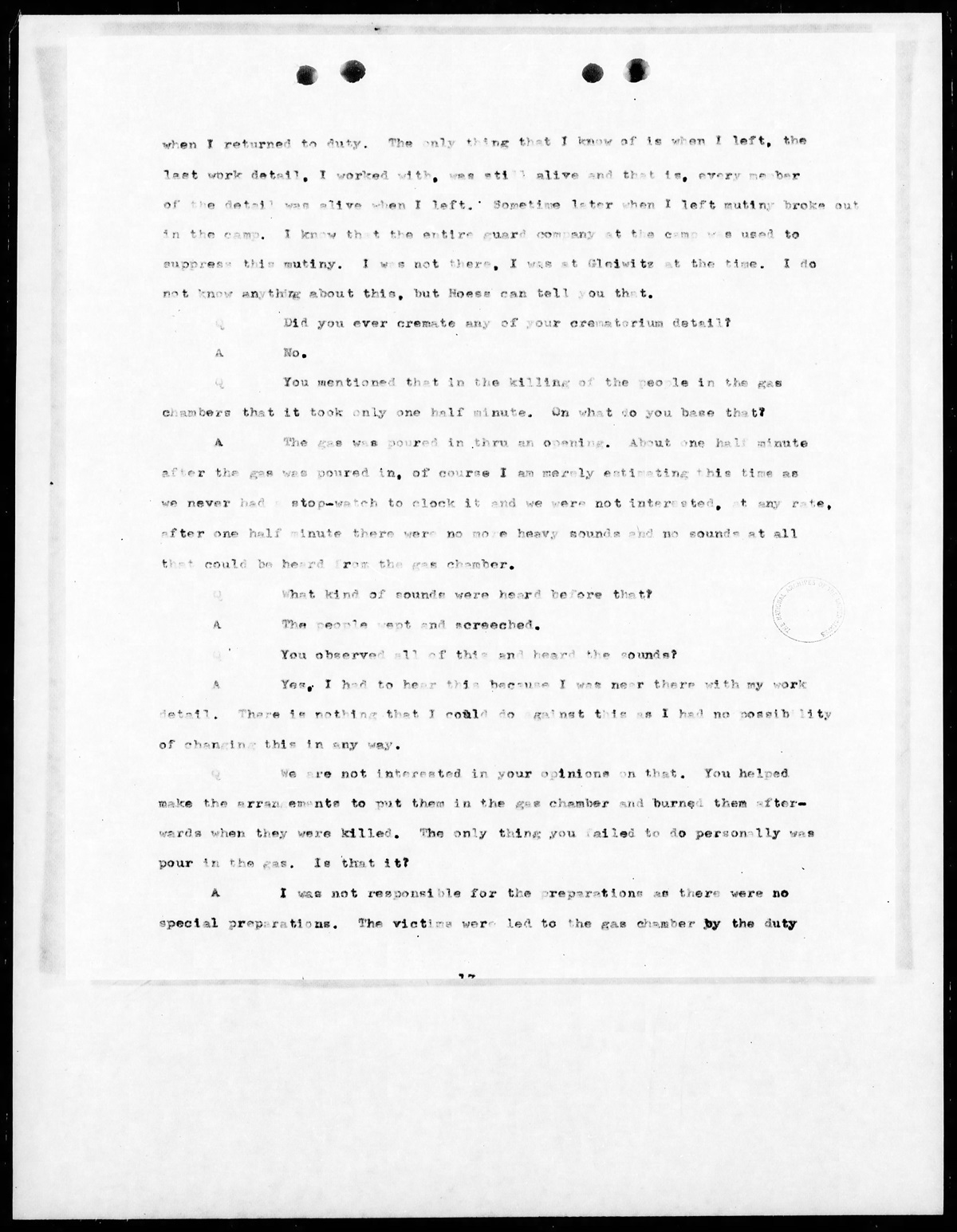
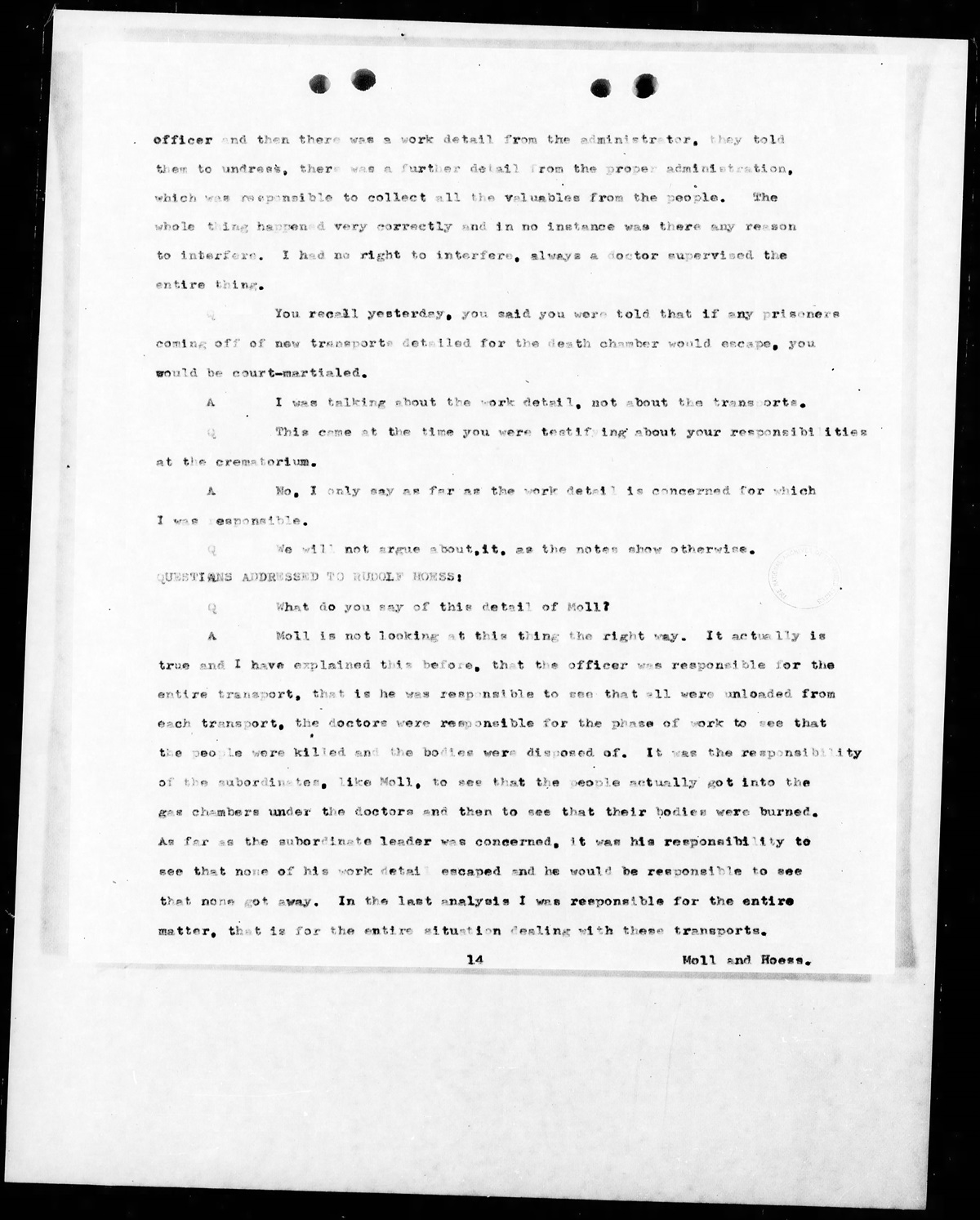
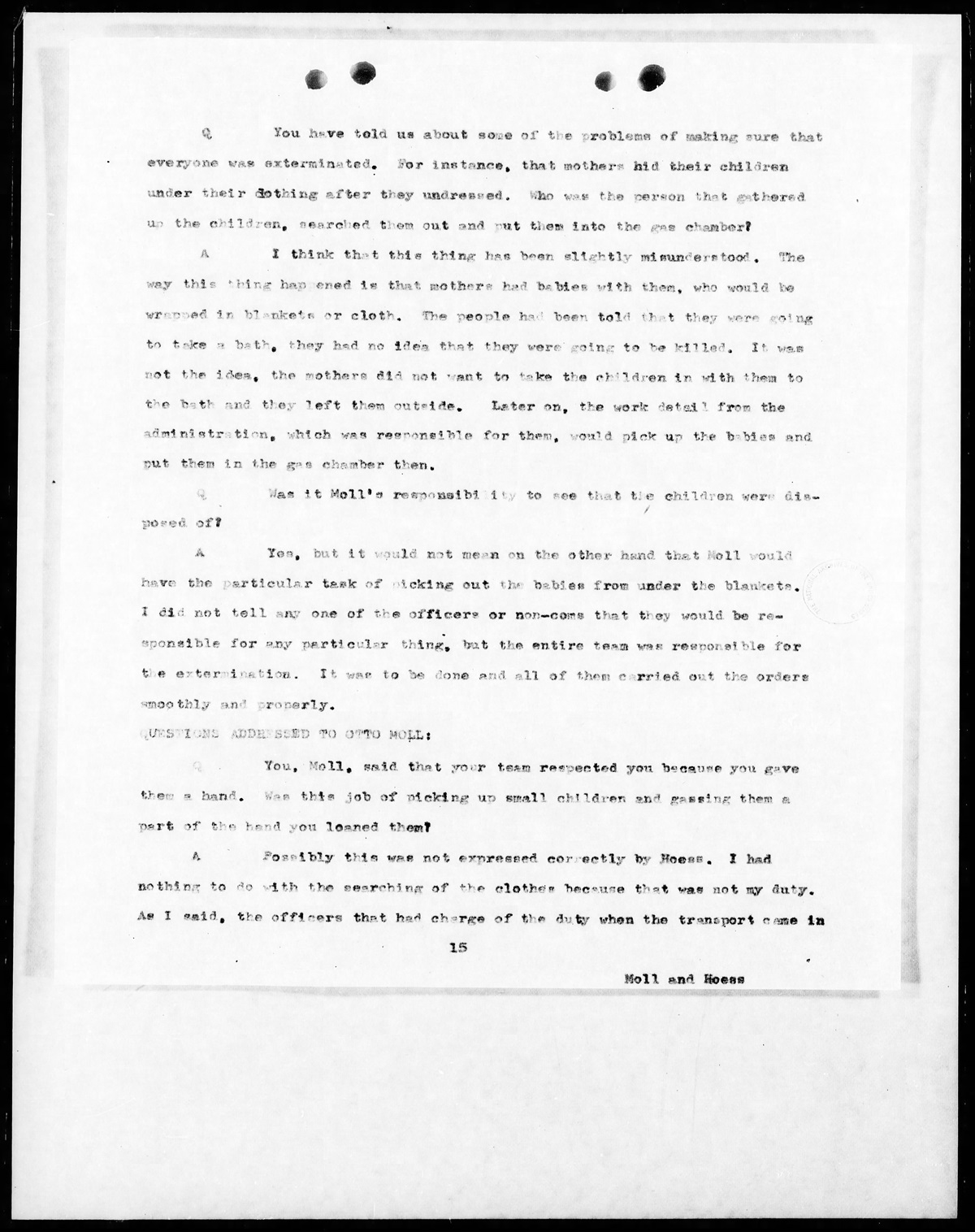
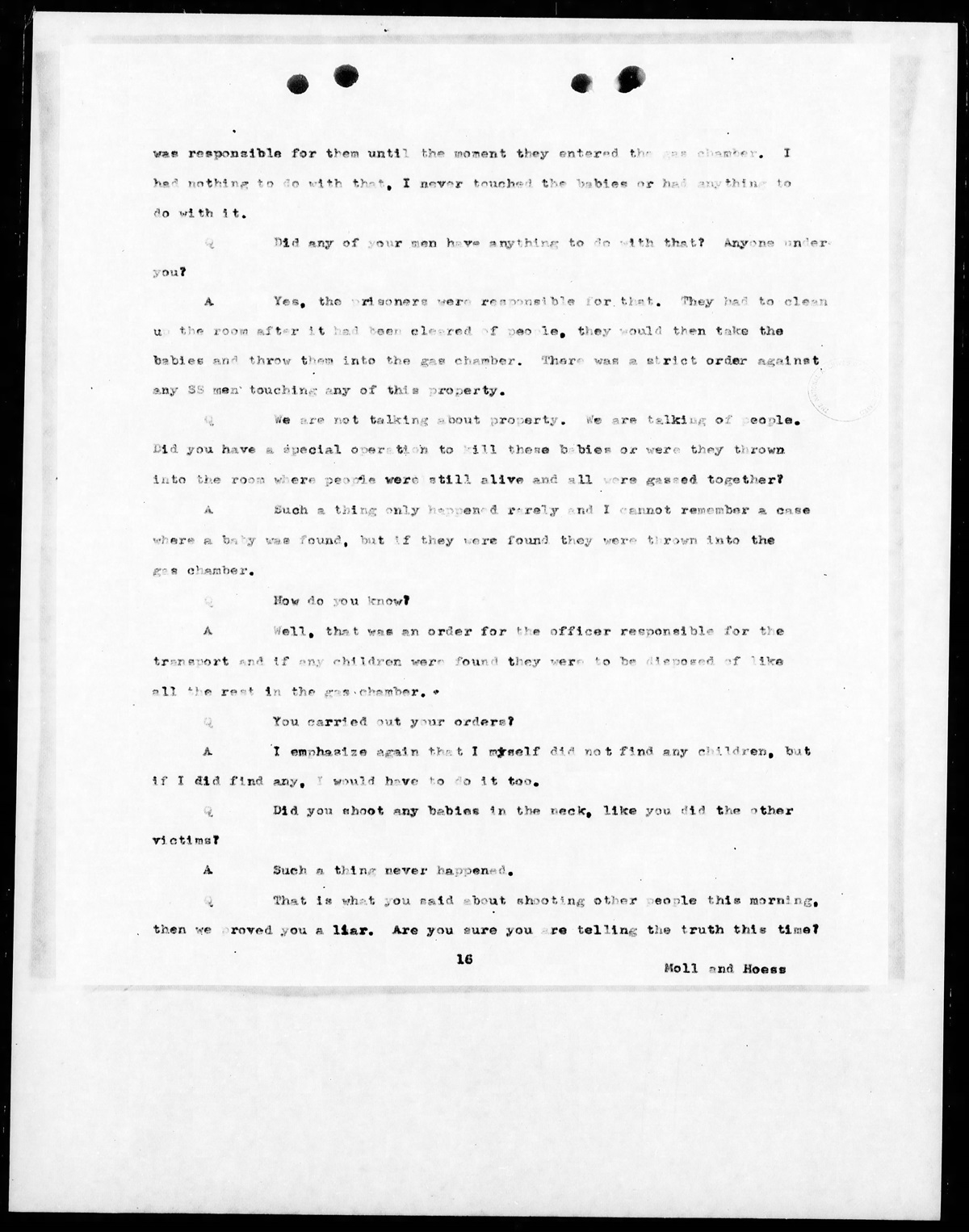
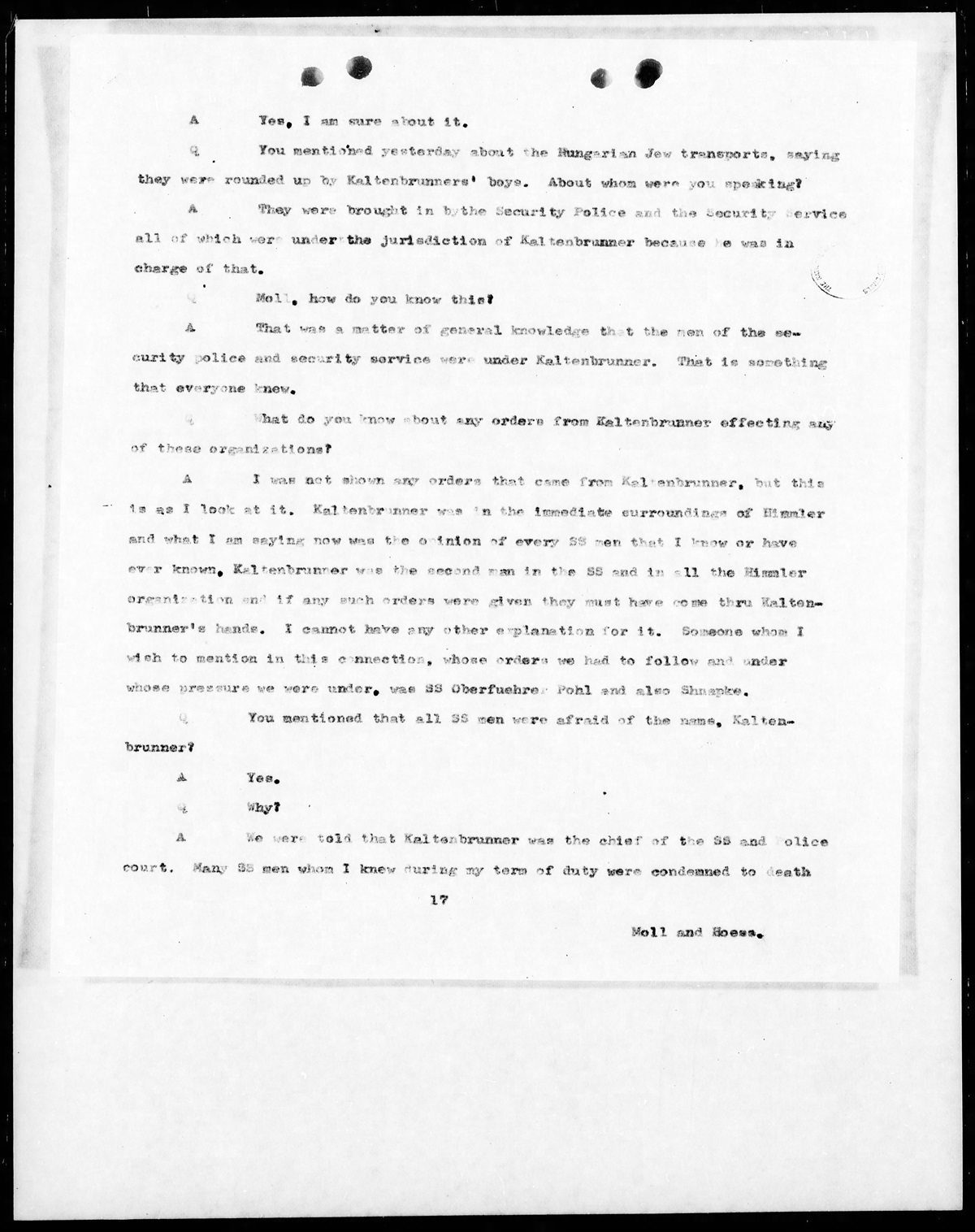
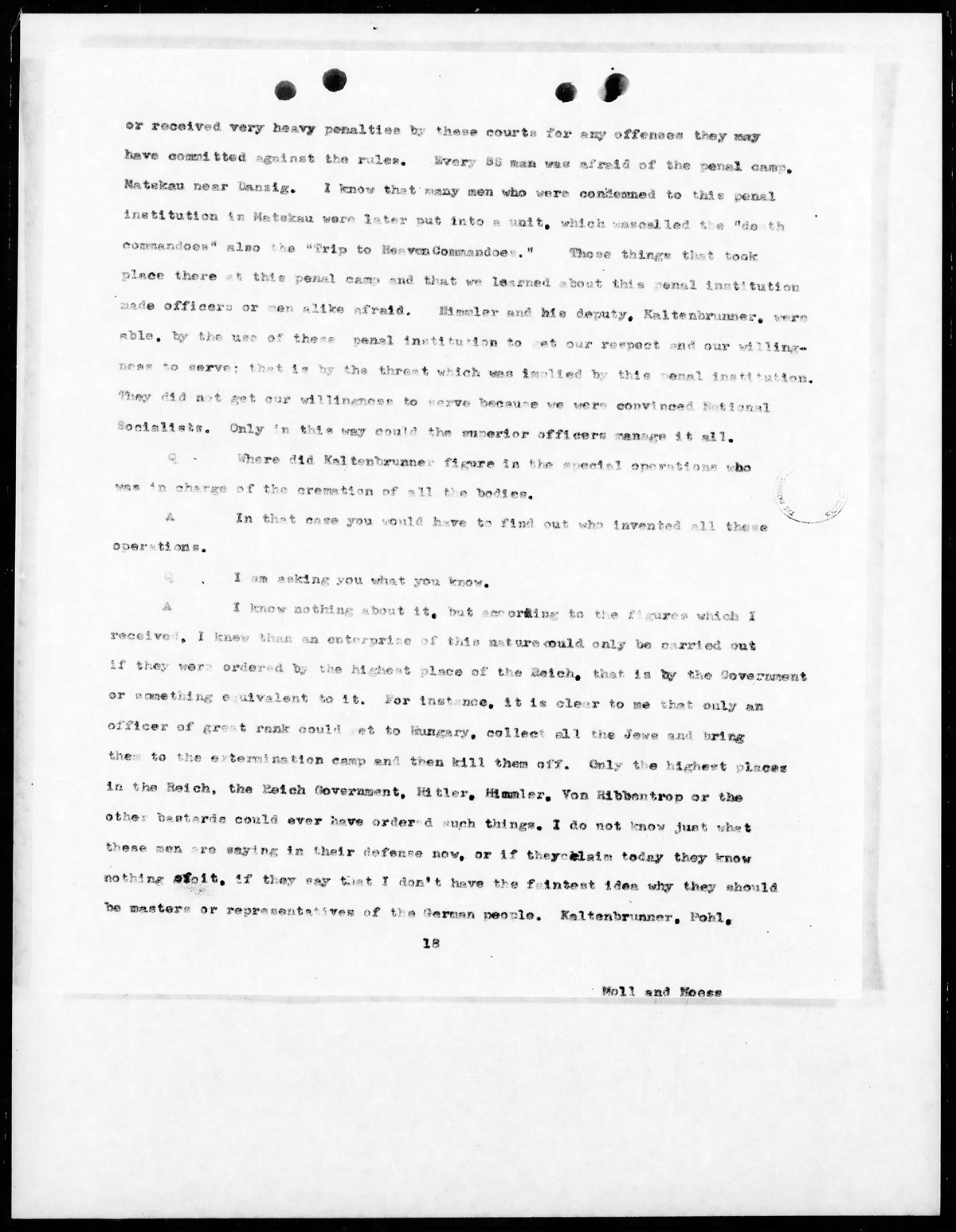
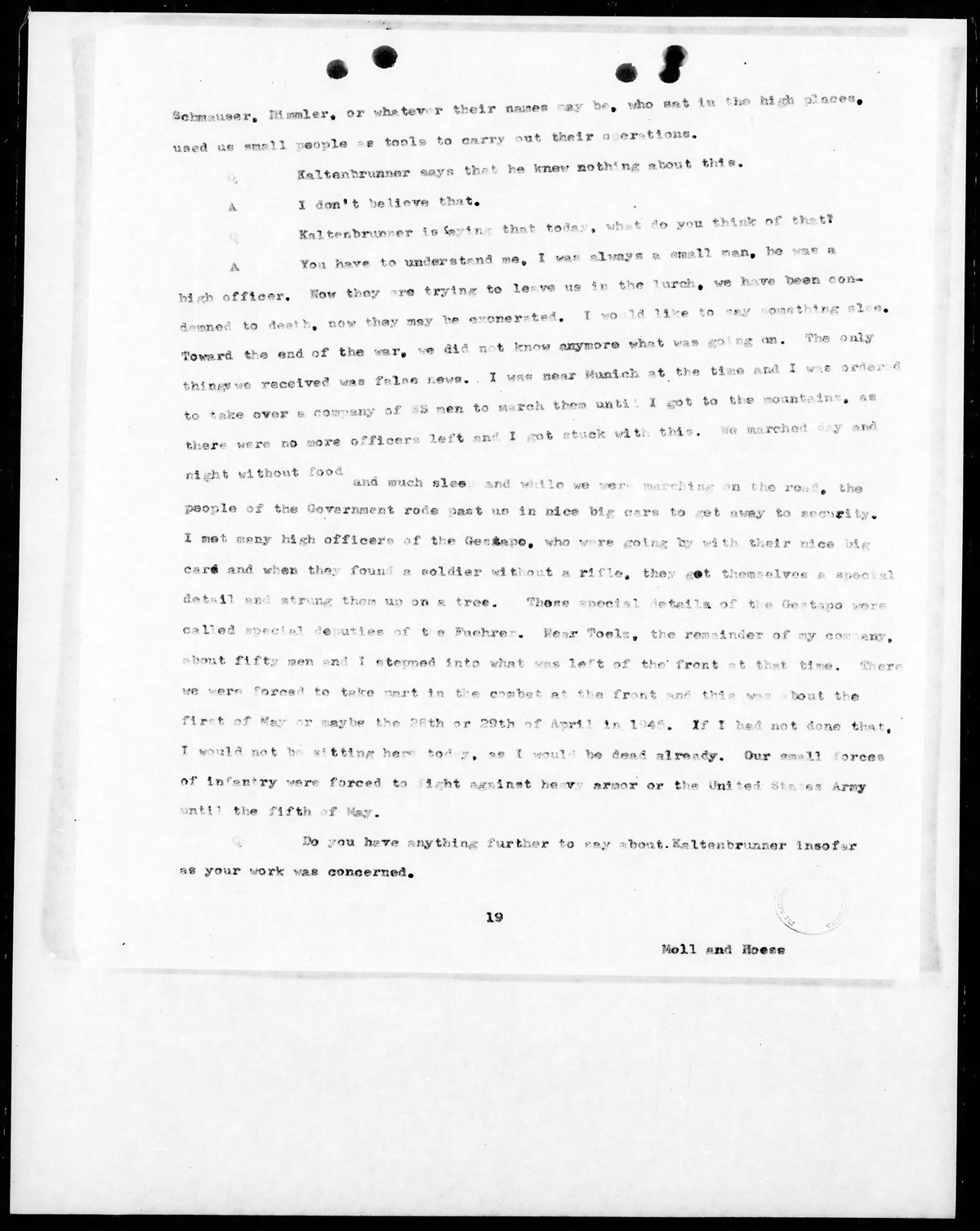
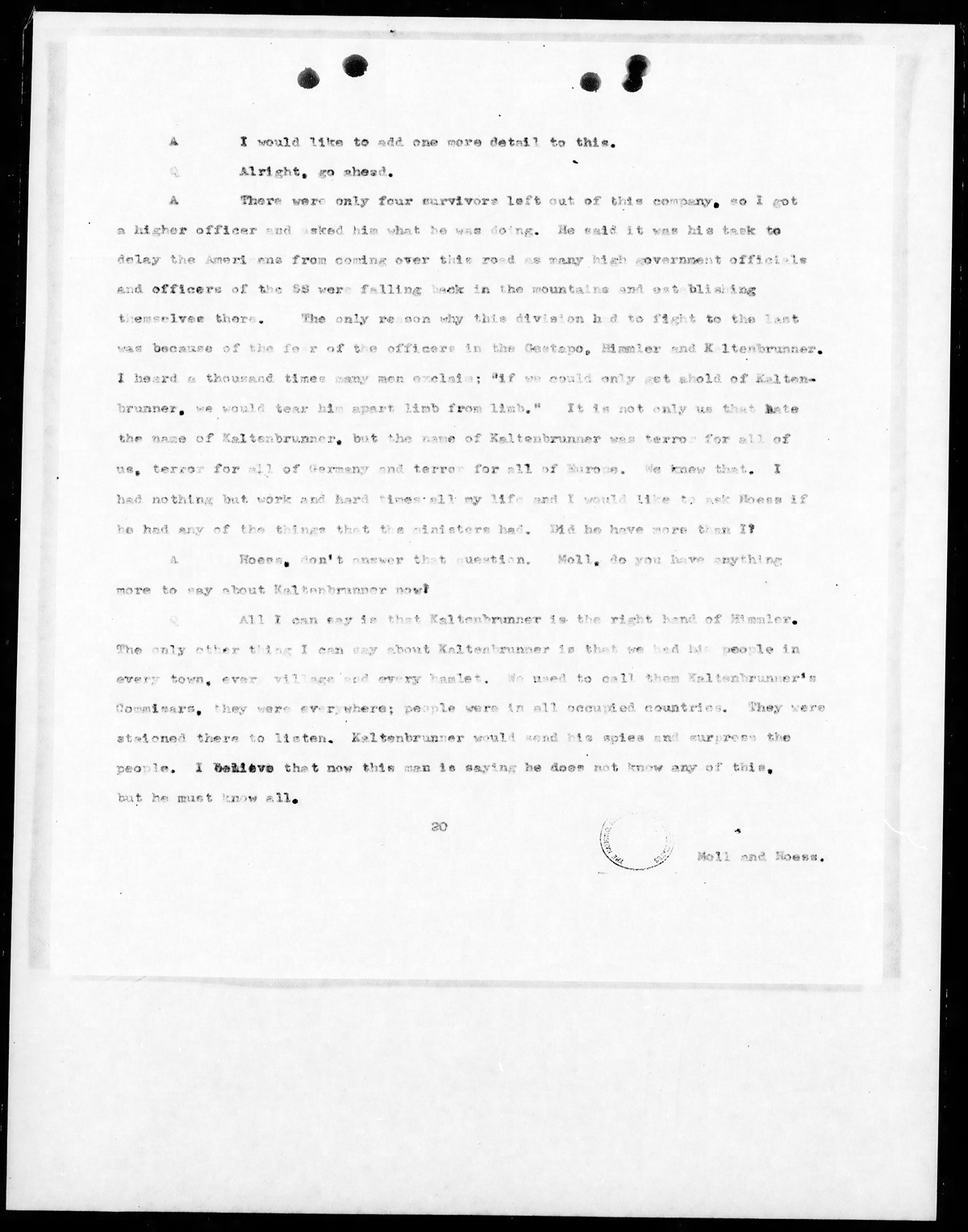
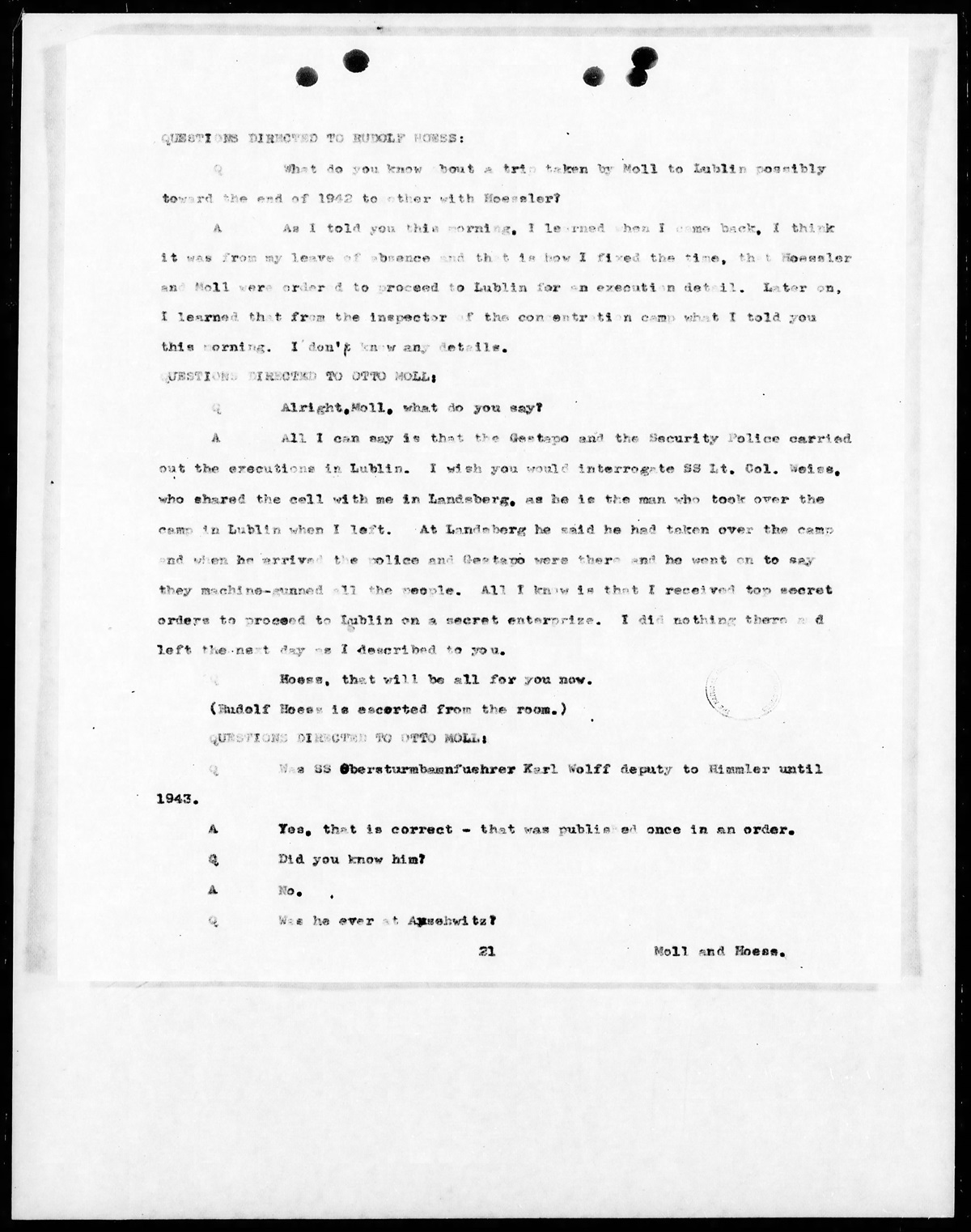
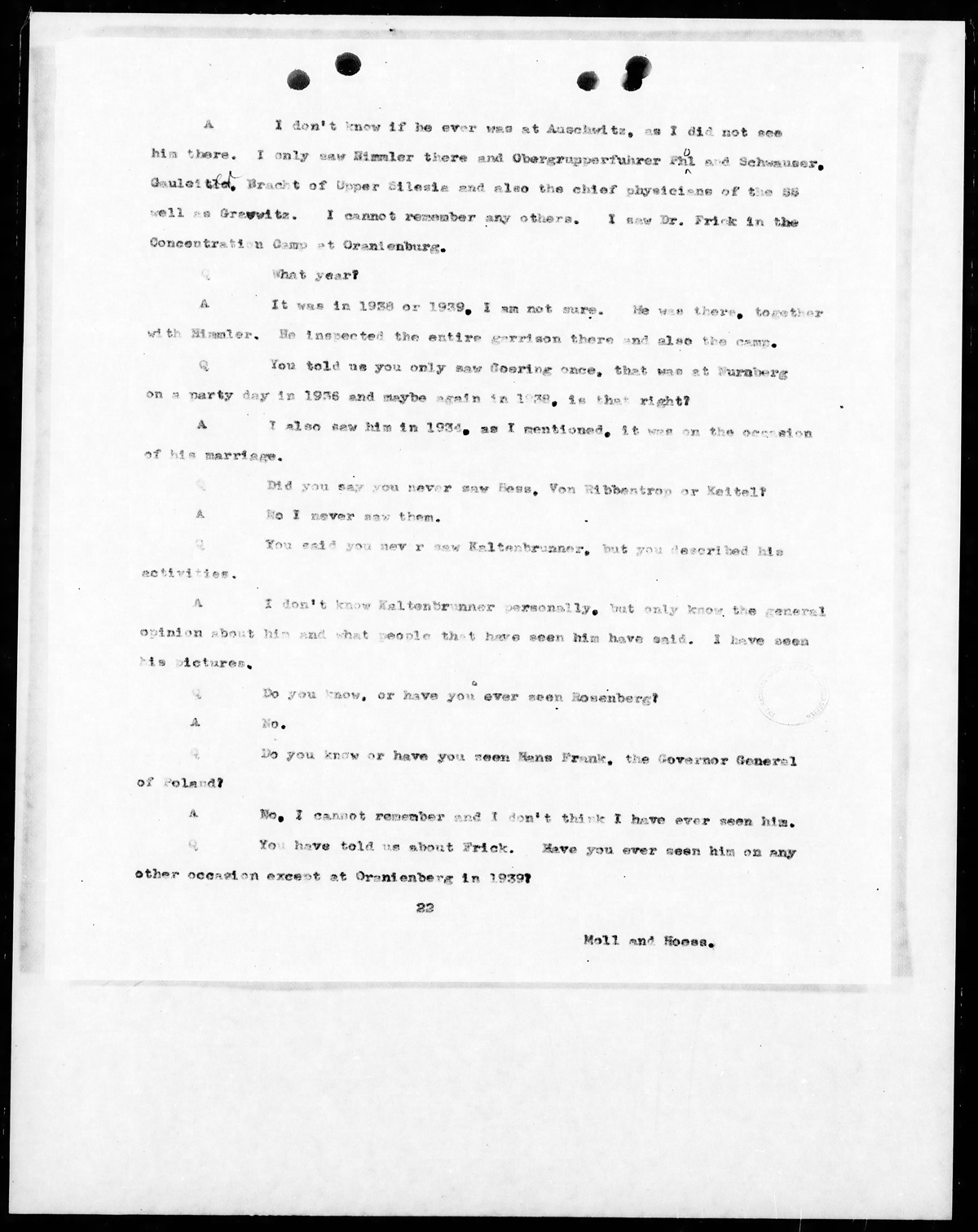
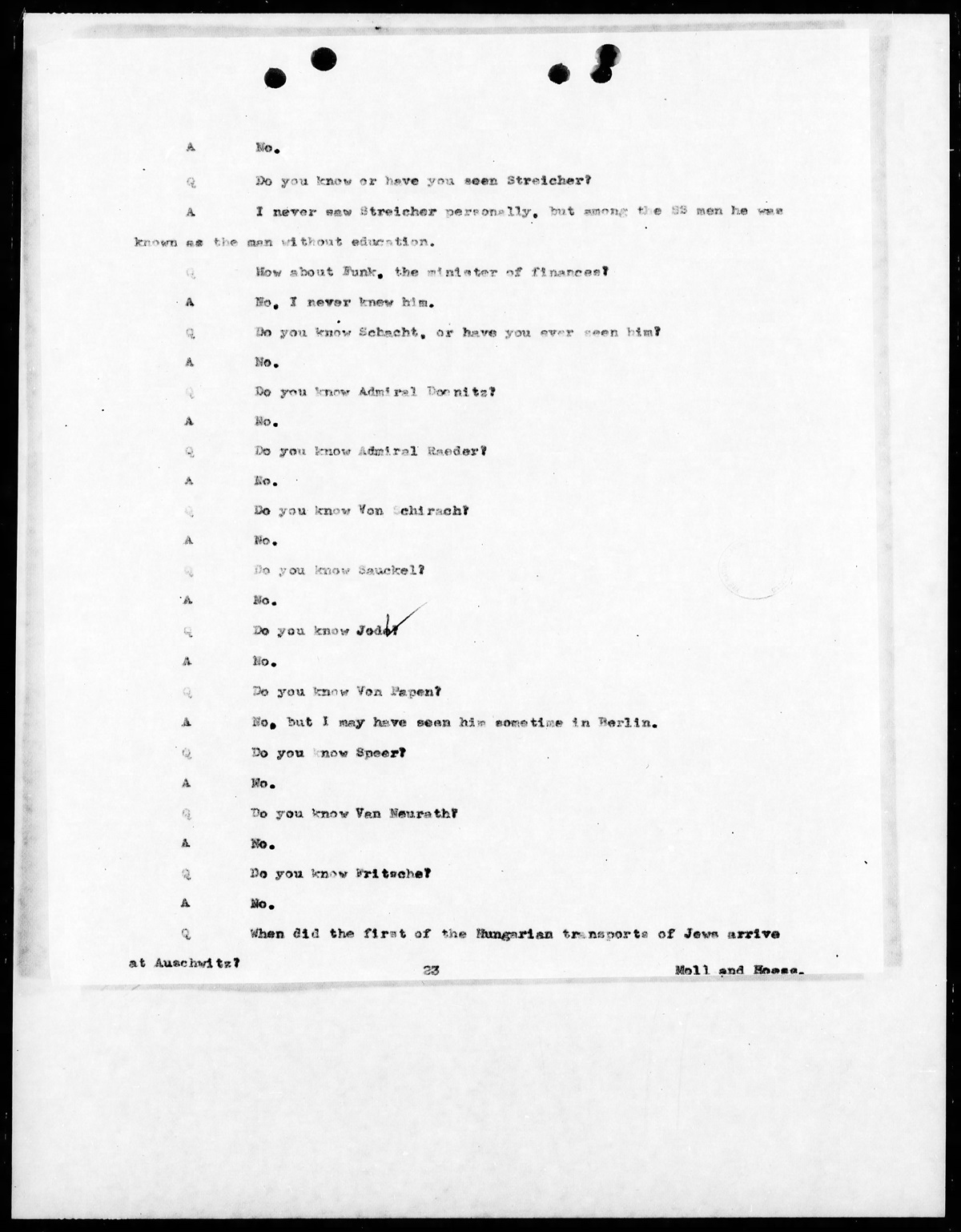
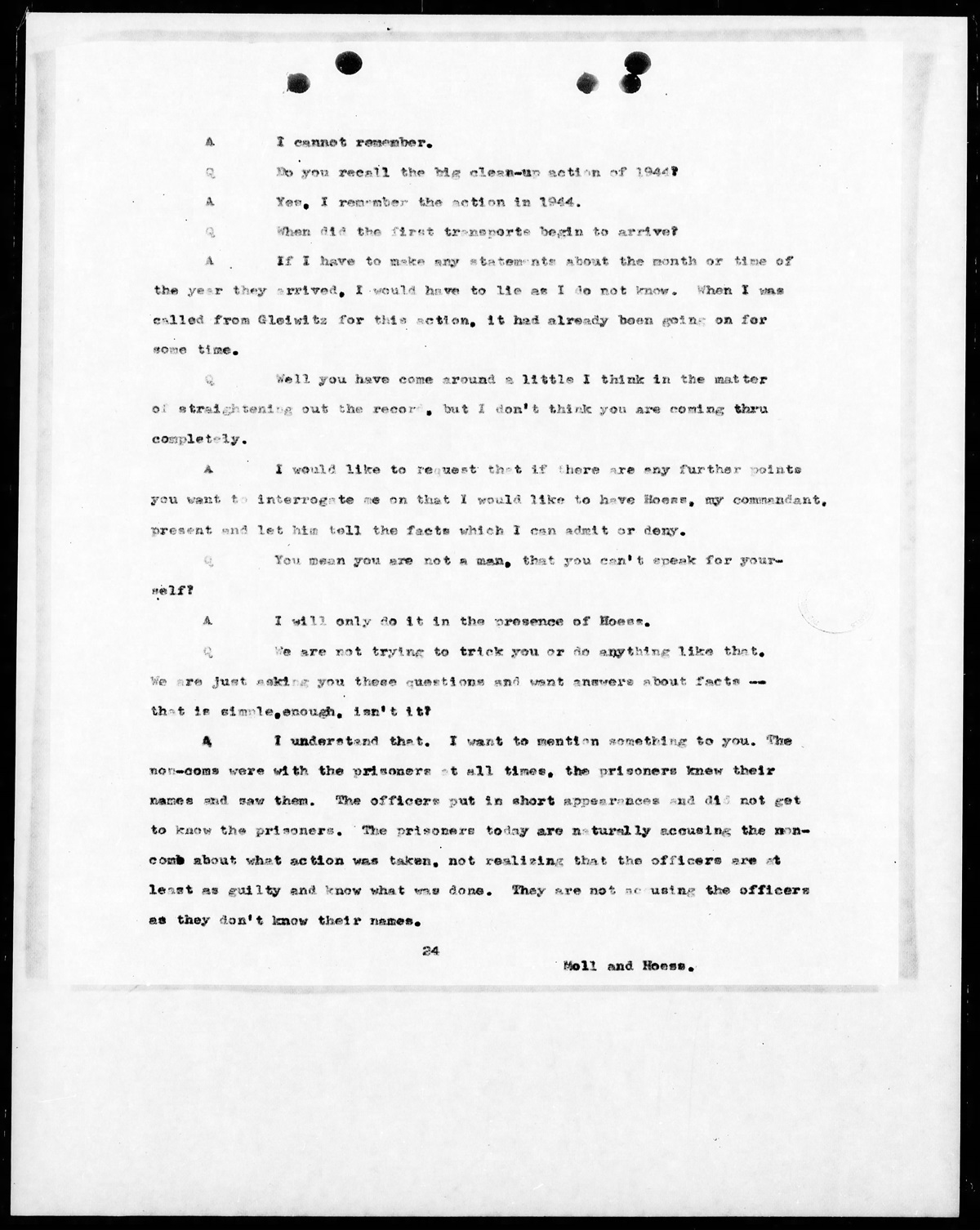
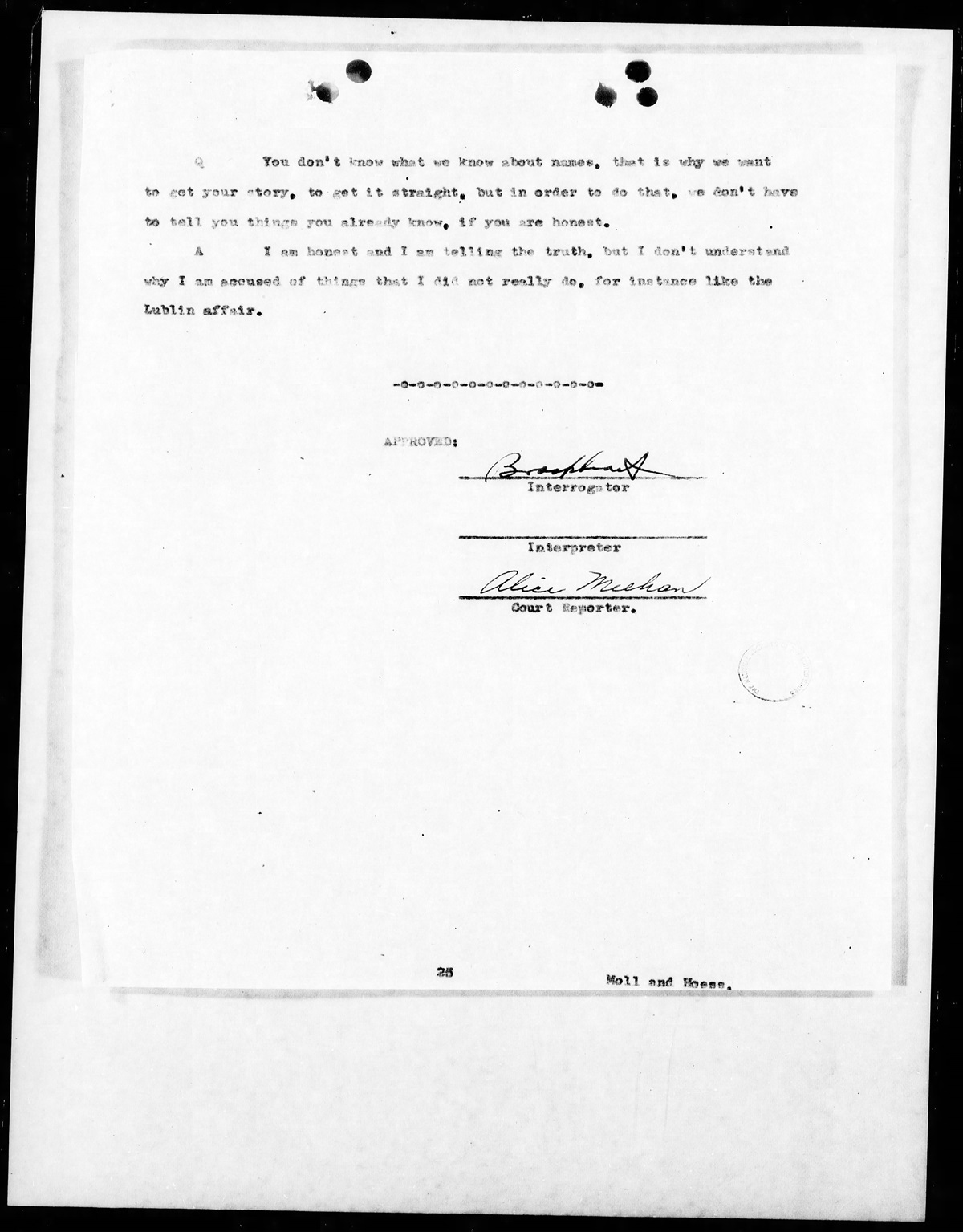


Testimony of Otto Moll and Rudolf Hoess, taken at Nurnberg, Germany by Lt. Col. Smith W. Brockhart Jr., on 16 April, 1946 – 1415 to 1615. Also present: Richard B. Sonnenfelt, Interpreter and Alice Meehan, Court Reporter.
(The interrogation was conducted in English and German.)
Q. You are the same Otto Moll who appeared here this morning and you understand that your statements here are made under oath?
A. Yes. May I make a request please?
Q. Yes.
A. In Landsberg I made the request that I be confronted with Rudolf Hoess, the commandant of the Auschwitz Camp, so that I may testify in front of Hoess and Hoess may testify in front of me. I request you now that this may be granted. I would like to have Hoess testify in my presence, as I would like to see him make the statements in my presence and I can testify as to the truth.
Q. Assuming that you are confronted by Hoess, are you going to tell the truth, or are you going to continue to give us the same kind of a story that you gave us this morning?
A. No, I want Hoess to come here and state just what orders he gave me and I can say “yes” or “no” as to what is true or what is not true. Hoess should come here and say what orders he gave me, what duties I fulfilled and in what manner I accomplished them and then I can deny or confirm what he says.
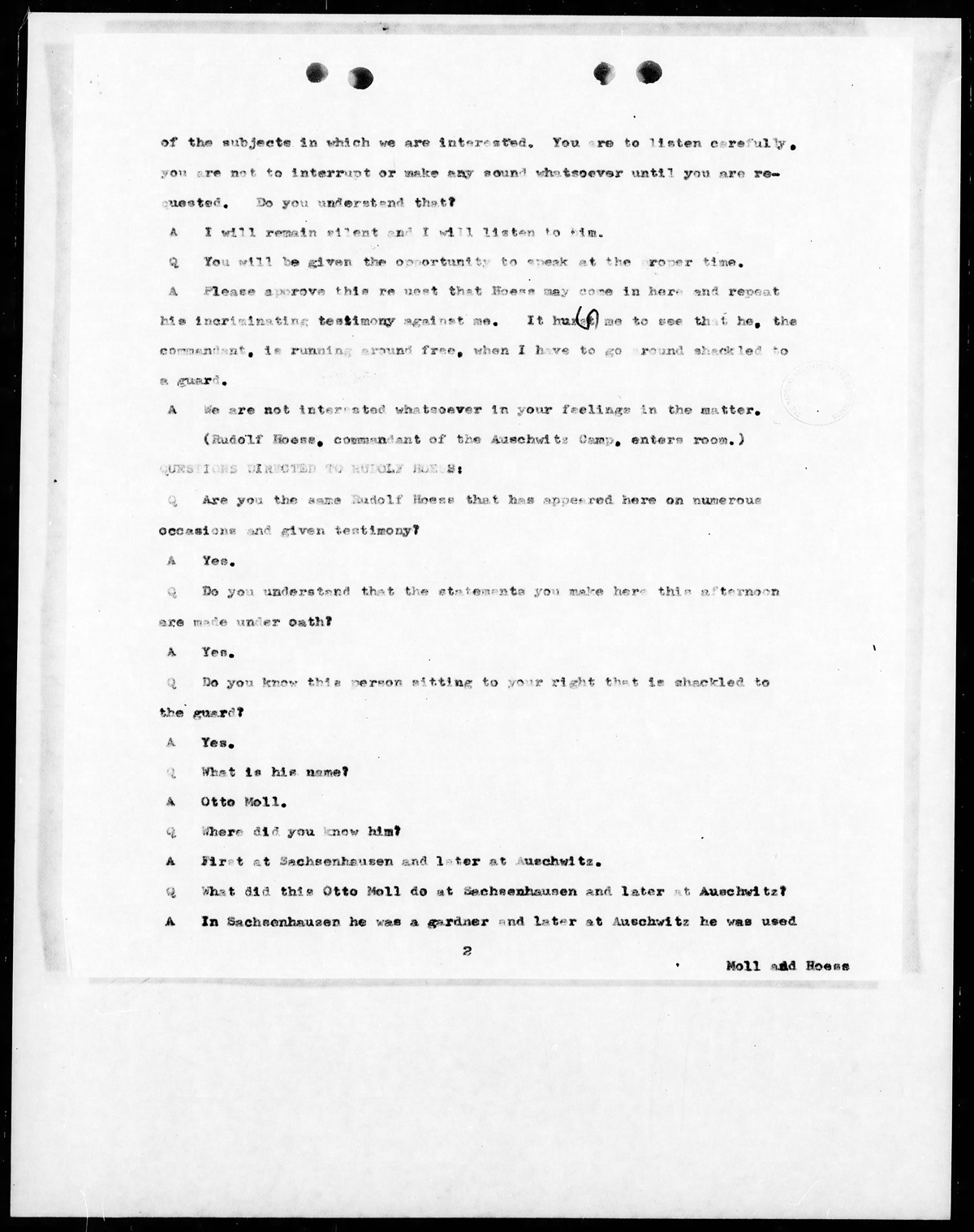
Q. We will conduct the interrogation in the manner we wish and on the basis of the subjects in which we are interested. You are to listen carefully. You are not to interrupt or make any sound whatsoever until you are requested. Do you understand that?
A. I will remain silent and I will listen to him.
Q. You will be given the opportunity to speak at the proper time.
A. Please approve this request that Hoess may come in here and repeat his incriminating testimony against me. It hurts me to see that he, the commandant, is running around free, when I have to go around shackled to a guard.
Q. We are not interested whatsoever in your feelings in the matter.
(Rudolf Hoess, commandant of the Auschwitz Camp, enters room.)
QUESTIONS DIRECTED TO RUDOLF HOESS:
Q. Are you the same Rudolf Hoess that has appeared here on numerous occasions and given testimony?
A. Yes.
Q. Do you understand that the statements you make here this afternoon are made under oath?
A. Yes.
Q. Do you know this person sitting to your right that is shackled to the guard?
A. Yes.
Q. What is his name?
A. Otto Moll.
Q. Where did you know him?
A. First at Sachsenhausen and later at Auschwitz.
Q. What did this Otto Moll do at Sachsenhausen and later at Auschwitz?
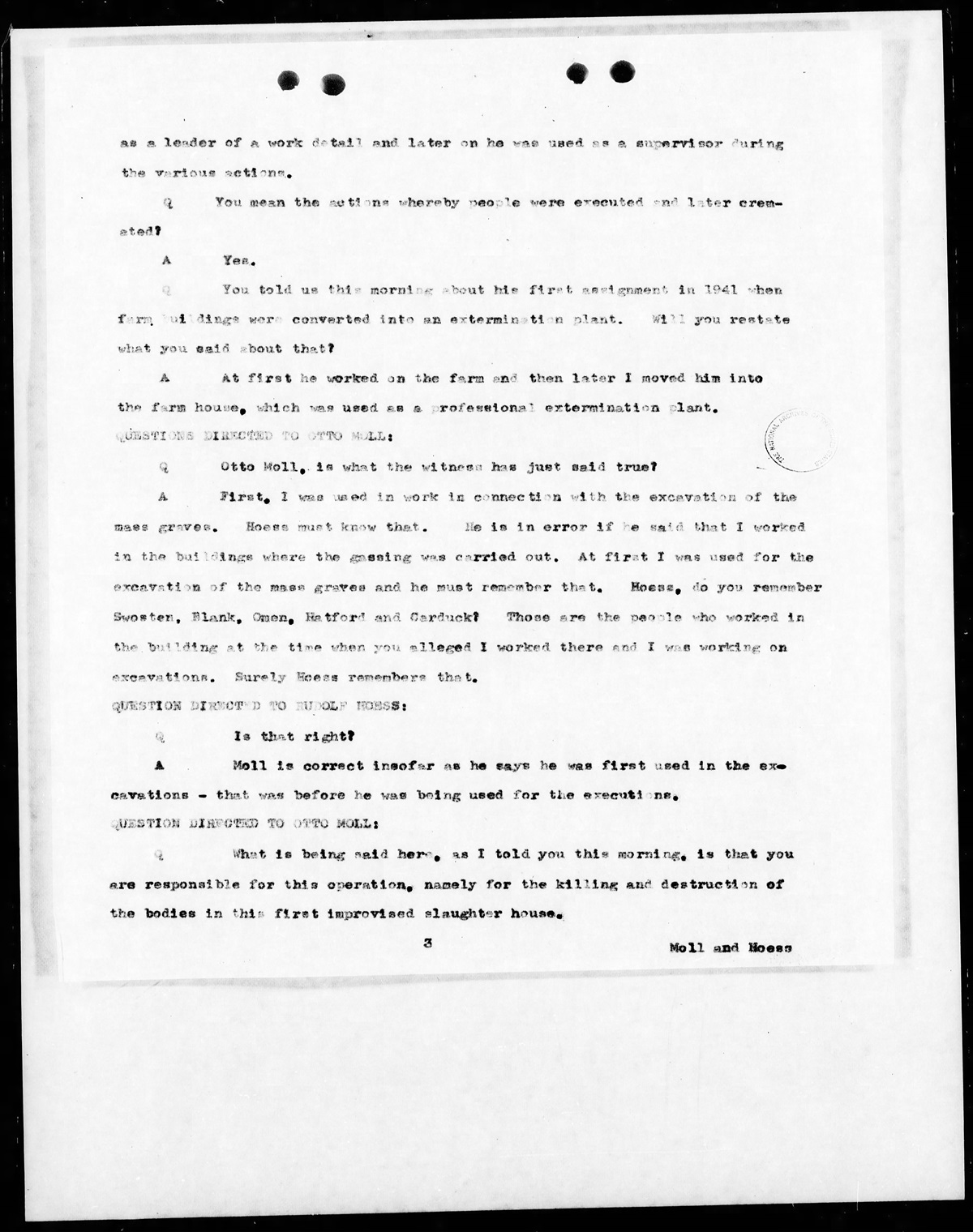
A. In Sachsenhausen he was a gardener and later at Auschwitz he was used as a leader of a work detail and later on he was used as a supervisor during the various actions.
Q. You mean the actions whereby people were executed and later cremated?
A. Yes.
Q. You told us this morning about his first assignment in 1941 when farm buildings were converted into an extermination plant. Will you restate what you said about that?
A. At first he worked on the farm and then later I moved him into the farm house, which was used as a professional extermination plant.
QUESTIONS DIRECTED TO OTTO MOLL:
Q. Otto Moll, is what the witness has just said true?
A. First, I was used in work in connection with the excavation of the mass graves. Hoess must know that. He is in error if he said that I worked in the buildings where the gassing was carried out. At first I was used for the excavation of the mass graves and he must remember that. Hoess, do you remember Swosten, Blank, Owen, Hatford and Carduck? Those are the people who worked in the buildings at the time when you alleged I worked there and I was working on excavations. Surely Hoess remembers that.
QUESTION DIRECTED TO RUDOLF HOESS:
Q. Is that right?
A. Moll is correct insofar as he says he was first used in the excavations – that was before he was being used for the executions.
QUESTION DIRECTED TO OTTO MOLL:
Q. What is being said here, as I told you this morning, is that you are responsible for this operation, namely for the killing and destruction of the bodies in this first improvised slaughter house.
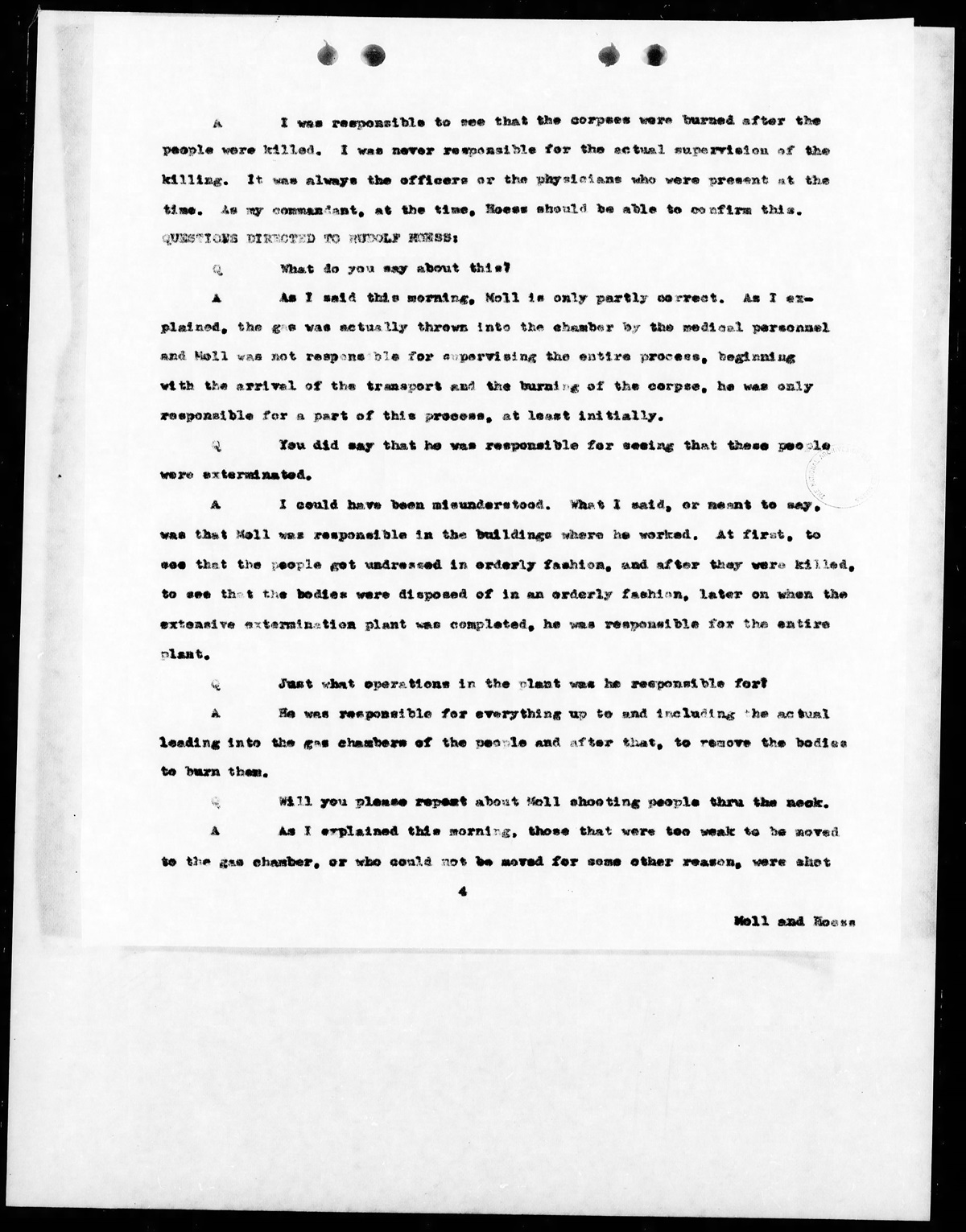
A. I was responsible to see that the corpses were burned after the people were killed. I was never responsible for the actual supervision of the killing. It was always the officers or the physicians who were present at the time. As my commandant, at the time, Hoess should be able to confirm this.
QUESTIONS DIRECTED TO RUDOLF HOESS:
Q. What do you say about this?
A. As I said this morning, Moll is only partly correct. As I explained, the gas was actually thrown into the chamber by the medical personnel and Moll was not responsible for supervising the entire process, beginning with the arrival of the transport and the burning of the corpses, he was only responsible for a part of this process, at least initially.
Q. You did say that he was responsible for seeing that these people were exterminated.
A. I could have been misunderstood. What I said, or meant to say, was that Moll was responsible in the buildings where he worked. At first, to see that the people got undressed in orderly fashion, and after they were killed, to see that the bodies were disposed of in an orderly fashion. Later on when the extensive extermination plant was completed, he was responsible for the entire plant.
Q. Just what operations in the plant was he responsible for?
A. He was responsible for everything up to and including the actual leading into the gas chambers of the people and after that, to remove the bodies to burn them.
Q. Will you please repeat about Moll shooting people thru the neck.
A. As I explained this morning, those that were too weak to be moved to the gas chamber, or who could not be moved for some other reason, were shot thru the neck by him or by Politsch or some of the other fellows around, with small caliber arms.
QUESTIONS DIRECTED TO OTTO MOLL:
Q. Moll, what do you say about this?
A. It may be possible that some of them were shot by me, but it was a comparatively small number and I would like to know if Hoess ever saw me do it.
Q. I told you this morning that Hoess said he saw you do it many times and so did many others.
QUESTIONS DIRECTED TO RUDOLF HOESS:
Q. Hoess, isn’t that right?
A. Yes, that is true. I mentioned this morning that there were comparatively few killed in that manner.
Q. You could not tell if it was a few dozen or a few hundred. That was your problem.
A. I cannot give you an exact number – that is impossible for so many years; there were many. Sometimes there were a few out of each incoming transport and sometimes there were none. That is why I cannot tell you the exact number.
QUESTIONS ADDRESSED TO OTTO MOLL:
Q. Well, this is the first thing you have admitted, now you are telling the truth about which you lied this morning. Are you now ready to tell us the truth regarding your responsibility about other operations?
A. Yes. I will tell you the truth as long as my Commandant is present. Let my Commandant tell you what I did and what my duties were.
Q. We know what Hoess said. What we want to know is your story. You are asking us for the opportunity to tell your story and that caused us to bring Hoess in here.
A. No, I asked that I be interrogated in the presence of Hoess.
QUESTION ADDRESSED TO RUDOLF HOESS:
Q. You told us this morning that Moll was considered the best man for exterminations because he handled the teams of prisoners and guards better than your other subordinates. Is that right?
A. Yes.
QUESTIONS ADDRESSED TO OTTO MOLL:
Q. Moll, suppose you tell us what was your method of selection of foremen from the Capos and just what you found to be the best method of handling the guards that had charge of the transports after they came in.
A. When I was ordered to do this work, the work details had already been selected. My Oberfuehrers had already selected the Capos or foremen, whatever you call them. I carried out correctly the work in all kinds of weather. I was never drunk on duty, or when I was with prisoners, and I never mistreated any of the prisoners. I achieved good success in the work of the prisoners because I, myself, helped them with their work with my own hands. The prisoners had respect for me because I always behaved as an exemplary soldier toward them, therefore, I was designated for any kind of difficult work that came up. May I ask Hoess to confirm that?
QUESTION ADDRESSED TO RUDOLF HOESS:
Q. Is that correct?
A. Yes, that is what I stated this morning.
QUESTIONS ADDRESSED TO OTTO MOLL:
Q. You were decorated for your work, were you not?
A. I received a decoration for my services. Almost all of them who served for a number of years in the whole of Germany received those decorations. I did not receive any decorations for special work that I had done like this work. I would not have wanted to receive a decoration for this kind of work.
Q. Why?
A. Because I did not look upon this work as honorable work.
Q. Did you ever protest?
A. I asked many times why these things had to be done, why they could not be stopped. I even asked Hoess and he answered that he himself did not like them, but he himself had strict orders and nothing could be done about it. He, like the rest of us, suffered by this work and none of us were really sane anymore.
QUESTIONS ADDRESSED TO RUDOLF HOESS:
Q. Is that right, Hoess?
A. Yes, others also said that and already testified to that in the Reich.
Q. When do you think you lost your sanity, Hoess?
A. I think you mean that just when our nerves started to crack. I can testify that I was not healthy in 1942. I told you about my leave in 1943, however, I had to do these things as there was no one else who would do it for us. There were strict orders and they had to be followed. Many of the others felt as I did and subordinate leaders came to me in the same manner as Moll did and discussed it and they had the same feelings.
Q. Do you think that Moll is crazy?
A. No.
QUESTIONS ADDRESSED TO OTTO MOLL:
Q. How long do you think you have been without your sanity?
A. I did not mean to say that I was insane or I have been insane. What I mean is that my nerves have cracked and have cracked repeatedly. They were very bad after the accident I described in 1937, later, they were very bad after I had an attack of typhus and I was in the hospital and was granted a leave of absence by the doctors for the condition of my nerves. I was never declared unfit for duty on account of bad nerves, or because of the so-called paragraph 51.
Q. How many people do you estimate went to run the operation, which you were responsible for — how many victims?
A. When you use the words — “you were responsible” I want to emphasize again that I do not wish to have that term applied in any way to the actual killing of the people, as I was not responsible for the actual physical ending of their lives, and I will not admit that as it is not the fact.
Q. You did not pull the trigger, but you caused someone else to do it. Is that your position?
A. I do not understand the question.
Q. How many victims were exterminated in the camp from 1941 on?
A. I don’t know the number and I don’t think I would be able to give you any number at all as far as the total number of victims goes. I believe Hoess might know that.
Q. The only thing we are interested in is what you have knowledge of.
A. When I was in charge of those excavations, as I told you about before, together with another commando, which was confirmed by Hoess today, we put between 30,000 and 40,000 people in those mass graves. It was the most terrible work that could be carried out by any human being.
Q. Stick to the figures.
A. I don’t know who those people were or how they got there. I only excavated the mass graves. I was responsible for burning the bodies right there.
QUESTION ADDRESSED TO RUDOLF HOESS:
Q. How does that figure strike you, Hoess?
A. It is impossible for him to know the exact figures, but they appear to me to be much too small as far as I can remember today. The people buried in the two big mass graves of the so-called dugouts: one and two, amounted to 106,000 or 107,000 people.
QUESTIONS ADDRESSED TO OTTO MOLL:
A. I could not complete the excavation detail, which I mentioned before. I then got the attack of typhus.
Q. What do you estimate was the number of bodies you handled?
A. It was later they went thru my crematory plant and I would say between 40,000 and 50,000, that is at the crematory where I was responsible. I was not responsible for the two large crematories, as they were two SS corps Muesfeld and also Foss, who were responsible for the two large crematories and Hoess will remember that.
Q. You tell us about the figures you know.
A. I told you the number, maybe 50,000 and possibly there were more.
Q. Is that for all times from 1941 clear to the end?
A. Yes, that is from 1941 for the entire length of my service when I had anything to do with this matter.
Q. Don’t you think you are much too modest? You had the reputation of being the biggest killer in Auschwitz. The figures there run into millions. Won’t you change your answer?
A. It is not true that I was the greatest killer in Auschwitz.
Q. You were the greatest cremator.
A. That is not true either. The number is not right and is possibly brought up by the men who want me to be punished by death.
QUESTIONS ADDRESSED TO RUDOLF HOESS:
Q. Hoess, what do you think would be the correct figures?
A. Moll, in my opinion, cannot possibly have any idea of the number of killings in the dugouts where he was working and responsible. At any rate, they were far, far too low – that is Moll’s figures.
Q. What figure would you attribute to Moll’s responsibility?
A. It is impossible for me to quote the exact, or even a very rough figure, of the number of corpses that were handled by Moll. As the use of the extermination plant varied at all times, I do not know how many corpses I would have to attribute to Moll or how many to Muesfeld and the others.
QUESTIONS ADDRESSED TO OTTO MOLL:
Q. Moll, how many women and children do you estimate were among the bodies that you handled?
A. Men and women were there in about equal numbers and the ratio of children to the other people was about one child in one hundred people brought in. Sometimes transports arrived without children. I would also like to say that I was not constantly working with these transports and of course, I cannot tell you what happened during my absence when I was not there, as I was away on leave of absence, etc.
Q. We have heard that there were more children than that. Do you want to change your statement?
A. As I told you, it may be one child in a hundred or it may be more. I cannot remember that exactly.
QUESTIONS ADDRESSED TO RUDOLF HOESS:
Q. What do you say to that Hoess?
A. My estimate is that one-third of all the victims would be men and two-thirds women and children. I am not able to quote the exact ratio between women and children, as that depended on/and varied greatly with the transports that came in, however, I do remember that in the transports that came in from the Ukraine and Hungary the proportion of children was particularly high.
Q. In what year was that?
A. That was particularly in 1943, or it may have been early in the year 1944.
QUESTIONS ADDRESSED TO OTTO MOLL:
Q. Moll, yesterday, you told us you had two installations and spoke of the furnaces in which there were twelve large ovens and two additional with two ovens each, making a total of 28 separate burning units. How many human beings could you cremate at one time?
A. Two to three corpses could be burned in one furnace at one time. The furnaces were built large enough for that.
Q. Did you operate at full capacity often?
A. I would like to emphasize that I had no responsibility at all with the cremation in the stoves. What I was responsible for was the burning of the corpses out in the open. Corporals Muesfeld and Foss were responsible for the cremation in the furnaces.
QUESTIONS ADDRESSED TO RUDOLF HOESS:
Q. Is that right, Hoess?
A. First of all, Moll is slightly wrong in regard to the figures he quoted on the furnaces. The two large units were made up of five double furnaces each and the others of four double furnaces each. It is true that Muesfeld and Foss were responsible for the furnace details, each had a large and a small one and Moll was responsible for the burning of the bodies out in the open. Moll was responsible for the disposition of the ashes, but later on I put Moll in charge of the entire cremation. This was in the year 1944.
Q. Was that in the two months you were back at Auschwitz after you were away?
A. Yes, that is when I was transferred back to Auschwitz.
Q. How often were the crematory details of prisoners exterminated?
A. As far as I can remember, it was twice before I left for the first time and they were exterminated again after the action against the Hungarian Jews was completed.
Q. On whose orders were the prisoners exterminated?
A. I received that order from Eichmann and he ordered in particular that the furnace commandos should be shot every three months, however, I failed to comply with these orders as I did not think this was right.
QUESTIONS ADDRESSED TO OTTO MOLL:
Q. You have said that your detail was never exterminated. What do you say now?
A. No, that is not true. The work detail with which I worked was never exterminated as long as I was there and as long as I worked. As regards to the first work detail I had for the excavation of mass graves, which I had to leave because of my attack of typhus, they may have been exterminated when I returned to duty. The only thing that I know of is when I left, the last work detail I worked with was still alive and that is, every member of the detail was alive when I left. Sometime later when I left mutiny broke out in the camp. I know that the entire guard company at the camp was used to suppress this mutiny. I was not there, I was at Gleiwitz at the time. I do not know anything about this, but Hoess can tell you that.
Q. Did you ever cremate any of your crematorium detail?
A. No.
Q. You mentioned that in the killing of the people in the gas chambers that it took only one half minute. On what do you base that?
A. The gas was poured in thru an opening. About one half minute after the gas was poured in, of course I am merely estimating this time as we never had a stop-watch to clock it and we were not interested, at any rate, after one half minute there were no more heavy sounds and no sounds at all that could be heard from the gas chamber.
Q. What kind of sounds were heard before that?
A. The people wept and screeched.
Q. You observed all of this and heard the sounds?
A. Yes, I had to hear this because I was near there with my work detail. There is nothing that I could do against this as I had no possibility of changing this in any way.
Q. We are not interested in your opinions on that. You helped make the arrangements to put them in the gas chamber and burned them afterwards when they were killed. The only thing you failed to do personally was pour in the gas. Is that it?
A. I was not responsible for the preparations as there were no special preparations. The victims were led to the gas chamber by the duty officer and then there was a work detail from the administrator, they told them to undress, there was a further detail from the proper administration, which was responsible to collect all the valuables from the people. The whole thing happened very correctly and in no instance was there any reason to interfere. I had no right to interfere, always a doctor supervised the entire thing.
Q. You recall yesterday, you said you were told that if any prisoners coming off of new transports detailed for the death chamber would escape, you would be court-martialed.
A. I was talking about the work detail, not about the transports.
Q. This came at the time you were testifying about your responsibilities at the crematorium.
A. No, I only say as far as the work detail is concerned for which I was responsible.
Q. We will not argue about it, as the notes show otherwise.
QUESTIONS ADDRESSED TO RUDOLF HOESS:
Q. What do you say of this detail of Moll?
A. Moll is not looking at this thing the right way. It actually is true and I have explained this before, that the officer was responsible for the entire transport, that is he was responsible to see that all were unloaded from each transport, the doctors were responsible for the phase of work to see that the people were killed and the bodies were disposed of. It was the responsibility of the subordinates, like Moll, to see that the people actually got into the gas chambers under the doctors and then to see that their bodies were burned. As far as the subordinate leader was concerned, it was his responsibility to see that none of his work detail escaped and he would be responsible to see that none got away. In the last analysis I was responsible for the entire matter, that is for the entire situation dealing with these transports.
Q. You have told us about some of the problems of making sure that everyone was exterminated. For instance, that mothers hid their children under their clothing after they undressed. Who was the person that gathered up the children, searched them out and put them into the gas chamber?
A. I think that this thing has been slightly misunderstood. The way this thing happened is that mothers had babies with them, who would be wrapped in blankets or cloth. The people had been told that they were going to take a bath, they had no idea that they were going to be killed. It was not the idea, the mothers did not want to take the children in with them to the bath and they left them outside. Later on, the work detail from the administration, which was responsible for them, would pick up the babies and put them in the gas chamber then.
Q. Was it Moll’s responsibility to see that the children were disposed of?
A. Yes, but it would not mean on the other hand that Moll would have the particular task of picking out the babies from under the blankets. I did not tell any one of the officers or non-coms that they would be responsible for any particular thing, but the entire team was responsible for the extermination. It was to be done and all of them carried out the orders smoothly and properly.
QUESTIONS ADDRESSED TO OTTO MOLL:
Q. You, Moll, said that your team respected you because you gave them a hand. Was this job of picking up small children and passing them a part of the hand you loaned them?
A. Possibly this was not expressed correctly by Hoess. I had nothing to do with the searching of the clothes because that was not my duty. As I said, the officers that had charge of the duty when the transport came in was responsible for them until the moment they entered the gas chamber. I had nothing to do with that. I never touched the babies or had anything to do with it.
Q. Did any of your men have anything to do with that? Anyone under you?
A. Yes, the prisoners were responsible for that. They had to clean up the room after it had been cleared of people, they would then take the babies and throw them into the gas chamber. There was a strict order against any SS man touching any of this property.
Q. We are not talking about property. We are talking of people. Did you have a special operation to kill these babies or were they thrown into the room where people were still alive and all were gassed together?
A. Such a thing only happened rarely and I cannot remember a case where a baby was found, but if they were found they were thrown into the gas chamber.
Q. How do you know?
A. Well, that was an order for the officer responsible for the transport and if any children were found they were to be disposed of like all the rest in the gas chamber.
Q. You carried out your orders?
A. I emphasize again that I myself did not find any children, but if I did find any, I would have to do it too.
Q. Did you shoot any babies in the neck, like you did the other victims?
A. Such a thing never happened.
Q. That is what you said about shooting other people this morning, then we proved you a liar. Are you sure you are telling the truth this time?
A. Yes, I am sure about it.
Q. You mentioned yesterday about the Hungarian Jew transports, saying they were rounded up by Kaltenbrunner’s boys. About whom were you speaking?
A. They were brought in by the Security Police and the Security Service, all of which were under the jurisdiction of Kaltenbrunner because he was in charge of that.
Q. Moll, how do you know this?
A. That was a matter of general knowledge that the men of the security police and security service were under Kaltenbrunner. That is something that everyone knew.
Q. What do you know about any orders from Kaltenbrunner effecting any of these organizations?
A. I was not shown any orders that came from Kaltenbrunner, but this is as I look at it. Kaltenbrunner was in the immediate surroundings of Himmler and what I am saying now was the opinion of every SS man that I know or have ever known. Kaltenbrunner was the second man in the SS and in all the Himmler organization and if any such orders were given they must have come thru Kaltenbrunner’s hands. I cannot have any other explanation for it. Someone whom I wish to mention in this connection, whose orders we had to follow and under whose pressure we were under, was SS Oberfuehrer Pohl and also Shimke.
Q. You mentioned that all SS men were afraid of the name, Kaltenbrunner?
A. Yes.
Q. Why?
A. We were told that Kaltenbrunner was the chief of the SS and police court. Many SS men whom I knew during my term of duty were condemned to death or received very heavy penalties by these courts for any offenses they may have committed against the rules. Every SS man was afraid of the penal camp, Matzkau near Danzig. I know that many men who were condemned to this penal institution in Matzkau were later put into a unit, which was called the “death commandos” also the “Trip to Heaven Commandos.” Those things that took place there in this penal camp and that we learned about this penal institution made officers or men alike afraid. Himmler and his deputy, Kaltenbrunner, were able, by the use of these penal institutions to get our respect and our willingness to serve; that is by the threat which was implied by this penal institution. They did not get our willingness to serve because we were convinced National Socialists. Only in this way could the superior officers manage it all.
Q. Where did Kaltenbrunner figure in the special operations who was in charge of the cremation of all the bodies.
A. In that case you would have to find out who invented all these operations.
Q. I am asking you what you know.
A. I know nothing about it, but according to the figures which I received, I know that an enterprise of this nature could only be carried out if they were ordered by the highest places of the Reich, that is by the Government or something equivalent to it. For instance, it is clear to me that only an officer of great rank could go to Hungary, collect all the Jews and bring them to the extermination camp and then kill them off. Only the highest places in the Reich, the Reich Government, Hitler, Himmler, Von Ribbentrop or the other bastards could ever have ordered such things. I do not know just what these men are saying in their defense now, or if they claim today they know nothing of it, if they say that I don’t have the faintest idea why they should be masters or representatives of the German people. Kaltenbrunner, Pohl, Schmauser, Himmler, or whatever their names may be, who sat in the high places, used us small people as tools to carry out their operations.
Q. Kaltenbrunner says that he knew nothing about this.
A. I don’t believe that.
Q. Kaltenbrunner is saying that today, what do you think of that?
A. You have to understand me, I was always a small man. He was a high officer. Now they are trying to leave us in the lurch, we have been condemned to death, now they may be exonerated. I would like to say something else. Toward the end of the war, we did not know anymore what was going on. The only things we received was false news. I was near Munich at the time and I was ordered to take over a company of SS men to march them until I got to the mountains, as there were no more officers left and I got stuck with this. We marched day and night without food and much sleep and while we were marching on the road, the people of the Government rode past us in nice big cars to get away to safety. I met many high officers of the Gestapo, who were going by with their nice big cars and when they found a soldier without a rifle, they set themselves a special detail and strung them up on a tree. These special details of the Gestapo were called special justice or to butcher. Near Pock, the remainder of my company, about fifty men and I stepped into what was left of the front at that time. There we were forced to take part in the combat at the front and this was about the first of May or maybe the 28th or 29th of April in 1945. If I had not done that, I would not be sitting here today, as I would be dead already. Our small forces of infantry were forced to fight against heavy armor of the United States Army until the fifth of May.
Q. Do you have anything further to say about Kaltenbrunner insofar as your work was concerned.
A. I would like to add one more detail to this.
Q. Allright, go ahead.
A. There were only four survivors left out of this company, so I got a higher officer and asked him what he was doing. He said it was his task to delay the Americans from coming over this road as many high government officials and officers of the SS were falling back in the mountains and establishing themselves there. The only reason why this division had to fight to the last was because of the fear of the officers in the Gestapo, Himmler and Kaltenbrunner. I heard a thousand times many men exclaim; “If we could only get ahold of Kaltenbrunner, we would tear him apart limb from limb.” It is not only us that hate the name of Kaltenbrunner, but the name of Kaltenbrunner was terror for all of us, terror for all of Germany and terror for all of Europe. We know that. I had nothing but work and hard times all my life and I would like to ask Hoess if he had any of the things that the ministers had. Did he have more than I?
Q. Hoess, don’t answer that question. Moll, do you have anything more to say about Kaltenbrunner now?
A. All I can say is that Kaltenbrunner is the right hand of Himmler. The only other thing I can say about Kaltenbrunner is that he had his people in every town, every village and every hamlet. We used to call them Kaltenbrunner’s Commandoes. They were everywhere; people were in all occupied countries. They were stationed there to listen. Kaltenbrunner would send his spies and suppress the people. I believe that any man is saying he does not know any of this, but he must know all.
QUESTIONS DIRECTED TO RUDOLF HOESS:
Q. What do you know about a trip taken by Moll to Lublin possibly toward the end of 1942 to confer with Hoessler?
A. As I told you this morning, I learned about it when I came back. I think it was from my leave of absence and that is how I fixed the time, that Hoessler and Moll were ordered to proceed to Lublin for an execution detail. Later on, I learned that from the inspector of the concentration camp what I told you this morning. I don’t know any details.
QUESTIONS DIRECTED TO OTTO MOLL:
Q. Allright, Moll, what do you say?
A. All I can say is that the Gestapo and the Security Police carried out the executions in Lublin. I wish you would interrogate SS Lt. Col. Weiss, who shared the cell with me in Landsberg, as he is the man who took over the camp in Lublin when I left. At Landsberg he said he had taken over the camp and when he arrived the police and Gestapo were there and he went on to say they machine-gunned all the people. All I know is that I received top secret orders to proceed to Lublin on a secret enterprise. I did nothing there and left the next day as I described to you.
Hoess, that will be all for you now.
(Rudolf Hoess is escorted from the room.)
QUESTIONS DIRECTED TO OTTO MOLL:
Q. Was SS Obersturmbannfuehrer Karl Wolff deputy to Himmler until 1943.
A. Yes, that is correct – that was published once in an order.
Q. Did you know him?
A. No.
Q. Was he ever at Auschwitz?
A. I don’t know if he ever was at Auschwitz, as I did not see him there. I only saw Himmler there and Obergruppenfuehrer Pohl and Schmauser. Gauleiter Bracht of Upper Silesia and also the chief physicians of the SS as well as Grawitz. I cannot remember any others. I saw Dr. Frick in the Concentration Camp at Oranienburg.
Q. What year?
A. It was in 1938 or 1939, I am not sure. He was there together with Himmler. He inspected the entire garrison there and also the camp.
Q. You told us you only saw Goering once, that was at Nurnberg on a party day in 1936 and maybe again in 1938, is that right?
A. I also saw him in 1937, as I mentioned, it was on the occasion of his marriage.
Q. Did you say you never saw Hess, Von Ribbentrop or Keitel?
A. No I never saw them.
Q. You said you never saw Kaltenbrunner, but you described his activities.
A. I don’t know Kaltenbrunner personally, but only know the general opinion about him and what people that have seen him have said. I have seen his pictures.
Q. Do you know, or have you ever seen Rosenberg?
A. No.
Q. Do you know or have you seen Hans Frank, the Governor General of Poland?
A. No, I cannot remember and I don’t think I have ever seen him.
Q. You have told us about Frick. Have you ever seen him on any other occasion except at Oranienburg in 1939?
A. No.
Q. Do you know or have you seen Streicher?
A. I never saw Streicher personally, but among the SS men he was known as the man without education.
Q. How about Funk, the minister of finances?
A. No. I never knew him.
Q. Do you know Schacht, or have you ever seen him?
A. No.
Q. Do you know Admiral Doenitz?
A. No.
Q. Do you know Admiral Raeder?
A. No.
Q. Do you know Von Schirach?
A. No.
Q. Do you know Sauckel?
A. No.
Q. Do you know Jodel?
A. No.
Q. Do you know Von Papen?
A. No, but I may have seen him sometime in Berlin.
Q. Do you know Speer?
A. No.
Q. Do you know Von Neurath?
A. No.
Q. Do you know Fritsche?
A. No.
Q. When did the first of the Hungarian transports of Jews arrive at Auschwitz?
A. I cannot remember.
Q. Do you recall the big clean-up action of 1944?
A. Yes, I remember the action in 1944.
Q. When did the first transports begin to arrive?
A. If I have to make any statement about the month or time of the year they arrived, I would have to lie as I do not know. When I was called from Gleiwitz for this action, it had already been going on for some time.
Q. Well you have come around a little I think in the matter of straightening out the record, but I don’t think you are coming thru completely.
A. I would like to request that if there are any further points you want to interrogate me on that I would like to have Hoess, my commandant, present and let him tell the facts which I can admit or deny.
Q. You mean you are not a man that you can’t speak for yourself?
A. I will only do it in the presence of Hoess.
Q. We are not trying to trick you or do anything like that. We are just asking you these questions and want answers about facts — that is simple enough, isn’t it?
A. I understand that. I want to mention something to you. The non-coms were with the prisoners at all times, the prisoners knew their names and saw them. The officers put in short appearances and did not get to know the prisoners. The prisoners today are naturally accusing the non-coms about what action was taken, not realizing that the officers are at least as guilty and know what was done. They are not accusing the officers as they don’t know their names.
Q. You don’t know what we know about names, that is why we want to get your story, to get it straight, but in order to do that, we don’t have to tell you things you already know, if you are honest.
A. I am honest and I am telling the truth, but I don’t understand why I am accused of things that I did not really do, for instance like the Lublin affair.
APPROVED:
[signature]
Interrogator
Interpreter
[signature]
Court Reporter.
Archivial reference:
National Archives and Records Administration (NARA), Record Group 238, Series Interrogations, Summaries of Interrogations, and Related Records (NAID: 57328333)