
On January 6, 1942, Herman Krumey, the head of the Migration Central Office in Litzmannstadt, recorded the names of three

The document, dated January 16, 1941, was addressed from Forschungsstelle A in Litzmannstadt to Forschungsamt 5 A 3. Both offices

In January 1942, authorities in the Warthegau region grappled with the spread of typhus originating from Sinti and Roma victims,

On 29 January 1942, the office of the Reichsführer-SS forwarded to the Reich Ministry for the Occupied Eastern Territories a

Deposition in Yiddish in February 1942 in the Warszaw Ghetto by Szlama Winer aka Jakub Grojnowski. In his account titled

On February 6, 1942, the BdS Ostland in Riga (head of Einsatzgruppe A) telexed its Einsatzkommandos in Reval, Minsk and

On February 13, 1942, Reinhard Heydrich's adjutant, SS-Hauptsturmführer Hans-Achim Ploetz, forwarded a report from Einsatzgruppe A to the staff of

Letter dated 17 February 1942 by the District Commissioner of Vilnius county reminded the Local Administrative Head in Nemenčinė "to

On February 6, 1942, Martin Luther of the German Foreign Office forwarded an anonymous letter to Gestapo chief Heinrich Müller.

The document provides a list of transports with 10,348 Jews deported between March 1 and 15, 1942 from Radegast Station

In this letter dated March 4, 1942, the Reichsarzt SS Ernst-Robert Grawitz describes the medical condition and recovery process of

In a report dated 6 March 1942, Oberregierungsrat Paul Haensel presented findings from his inspection trip to Minsk. According to

On 8 March 1942, the F. Reichelt Aktiengesellschaft Litzmannstadt, a Pharmaceutical Company, issued an invoice to the Ghetto Administration in

German military report from March 19, 1942 on the mood and conditions of the civilian population in Lemberg (now

In March 1942, the Inspector of the Health Service under the Reich Commissary for the Consolidation of German Folk ordered

The document details a list of transports carrying 16,748 Jews from Radegast Station in the Łódź Ghetto to Przybyłów near

In a report titled "The Incidents in Kulmhof," Hersz Wasser, the secretary of the Warsaw Ghetto underground organisation Oneg Shabbbat,

Medical Services Report issued by the Ortskommandantur in Mariampol (Lithuania) on 5 April 1942. the report notes the need to

A confidential report dated April 7, 1942, issued by the Lublin Labor Office, documents labor allocations for March 1942, including

The document is dated April 22, 1942 and was written by Forschungsstelle A Litzmannstadt (Łódź), a local branch of

This directive on "Burial sites of the Jews", issued on 25 April 1942 by the District Commissioner of Wilna-Land (Vilnius

On May 1, 1942, Arthur Greiser, the Reich Governor in the Reichsgau Wartheland, relayed to Reichsführer-SS Heinrich Himmler that "The

On May 3, 1942, in a coordinated action with the Reich Governor Arthur Greiser of the Reichsgau Wartheland, Wilhelm Koppe,

Between 1940 and 1942, Franz Heinrich Bock served as Mayor and Official Commissioner of the Polish village of Poddębice. During

On May 16, 1942, SS-Untersturmführer August Becker submitted a report to the head of RSHA department II D, Walther Rauff,

Radio message from the Gendarmerie District Ostrowo to the Gendarmerie post in Adelnau, dated May 16, 1942. The message reported

In June and July 1942, the Ghetto Łódź Administration delivered large quantities of chlorinated lime and cement to the

Memo dated June 5, 1942, authored by SS-Hauptsturmführer Willy Just of RSHA office II D 3 a (Motor Vehicle Department

After receiving the request from the government of the Warthegau to kill Polish nationals suffering from incurable tuberculosis through the

On 23 June, 1942, SS-Oberführer Viktor Brack from Hitler's Chancellory wrote to Heinrich Himmler on the matter of mass sterilisation

On 8 July 1942, Albert Plate from the Sonderkommando Kulmhof discussed with the Ghetto Lodz Administration regarding the supply of

On 15 July 1942, SS-Obersturmbannführer Ernst Fick, commander of the Sennheim training camp, requested a portable flamethrower unit from the

A form sheet by SS-Sturmbannführer Hermann Höfle dated July 18, 1942, on the individual's responsibilities and strict secrecy surrounding their

On July 19, 1942, Heinrich Himmler, the Reichsführer of the SS, issued a directive ordering the complete "resettlement of the
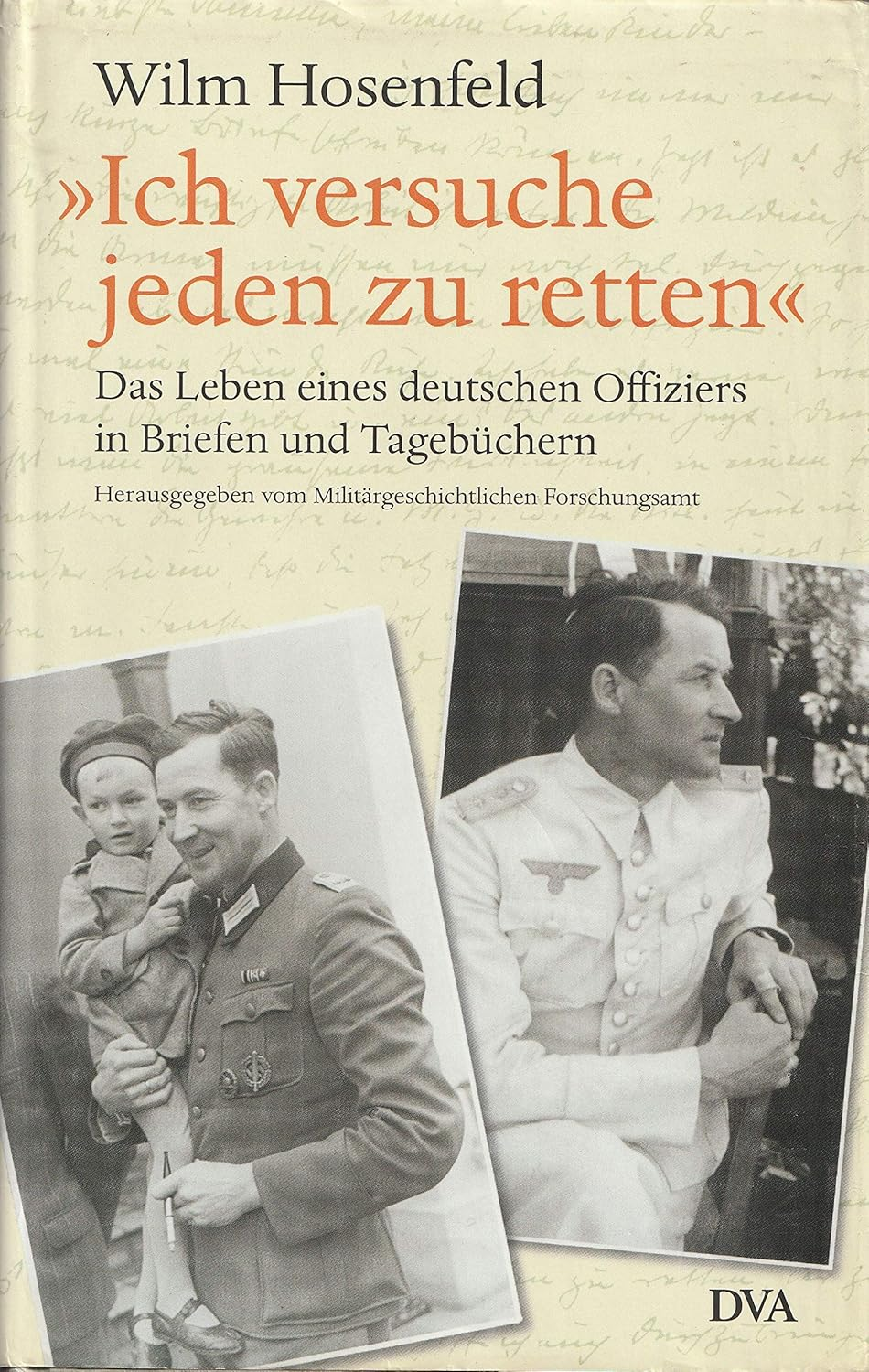
Wilm Hosenfeld, a German officer stationed in Warsaw during World War II, recounts in a diary entry of 23 July

On July 28, 1942, Albert Ganzenmüller, State Secretary in the Reich Ministry of Transport and Deputy Director General of the

The Swiss cardiologist and medical captain Robert Hegglin participated in the so-called third medical mission of the Swiss Red Cross,

1942-08-13 Letter from Wolff to Ganzenmüller on Deportations of Jews to Treblinka Extermination Camp
The following document, dated August 13, 1942, is SS-Obergruppenführer Karl Wolff's response to an earlier letter from Albert Ganzenmüller, Deputy

Report of SS-Untersturmführer Fritz Ertl, dated August 21, 1942 about a meeting with engineers Kurt Prüfer and Robert Köhler in

A radio message from the SS Economic and Administrative Main Office (SS-WVHA) to the Auschwitz concentration camp, dated 26 August

The letter dated 28 August 1942 discusses the transfer of furs confiscated from those murdered in Kulmhof (Chelmno) to the

In 1942, the SS Main Office pursued an investigation into Oskar Dirlewanger, commander of the notorious penal unit, Sonderkommando Dirlewanger.

Memo by Topf & Söhne engineer Kurt Prüfer regarding a phone call with the SS-Wirtschafts-Verwaltungshauptamt (SS Economic and Administrative Main

Report by Topf & Söhne engineer Fritz Sander, dated September 14, 1942, on the new construction of incineration ovens for

According to a radio message from September 15, 1942 and a trip report dated September 17, 1942, on 16 September

On September 16, 1942, SS-Obergruppenführer Oswald Pohl, head of the SS Economic and Administrative Main Office, sent a letter to

War Diary no. 1 of the Operation Staff Minsk, compiled by SS-Obersturmführer Fritz Biermeier for the Higher SS and Police

1942-09-30 Poison and Human Soap – SS Investigator Interrogates Member of Sonderkommando Dirlewanger
Interrogation report dated September 30, 1942, documenting the questioning of SS-Oberscharführer Heinrich Feiertag by an SS court officer regarding allegations

In this secret directive (telex dated 25 October 1942), SS-Obersturmbannführer Arthur Liebehenschel instructed SS-Hauptsturmführer Hans Aumeier that any inspection of

On October 27, 1942, Heinrich Himmler issued an order to Hans-Adolf Prützmann, the Higher SS and Police Leader in Ukraine,

In 1942, the Reichsführer-SS, Heinrich Himmler, authorized the killing of 150 prisoners – primarily Jews – from Auschwitz to create

While the Nazi authorities in the Warthegau were already planning the killing of Polish individuals incurably afflicted with tuberculosis, concerns

The letter, dated November 21, 1942, from the Reich Governor of the Reichsgau Wartheland Posen to Reichsführer-SS Heinrich Himmler, discusses

The letter, dated December 3, 1942, from Himmler to SS-Obergruppenführer Greiser, acknowledges Dr. Blome's concerns regarding the proposed plan to

On December 7, 1942, a German city medical officer named Dr. Wilhelm Hagen wrote an extraordinary letter addressed directly to

In late 1942, several thousand Poles were deported from Zamosc, Poland, following Nazi racial classifications that determined their fate. This

On December 29, 1942, SS-Reichsführer Heinrich Himmler delivered a report to Adolf Hitler, mentioning the execution of 363,211 Jews within

Proposal for the Award of the War Merit Cross II Class with Swords by the Gestapo Headquarters in Posen, dated